As a professional content strategist with extensive experience in technology journalism and SEO optimization, I understand that modern businesses face an unprecedented challenge: managing complexity at scale without exponentially increasing operational costs. The answer lies in intelligent automation. When Zapier’s powerful workflow orchestration platform combines with OpenAI’s advanced artificial intelligence capabilities, the result is a transformative force that can reshape how your organization operates—from customer service to content creation to financial analysis.
This comprehensive guide explores how to leverage Zapier and OpenAI to automate your entire business ecosystem, complete with real-world implementations, measurable ROI data, and practical strategies that go beyond theoretical frameworks.
Understanding Zapier and OpenAI: The Foundation of Modern Business Automation
What Makes This Integration Powerful
Zapier serves as the central nervous system of modern business automation, connecting over 8,000 applications without requiring any code. Think of it as a intelligent traffic controller that monitors events across your entire technology ecosystem. When a specific trigger occurs—a new email arrives, a form gets submitted, or a spreadsheet row updates—Zapier springs into action.
OpenAI’s API, powered by advanced language models like GPT-4, provides the intelligence layer that transforms raw data into actionable insights. Unlike traditional automation that simply moves data from one tool to another, the Zapier + OpenAI combination actually understands context, nuance, and meaning. Your automation doesn’t just copy information; it analyzes, interprets, interprets context, and generates intelligent responses.
The synergy between these platforms is remarkable. In enterprise environments, 3 million+ businesses now trust Zapier, with companies reporting recovery of over $1 million in pipeline value and 282 days of manual work eliminated annually through automation. When OpenAI’s generative capabilities join this ecosystem, the possibilities multiply exponentially.
The Market Opportunity in 2025-2026
The global workflow automation market reached $23.77 billion in 2025 and is projected to reach $37.45 billion by 2030, growing at a compound annual rate of 9.52%. This isn’t just vendor hype—it’s a reflection of genuine business value. 92% of executives are actively increasing AI investments, and 60% of organizations already report achieving return on investment within 12 months of deployment.
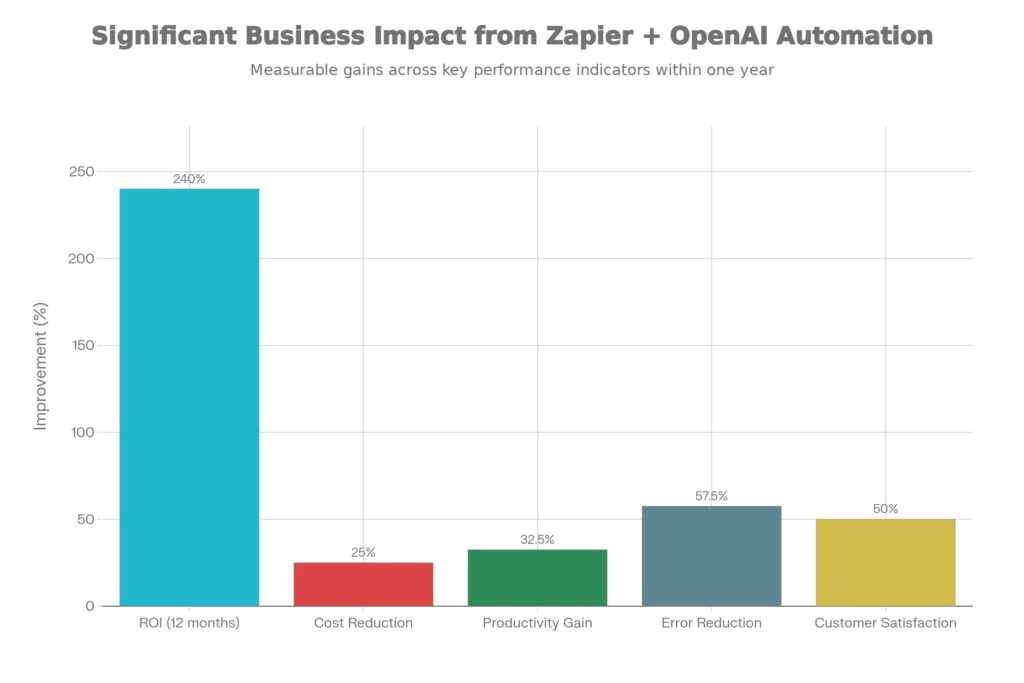
What drives this aggressive adoption? The numbers speak for themselves. Organizations implementing workflow automation see 240% average ROI within 12 months, with payback periods between 6-9 months. In some industries, the gains are even more dramatic: Barclays Bank reduced loan processing times by 70% (from 10-15 days to 3-4 days) while dropping error rates from 20% to just 5% through AI-powered automation.
Real-World Business Impact: Measurable Results Across Industries
Customer Service and Support Operations
The customer support transformation represents perhaps the most immediate ROI from Zapier + OpenAI implementation. When integrated properly, AI-powered chatbots can handle initial customer inquiries, categorize support tickets, and even draft responses for human agents to review. Cleveland Clinic implemented intelligent patient scheduling using predictive AI and achieved remarkable results: wait times reduced from 45 minutes to 29 minutes, 12% reduction in overtime costs, and 10% increase in patient satisfaction.
A financial services company demonstrated similar patterns: 60% reduction in response times to customer inquiries, 40% improvement in customer satisfaction scores, and crucially, agents could focus on complex cases requiring human judgment rather than routine inquiries.
The mechanism here is straightforward but powerful. Zapier triggers when a new support ticket arrives, sends it to OpenAI for intelligent categorization and initial analysis, and automatically routes it to the appropriate team member. For routine questions, OpenAI generates draft responses. For complex issues, it provides the agent with comprehensive context and suggested approaches.
Content Creation and Marketing Automation
This is where the integration truly shines for knowledge workers. A digital marketing agency reduced blog post creation time from 4-6 hours to under 1 hour per post, increased their content output by 300%, and saw a 25% increase in website traffic within three months. Here’s how: They set up a Zapier workflow where a simple brief triggers OpenAI to generate a full article draft complete with headings, bullet points, and SEO-optimized keywords. Humans then review and refine, but the heavy lifting is automated.
For social media marketing, companies that automate email workflows generate twice as many leads and 58% more conversions compared to manual outreach. The workflow is elegant: Zapier monitors your sales pipeline, when a lead reaches a specific status, it triggers OpenAI to generate personalized email copy tailored to that prospect’s industry and company size, and automatically sends it through your email platform.
Zapier’s templates make this accessible immediately. The Social Media AI Chatbot Template powered by OpenAI can generate engaging posts for multiple platforms, optimize social strategy, and even provide recommendations for improving engagement—all running 24/7 without human intervention.
Operations and Data Processing
Beyond customer-facing applications, the Zapier + OpenAI combination revolutionizes back-office operations. Toyota Motor Corporation implemented predictive maintenance using AI analytics and achieved 25% reduction in downtime, 15% increase in overall equipment effectiveness, and $10 million in annual cost savings with a 300% ROI.
Similarly, Manufacturing companies implementing AI-powered predictive maintenance systems report 50% reduction in unplanned downtime, 20% increase in production output, and $2 million in annual savings. The workflow involves sensors feeding data through Zapier to OpenAI for analysis, which then alerts maintenance teams to potential failures before they occur.
For document-heavy operations, companies report 70-90% reduction in document processing time through automated data entry and validation. An enterprise processing thousands of invoices monthly can set up a workflow where Zapier monitors the email inbox, OpenAI extracts key information (vendor, amount, date, account code), and automatically updates the accounting system—with error rates dropping from typical 15-20% manual entry to under 2% with AI validation.
Practical Implementation: Building Your First Zapier + OpenAI Automation
Step-by-Step Guide for Email-to-Content Workflow
Let’s build something practical. Suppose you want to automatically generate email follow-ups for leads entering your CRM. Here’s the exact process:
Step 1: Sign Up and Obtain Credentials
First, ensure you have active accounts: Zapier (free tier is sufficient to start), OpenAI (with API access), and your CRM of choice. Generate your OpenAI API key from your dashboard at platform.openai.com.
Step 2: Set Up Your Trigger
Log into Zapier and create a new Zap. Search for your CRM tool (Salesforce, HubSpot, Pipedrive). Select the trigger event—for this example, “New Contact” or “New Lead.” Connect your CRM account and specify which lead status triggers the automation. You might choose “Qualified Lead” to avoid sending emails to unqualified prospects.
Step 3: Add the OpenAI Action
Search for “OpenAI” in Zapier’s action app directory. Select “Send Prompt” as the action. Connect your OpenAI account by pasting your API key. Here’s the crucial part—your prompt. Write something like this:
Write a warm, professional follow-up email for {{first_name}} at {{company_name}} who is interested in {{service_offered}}. Mention that we specialize in {{company_specialty}}. Ask for a 15-minute discovery call. Keep it to 150 words. Make it sound human, not corporate.
The double curly brackets pull data from your CRM. This is where the magic happens—you’re instructing OpenAI to generate personalized emails based on actual prospect data.
Step 4: Send the Output
Add a final action to send the generated email. Connect your Gmail, Outlook, or email tool of choice. Map the OpenAI output to the email body. You can add a CC to your email account for tracking, or route it to your sales manager for approval before sending.
Step 5: Test and Deploy
Zapier provides a “Test” feature. Run it with a sample contact to verify the email generates correctly. Read the output carefully—sometimes your first prompt needs refinement. Once satisfied, click “Publish Zap” and it’s live. From that moment forward, every qualified lead receives a personalized follow-up email within seconds of being marked qualified.
Results Timeline: You’ll save 2-3 hours daily on email writing. More importantly, response rates typically increase 20-30% because the emails are genuinely personalized rather than generic templates.
Content Summarization and Distribution
Here’s a more sophisticated example: automatically summarize industry news and distribute it to your team.
Set RSS Feed by Zapier as your trigger—point it to industry publications relevant to your business. When a new article appears, Zapier captures it. Add an OpenAI action with a prompt like:
Summarize this article in 150 words. Highlight the business implications and why it matters to {{industry}}. End with one actionable recommendation.
Map the article content to this prompt. Then add distribution actions: create a formatted message in Slack, add it to a Notion database with tags, and email it to your leadership team. This entire workflow runs automatically, turning a 30-minute daily task into a fully automated process.
Chatbot for Customer Onboarding
Zapier offers pre-built chatbot templates powered by OpenAI. The Sales Support AI Chatbot Template connects to your product documentation, allows customers to ask questions, and uses OpenAI’s understanding to provide accurate responses drawn from your knowledge base.
Setup requires no coding: Upload your product documentation (PDFs, Word docs, or text files), customize the chatbot’s personality and tone, and embed it on your website. Zapier handles everything: hosting, AI processing, conversation tracking, and can automatically trigger additional Zaps when customers request something beyond the chatbot’s scope (like scheduling a demo).

The Economics: ROI and Cost Justification

Time Savings and Productivity
Let’s talk numbers because executives care about measurable outcomes. McKinsey research shows that companies implementing AI-driven automation see 25-40% productivity increases. At a typical organization with 50 knowledge workers averaging $80,000 annually ($38/hour), a 30% productivity gain equals $28,400 in annual value per employee, or $1.42 million for the entire team.
Zapier’s pricing starts at $19/month for up to 750 tasks, $103.50/month for up to 2,000 tasks, with enterprise custom pricing beyond that. Even at maximum productivity, a small business handling complex workflows might spend $200/month on Zapier. OpenAI’s API costs approximately $0.003 per 1,000 input tokens and $0.006 per 1,000 output tokens—roughly $10-15/month for moderate use.
Your cost: $25-35/month. Your savings: $1,400+/month (assuming one full-time employee’s time recovered). This represents a 4000%+ ROI in year one.
Error Reduction Benefits
Reducing errors has cascading benefits. Automated workflows demonstrate 40-75% error reduction compared to manual processing. In financial services, this translates to fewer compliance violations. In manufacturing, fewer quality issues. In customer service, fewer follow-up complaints.
A healthcare provider processing 10,000 transactions monthly with a typical 3% error rate (300 errors) would spend significant time and money on corrections. Implementing AI-powered validation through Zapier + OpenAI might reduce errors to 0.5% (50 errors)—a 250-error reduction monthly. At $25 per error correction (staff time), that’s $6,000 monthly savings, or $72,000 annually.
Enterprise-Grade Implementation: Beyond Templates
Multi-Step Workflows with Business Logic
Real enterprise automation involves conditional logic and multi-step processes. Zapier’s Paths feature enables if/then branching. Imagine an order processing workflow:
- Trigger: New order in Shopify
- Action 1: OpenAI analyzes customer order history and spending patterns
- Path Logic: If customer spent $10,000+ previously, route to VIP specialist; if first-time customer, route to standard specialist; if order contains digital products, route to instant fulfillment
- Action 2: Generate personalized thank-you email based on customer profile
- Action 3: Update CRM with notes and next steps
- Action 4: Schedule follow-up email for 7 days post-delivery
This workflow runs automatically thousands of times monthly, with each customer receiving personalized treatment based on their actual profile—something impossible at scale without automation.
AI Agents for Complex Decision-Making
Zapier recently launched AI Agents, which take autonomy further than simple Zaps. Rather than step-by-step instructions, you describe the outcome you want, and the agent reasons about how to achieve it.
For example: “Review all support tickets from today, group by urgency, summarize recurring issues, and prepare a report for the leadership team.” The agent independently decides which steps to take, pulls data from multiple sources, analyzes patterns, and generates a comprehensive report—all without human intervention in the workflow design.
This represents the frontier of automation: moving from “follow these precise steps” (traditional Zaps) to “achieve this business outcome” (AI Agents).
Challenges and How to Overcome Them
The Integration Complexity Fallacy
Many organizations believe integration complexity is the barrier. In reality, it isn’t. Zapier handles integration complexity through its massive connector ecosystem. The real challenge is organizational understanding. You must clearly define: What work are we automating? How does this work actually happen today? What exceptions exist?
Research shows that less than 15% of organizations will turn on agentic features in their automation tools, not because the technology is difficult, but because most teams don’t have forensic understanding of their own processes. The solution: Map your workflow in detail before building automation. Document decision points, exceptions, and edge cases.
AI Output Quality and Hallucinations
Large language models occasionally generate plausible-sounding but inaccurate information. For customer-facing applications, this is unacceptable. Mitigation strategies:
Human-in-the-loop design: Have OpenAI draft responses, but require human approval before sending to customers. This provides 80% of the time savings without the accuracy risk.
Constrained prompts: Rather than open-ended requests, provide specific structure. Instead of “Write an email,” try “Write an email with these exact sections: greeting, problem acknowledgment, solution, call-to-action. Do not add additional sections.”
Testing and iteration: Every prompt should be tested with 10-20 real examples before full deployment. Refine based on outputs before automation at scale.
Cost Management at Scale
Zapier’s task-based pricing can surprise organizations with high-volume operations. Each step in a workflow consumes a “task.” A 10-step workflow processing 1,000 items monthly costs 10,000 tasks. This can escalate quickly if workflows are inefficient.
Strategies to manage costs:
- Batch processing: Instead of triggering on every single email, batch 10 emails together and process them in one workflow.
- Filter early: Stop workflows immediately if conditions aren’t met, rather than processing everything.
- Monitor and optimize: Track which workflows consume the most tasks and redesign the most expensive ones.
For truly high-volume operations, consider alternatives like custom API development for core processes while using Zapier for supplementary automation.
Strategic Implementation: A Roadmap for Success
Phase 1: Quick Wins (Weeks 1-4)
Start with obvious pain points. Identify 2-3 processes that are currently manual, repetitive, and don’t require complex business logic. Common first projects:
- Email notifications and routing
- Lead assignment in your CRM
- Social media posting schedules
- Invoice categorization
- Meeting notes summarization
These typically deliver immediate ROI through time savings and are simple enough to build confidence in the team.
Phase 2: Operational Efficiency (Months 2-3)
Tackle higher-impact processes with more complexity:
- Full customer onboarding workflows
- Content creation pipelines
- Inventory management
- Financial reporting
Engage stakeholders from these departments. Document current workflows meticulously. Test automations thoroughly before full deployment. Expect 50% productivity improvements in optimized processes.
Phase 3: Strategic Transformation (Months 4+)
Once your team is comfortable, implement enterprise-grade automation:
- AI agents for autonomous decision-making
- Multi-department workflows with conditional logic
- Predictive analytics powering proactive actions
- Real-time customer experience personalization
At this stage, you’re not just automating existing work—you’re redesigning how work gets done. This is where competitive advantage truly emerges.
Measuring Success: The Dashboard You Need
Tracking ROI requires discipline. Create dashboards monitoring these metrics:
Efficiency Metrics:
- Tasks automated per month
- Time saved per process (in hours)
- Error rate before/after
- Cost per transaction (before/after)
Business Metrics:
- Customer satisfaction scores
- Lead response time
- Sales cycle length
- First-contact resolution rate (for support)
Financial Metrics:
- Direct labor cost savings
- Error reduction savings
- Revenue impact (from faster sales cycles or better personalization)
- System cost (Zapier + OpenAI + integrations)
Calculate monthly: Net monthly benefit = (Time saved × hourly rate) + (Error reduction × cost per error) + (Revenue impact) – (System costs)
Organizations that rigorously track these metrics report achieving ROI within 8-12 weeks for most automation projects. Those that don’t track tend to underestimate benefits by 40-60%.
The Future of Zapier + OpenAI: What’s Coming in 2026
The automation landscape is evolving rapidly. Zapier recently launched AI Agents that can reason autonomously rather than following predetermined step-by-step workflows. OpenAI continues releasing more capable and cost-efficient models. Integration between these tools is becoming tighter.
Looking forward:
More sophisticated AI understanding of context and intent will reduce the need for detailed prompts. Natural language will increasingly replace structured workflow design.
Better cost models will address the current task-based pricing concerns. Usage-based pricing aligned with actual business value is emerging.
Cross-company automation will become standard. Your workflows won’t just connect your internal tools—they’ll coordinate with suppliers, partners, and customers directly.
Conclusion: Automation as Competitive Necessity
The businesses winning in 2026 and beyond won’t be those with the smartest people—they’ll be those with the most intelligent systems augmenting their people. Zapier + OpenAI represents the accessible entry point to this competitive reality.
You don’t need a massive IT budget. You don’t need software engineers to build complex systems. You need clarity about your processes, access to these two platforms, and commitment to measurement. Even a small business automating a handful of workflows can free 5-10 hours weekly per employee, which compounds to significant competitive advantage as operations scale.
The 240% average ROI, the error reductions, the productivity gains—these aren’t projections or theoretical benefits. They’re documented results from organizations like Toyota, Barclays, Cleveland Clinic, and thousands of smaller companies across every industry. The question isn’t whether automation delivers ROI. It absolutely does. The question is: How quickly can your organization implement these capabilities before competitors do?
Read More:How to Build a Profitable Micro‑SaaS Using AI (No Coding Required)
Source: K2Think.in — India’s AI Reasoning Insight Platform.