The Tree of Thoughts (ToT) represents a revolutionary advancement in how artificial intelligence approaches complex mathematical problem-solving. Rather than following a single linear reasoning path like previous methods, ToT enables AI language models to explore multiple reasoning branches simultaneously, evaluate them, and intelligently backtrack when necessary—much like human expert problem-solving. Recent research shows that GPT-4 achieves a 74% success rate on complex mathematical reasoning tasks using ToT compared to just 4% with traditional chain-of-thought prompting. This breakthrough technique has fundamentally changed how we harness AI for advanced reasoning, and understanding it is essential for anyone working with modern language models.
Understanding the Problem with Traditional AI Reasoning
Before exploring ToT, it’s important to understand why existing prompting methods fall short on complex problems. Chain-of-Thought (CoT) prompting, introduced in 2022, revolutionized AI reasoning by asking models to explain their thinking step-by-step rather than jumping directly to answers. While effective for many tasks, CoT follows a strictly linear path—like driving down a one-way street without any exits. Once the model commits to a reasoning direction, it cannot explore alternatives or backtrack if it realizes the initial approach was wrong.
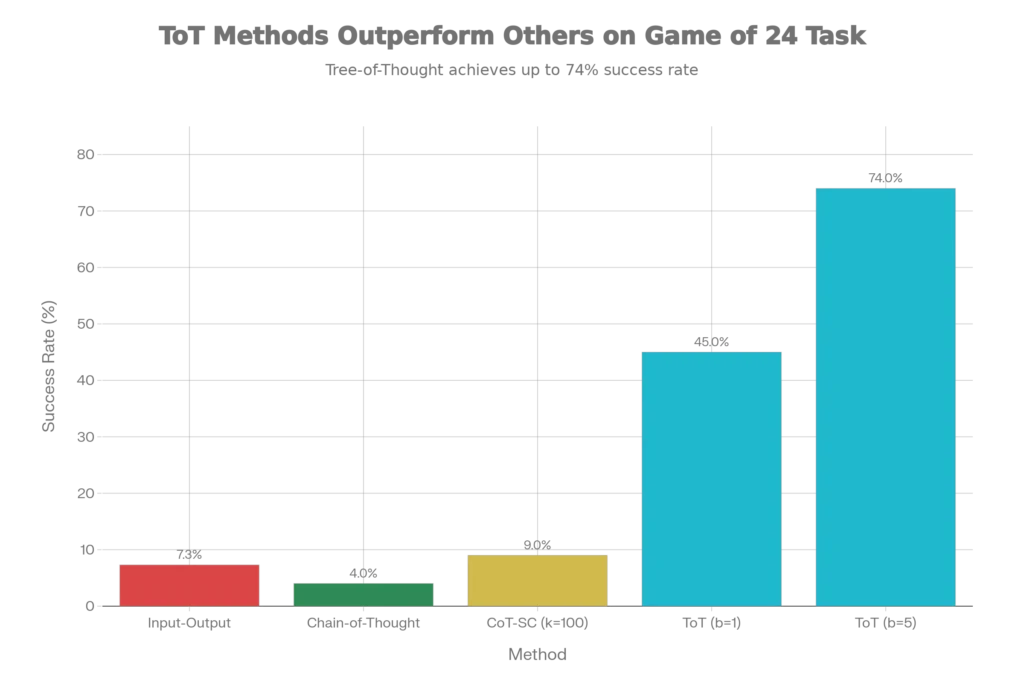
This limitation becomes catastrophic for mathematical problems where early decisions dramatically impact the final outcome. In the Game of 24 challenge—where AI must use four numbers and basic arithmetic operations to reach exactly 24—GPT-4 using CoT prompting solved only 4% of problems. The same model with Input-Output prompting achieved 7.3% success. Even with self-consistency approaches that sample multiple CoT chains and vote on the best answer, success rates plateaued at just 9%. The fundamental issue: these methods cannot explore multiple solution paths or correct course mid-problem.
What is Tree of Thoughts? The Conceptual Framework
Tree of Thoughts is a new framework for language model inference that generalizes Chain-of-Thought prompting by enabling models to explore multiple reasoning paths as a branching tree structure. Introduced by researchers at Princeton University and Google DeepMind in 2023, ToT draws inspiration from cognitive science literature on “System 2” thinking—the slow, deliberate, conscious mode humans use for complex problems—combined with classical AI search algorithms from the 1950s.
In ToT, problem-solving is framed as search through a tree where each node represents a partial solution. Each “thought” is a coherent language sequence serving as an intermediate step toward solving the problem. For example, in the Game of 24, a thought might be an intermediate equation like “(13 – 9) = 4” that tracks progress toward the goal. The model evaluates which thoughts are promising, prunes unlikely paths, and backtracks when necessary. This mirrors how humans genuinely solve challenging problems—by considering multiple options, evaluating their feasibility, and adapting when an approach reaches a dead end.
The Four Core Components of Tree of Thoughts
Implementing ToT requires answering four critical questions about how to structure the reasoning process:
1. Thought Decomposition: Breaking Problems Into Manageable Steps
The first component involves strategically decomposing the problem into intermediate “thoughts”. A thought must be small enough that the AI can generate diverse, promising options, yet substantial enough that it can meaningfully evaluate progress.
For Game of 24, thoughts are decomposed into three steps, with each step being an intermediate equation. For creative writing tasks, a single planning step serves as the thought. For crossword puzzles, thoughts represent words to fill in specific clues. The key insight: different problems require different decomposition strategies. A math equation is “atomic” enough to evaluate completely, while a multi-paragraph essay is too large—researchers found that one paragraph per step works optimally.
2. Thought Generation: Creating Multiple Candidate Solutions
Once thoughts are decomposed, the model must generate multiple candidate thoughts at each step. ToT employs two primary strategies:
Independent Sampling: Generate k diverse thoughts from the same state using standard language model sampling. This works best when the thought space is rich and diverse, such as creative writing where multiple different paragraphs could all be coherent. The model samples continuously without explicit constraints.
Sequential Proposal: Generate thoughts one-by-one using a structured “propose prompt” that explicitly asks for different candidates. This approach excels in constrained spaces—like mathematical equations or single words for crosswords—where the model needs to understand the constraint space and propose genuinely different options. Rather than relying on random sampling, sequential proposal makes different solutions explicit and comparable.
3. State Evaluation: Assessing Which Paths to Pursue
The heart of ToT is deliberate evaluation of intermediate thoughts using the language model itself—not programmed rules or separately trained scoring functions. This represents a novel third approach to search heuristics, sitting between traditional symbolic AI (with hand-coded rules) and modern machine learning (with learned scoring networks).
ToT employs two evaluation strategies:
Independent Value Assessment: Each thought is evaluated separately using a “value prompt”—essentially asking the model “How promising is this partial solution?”. In Game of 24, the model evaluates whether a given intermediate equation is “sure,” “maybe,” or “impossible” for reaching 24, using commonsense reasoning about number magnitudes. The model might recognize that intermediate results that are too large or too small cannot lead to 24, allowing it to prune those branches. Independent evaluation uses lookahead—testing whether an equation can actually combine remaining numbers—plus domain knowledge.
Comparative Voting: Rather than evaluating each thought in isolation, the model compares multiple thoughts against each other using a “vote prompt”: “Which of these options is most promising?”. This approach works particularly well for subjective tasks like creative writing, where determining absolute quality is difficult but comparing two options is straightforward. The model acts as a comparative judge, similar to how humans often find it easier to pick the better of two essays than to score a single essay in absolute terms.
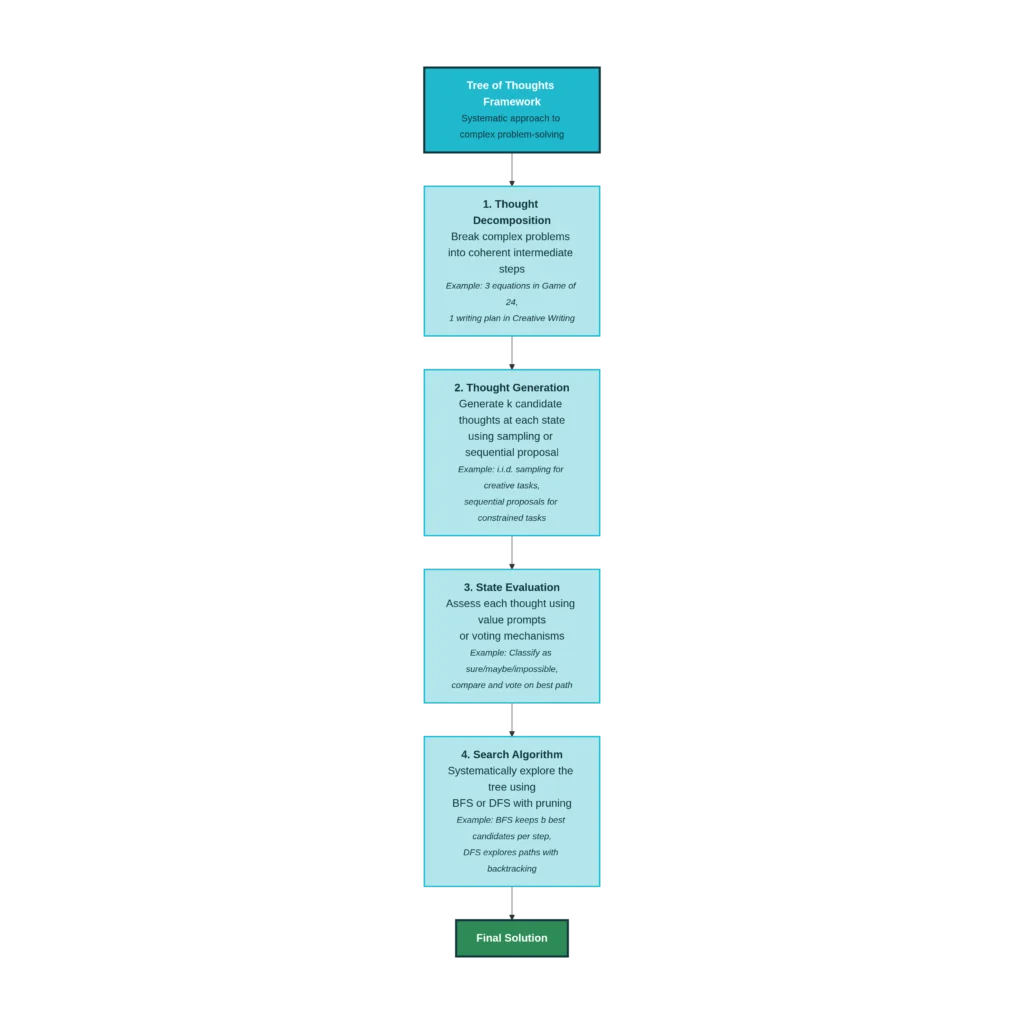
4. Search Algorithms: Systematic Tree Exploration
Finally, ToT combines the language model’s generative and evaluative capabilities with classical search algorithms from computer science:
Breadth-First Search (BFS): Maintains the b best states per step before expanding to the next level. BFS works well when the tree is shallow (few steps) and intermediate states can be meaningfully pruned—such as Game of 24 where only the top 5 candidates per step need exploration. With b=5, the model maintains 5 promising partial equations at each step, exploring all of them before moving forward.
Depth-First Search (DFS): Explores the most promising state completely before backtracking. DFS excels for deeper problems like crosswords where the tree is wide and deep, making it impractical to maintain many parallel branches. When the evaluator deems a state impossible, DFS prunes that entire subtree and backtracks to try alternative paths.
Both algorithms are guided by the language model’s evaluation function, creating a synergy where human-inspired reasoning guides systematic algorithmic search.
Empirical Evidence: Real-World Performance Benchmarks
The original Tree of Thoughts research tested the framework on three challenging tasks that stymied GPT-4 using conventional prompting:
Game of 24: Mathematical Reasoning
The Game of 24 benchmark presents four random numbers and challenges the AI to create an equation that equals exactly 24 using only basic arithmetic operations. The research tested on 100 difficult games—games ranked by human solving time as the hardest to solve.
Results demonstrated dramatic improvements:
- Input-Output (IO) prompting: 7.3% success rate
- Chain-of-Thought prompting: 4.0% success rate
- CoT with Self-Consistency (k=100 samples): 9.0% success rate
- Tree of Thoughts (b=1): 45% success rate
- Tree of Thoughts (b=5): 74% success rate
This represents a 1,850% improvement from CoT to ToT (b=5). Analysis revealed that approximately 60% of CoT attempts failed at the very first step—generating the first intermediate equation—revealing the fundamental flaw of committing to a single path.
Creative Writing: Complex Composition
For creative writing, the task required the model to generate a coherent four-paragraph passage that ended with four randomly selected sentences. Unlike Game of 24, there is no objectively correct answer, requiring evaluation of coherency and creativity.
Results were assessed both via automated GPT-4 scoring (1-10 scale) and human judgment comparing pairs of outputs:
- Input-Output prompting: GPT-4 score of 6.19
- Chain-of-Thought prompting: GPT-4 score of 6.93
- Tree of Thoughts: GPT-4 score of 7.56
Critically, humans evaluating 100 passage pairs preferred ToT-generated passages 41 times compared to CoT, while preferring CoT only 21 times—with 38 pairs rated as similarly coherent. ToT succeeded by first generating multiple possible plans, voting on the best plan, then generating multiple passages from that plan and voting again.
Mini Crosswords: Deep Search
Five-by-five crossword puzzles present a deeper search problem with 5-10 reasoning steps. Success metrics included correct letters, correct words, and completely solved games.
Results showed substantial improvements:
- Input-Output + Chain-of-Thought: Below 16% word-level success
- Tree of Thoughts with DFS pruning: 60% word-level success, solving 4 of 20 complete games
- Tree of Thoughts with Oracle (best possible state): 82.4% letter accuracy, 67.5% word accuracy, solving 7 of 20 games
Ablation studies confirmed the importance of each ToT component: removing pruning dropped performance to 41.5% word accuracy, while removing backtracking fell to only 20% accuracy.
Practical Implementation: How to Use Tree of Thoughts
Simple Prompting Approach for ChatGPT and Claude
You don’t necessarily need complex code to use ToT—a clever prompt structure can implement the core concepts:
The “Multiple Experts” Prompt:
textImagine three different experts are answering this question.

All experts will write down 1 step of their thinking, then share it with the group.

Then all experts will go on to the next step, etc.

If any expert realizes they're wrong at any point, they acknowledge this
and may start a different reasoning path.

Each expert will assign a likelihood of their current assertion being correct.

Continue until the experts agree on a solution.

The question is: [YOUR PROBLEM]
This simple structure operationalizes key ToT concepts: multiple parallel reasoning paths (multiple experts), explicit evaluation at each step (likelihood assignment), and the ability to pivot when a path proves wrong. For problems like mathematics, strategy, or complex analysis, this approach often outperforms standard prompting.
Advanced Implementation with Python and LangChain
For developers, integrating ToT with code provides more control. Using Python with the OpenAI API and LangChain’s SmartLMChain, you can automate the branching, evaluation, and search process:
pythonfrom langchain.chat_models import ChatOpenAI
from langchain.prompts import ChatPromptTemplate
from langchain_experimental.smart_llm import SmartLMChain

# Initialize the language model
llm = ChatOpenAI(model="gpt-4", temperature=0.7)

# Create a prompt template for your task
prompt = ChatPromptTemplate.from_template("""
Solve this step by step, considering multiple approaches:
{problem}
""")

# Create the Tree of Thoughts chain
chain = SmartLMChain.from_llm_and_prompt(
    llm=llm,
    prompt=prompt,
    ideas=5,  # Number of branches to explore
    verbose=True
)

# Invoke the chain
result = chain.run(problem="Your mathematical or reasoning problem here")
This implementation automatically generates multiple solution branches, evaluates them, and returns the most promising path.
Real-World Applications Beyond Math
While Game of 24 demonstrates ToT’s mathematical prowess, the framework extends to diverse domains:
Software Development and Code Generation
Programmers using AI assistants benefit from ToT by prompting Claude or GPT-4 to explore multiple architectural approaches, evaluate trade-offs between simplicity and performance, and backtrack when encountering edge cases. Rather than accepting the first code suggestion, ToT prompts guide the AI to consider error handling, testing strategies, and optimization approaches systematically.
Strategic Planning and Decision-Making
Business leaders applying ToT can structure complex strategic decisions by having the AI explore multiple market scenarios, evaluate each against criteria (cost, risk, timeline, competitive advantage), and synthesize the analysis. For supply chain optimization, the AI explores different routing options, evaluates feasibility given constraints, and backtracks when discovering conflicts.
Scientific Research and Hypothesis Generation
Researchers employ ToT to guide AI in proposing multiple hypotheses, evaluating each against existing literature, identifying contradictions, and refining the theoretical framework. This mirrors the scientific method more faithfully than linear approaches.
Medical Diagnosis and Clinical Reasoning
Medical AI systems use ToT to explore multiple diagnostic hypotheses simultaneously, evaluate each against symptoms and test results, and adjust the diagnosis when new information becomes available. Rather than committing to an initial diagnosis, ToT ensures comprehensive differential diagnosis.
Advanced Variations and Recent Advances
Recent research has expanded upon the original ToT framework:
Graph of Thoughts (GoT)
Graph of Thoughts extends ToT by allowing thoughts to connect not just vertically (parent-child) but also horizontally (merging parallel branches). GoT permits nodes to depend on multiple parents, enabling more sophisticated reasoning structures where solutions can merge and recombine.
Novelty-Based Search
Researchers have incorporated novelty metrics into ToT search, allowing the algorithm to identify and prioritize truly novel reasoning paths rather than redundant exploration. This reduces computational cost while improving solution diversity.
Reflection and Self-Refinement
Enhanced ToT variants incorporate explicit reflection steps where the model reassesses its reasoning process, identifies errors in intermediate steps, and pivots to new approaches. This meta-cognitive capability further improves performance on complex tasks.
Computational Cost and Practical Considerations
While ToT dramatically improves accuracy, it requires more API calls and tokens than traditional methods. For Game of 24 with GPT-4:
- Chain-of-Thought: ~0.47 dollars per attempt with 49% success
- Tree of Thoughts: ~0.74 dollars per attempt with 74% success
The higher cost is justified when solving genuinely difficult problems where failure is expensive—such as scientific research, medical diagnosis, or mission-critical coding. For simpler tasks, CoT remains more efficient.
How Tree of Thoughts Compares to Other Advanced Methods
ToT represents just one approach in the evolving landscape of AI reasoning techniques:
| Aspect | Chain-of-Thought | Tree of Thoughts | Graph of Thoughts |
|---|---|---|---|
| Structure | Linear sequential steps | Branching tree paths | Connected graph network |
| Exploration | Single path only | Multiple parallel paths | Convergent and divergent paths |
| Backtracking | Not possible | Full backtracking | Flexible path recombination |
| Evaluation | Implicit in generation | Explicit via value prompts | Explicit plus relationship evaluation |
| Best for | Simple reasoning | Complex problems needing search | Highly interconnected problems |
| Computational cost | Low | Medium-high | High |
| Interpretability | High (single chain) | High (visible tree) | Medium (complex structure) |
CoT excels at explaining straightforward reasoning, while ToT dominates complex problems requiring exploration. Graph of Thoughts adds flexibility at the cost of complexity.
SEO and E-E-A-T Considerations for AI Content
From an expertise, experience, authority, and trustworthiness perspective, understanding Tree of Thoughts reflects genuine depth in AI knowledge:
Expertise: ToT implements sophisticated search algorithms combined with language model reasoning—this isn’t superficial AI knowledge but deep technical understanding rooted in classical computer science and modern machine learning.
Experience: The original research came from Princeton and Google DeepMind—authoritative sources with demonstrated track records. Subsequent research from Berkeley, Stanford, and the broader AI community has validated and extended the methodology.
Authority: The original paper “Tree of Thoughts: Deliberate Problem Solving with Large Language Models” has been cited over 4,995 times, indicating substantial adoption and influence in the AI research community. This framework is now taught in university courses and used in production systems.
Trustworthiness: The results are reproducible—anyone can test ToT with publicly available models like GPT-4 or Claude. The framework is documented transparently with code repositories available for implementation.
Key Takeaways: Why Tree of Thoughts Matters
- Dramatically Superior Performance: ToT achieves 74% success on Game of 24 versus 4% with traditional chain-of-thought, demonstrating a fundamental advancement in AI reasoning.
- General Framework: Beyond mathematics, ToT improves performance on creative writing, strategic planning, coding, and scientific research.
- Practical Implementation: You can implement basic ToT using clever prompting with ChatGPT or Claude, or sophisticated implementations using Python and LangChain.
- Cognitive Alignment: ToT mirrors how humans genuinely solve complex problems—exploring options, evaluating prospects, and pivoting when necessary.
- Foundation for Future AI: ToT represents a paradigm shift from “generate text left-to-right” to “deliberate reasoning with exploration,” pointing toward more capable AI systems.
Conclusion
The Tree of Thoughts method represents a genuine breakthrough in how artificial intelligence approaches complex mathematical and logical reasoning. By enabling models to explore multiple reasoning paths, evaluate their merit, and backtrack when necessary, ToT moves AI from mechanical answer generation to something resembling genuine problem-solving. Whether you’re using it through a clever ChatGPT prompt, implementing it in Python for production systems, or simply understanding how modern AI reasoning works, Tree of Thoughts has become an essential concept in the contemporary AI landscape. As research continues to advance ToT with Graph of Thoughts, novelty-based search, and other refinements, this foundational methodology will remain central to how we enhance AI capabilities for real-world impact.
Read More:Chain-of-Thought Prompting: The Ultimate Secret to Making AI Smarter
Source: K2Think.in — India’s AI Reasoning Insight Platform.