
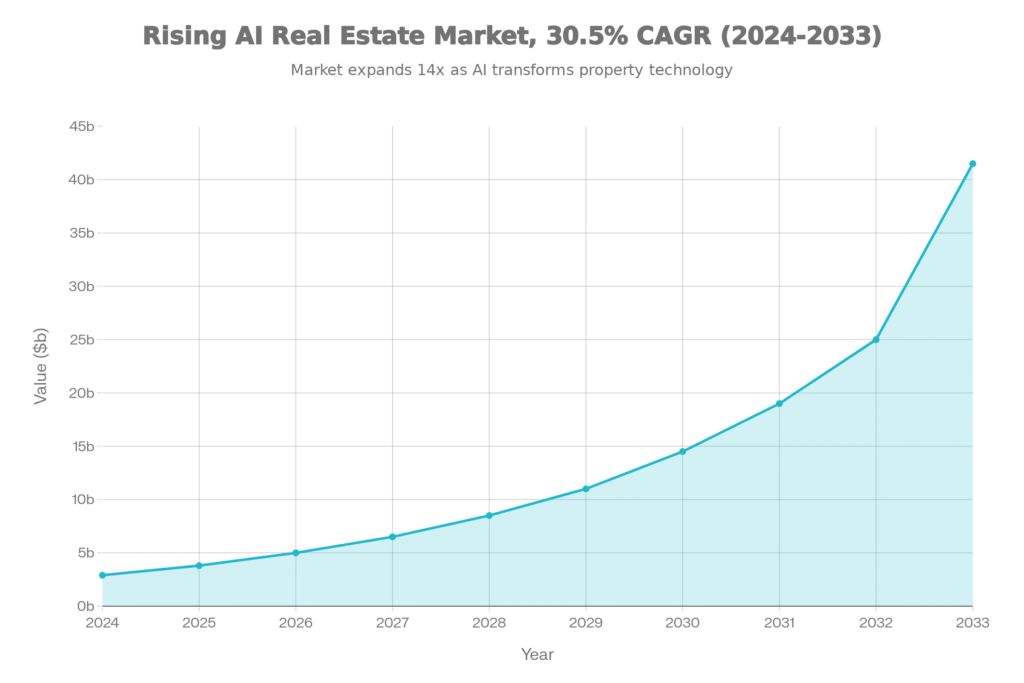
Writing property descriptions is one of the most time-consuming tasks for real estate agents—consuming 45-60 minutes per listing. Today’s AI-powered property description tools have fundamentally transformed this process, cutting description-writing time to just 5 minutes while dramatically improving online engagement and search engine visibility. The global AI real estate market, valued at $2.9 billion in 2024, is projected to skyrocket to $41.5 billion by 2033, reflecting the industry-wide shift toward AI adoption. This comprehensive guide explores the best AI tools for crafting compelling, SEO-optimized property descriptions that engage buyers and accelerate sales.
The Real Estate Industry’s AI Revolution in 2025
The transformation of property descriptions through artificial intelligence represents one of the most significant operational shifts in real estate marketing. Real estate agents now save 20-30 hours per week by adopting AI tools for various marketing tasks, with property description generation leading the efficiency gains. According to recent industry data, AI-assisted listings receive 34% more inquiries compared to traditionally written descriptions, while properties sell 8% faster when listed with AI-optimized copy.
The adoption rate among real estate professionals continues to accelerate. Research shows that 75% of brokerages are now using AI tools to maintain competitive advantage, and 39% of homebuyers actively use AI tools during their property search process. This widespread adoption creates both an opportunity and a necessity for real estate agents—those who embrace AI tools are significantly outpacing competitors who continue manual processes. The competitive landscape has shifted so dramatically that agents avoiding these tools risk losing market share, longer days-on-market, and fewer inquiries.
Top AI Tools for Property Descriptions Compared
When selecting an AI tool for property descriptions, you’ll encounter options ranging from general-purpose AI assistants to real estate-specific platforms. Each serves different needs and budgets, so understanding their strengths helps you make the right choice.
ChatGPT: The Versatile Foundation
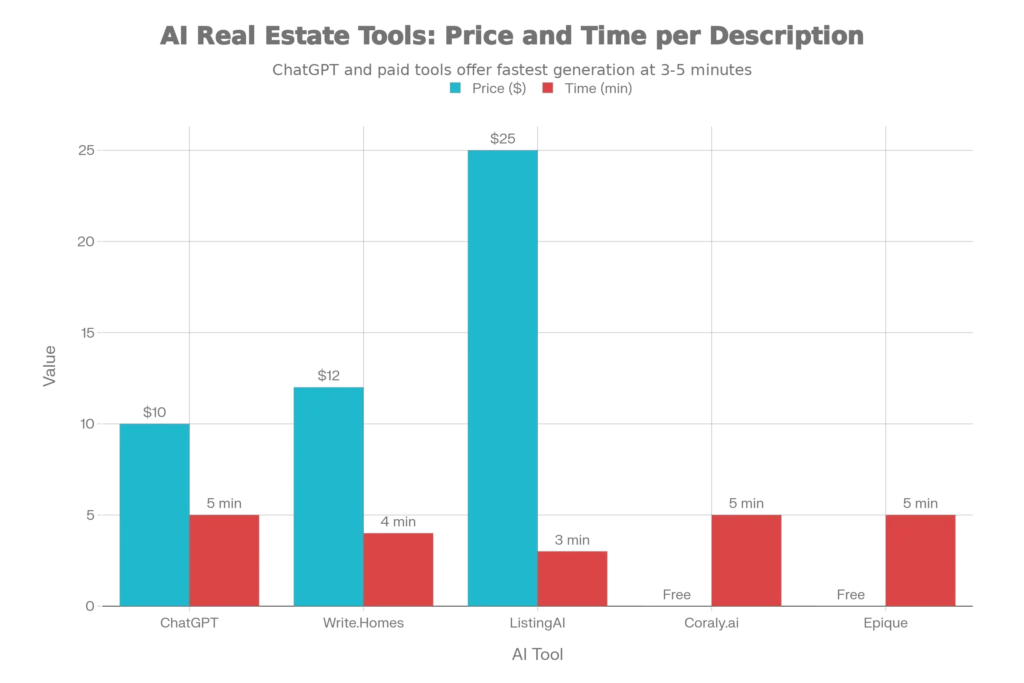
ChatGPT remains the most accessible entry point for agents exploring AI, offering both free and paid versions ($20/month for premium). The tool generates a complete property description in approximately 5 minutes, making it ideal for agents who need flexibility and affordability. ChatGPT excels because it allows customization through clear prompts—agents can specify target buyers (first-time homeowners, luxury buyers, investors), desired tone (casual, professional, enthusiastic), and key features to emphasize.
A proven ChatGPT prompt template agents use successfully is: “Write a listing description for a [property type] with [number] bedrooms, [number] bathrooms, located in [neighborhood]. Key features include [list 3-5 features]. Target: [buyer demographic], under 200 words.” The platform’s versatility extends beyond descriptions—agents use it for emails, social media content, market analysis, and even CMA reports. However, ChatGPT requires human review for accuracy, compliance, and tone consistency before publishing.
Write.Homes: Real Estate-Specific Excellence
Write.Homes is purpose-built for real estate professionals and generates descriptions in 3-5 minutes at just $8-15 per month. This platform’s competitive advantage lies in its real estate-specific training—the AI understands property terminology, buyer psychology, and market language in ways generic AI assistants cannot. Write.Homes automatically optimizes descriptions for SEO, ensuring your listings rank better in Google searches and on Zillow, Realtor.com, and MLS databases.
The platform’s real-world impact is quantifiable: according to Write.Homes’ 2025 AI Real Estate Marketing Benchmark Report, AI-assisted listings generate 34% more inquiries and sell 8% faster than manually written descriptions. The tool supports integration with MLS systems, multi-language generation, and customizable tone settings. For agents managing 5-10 listings monthly, Write.Homes delivers immediate ROI through time savings alone.
ListingAI: SEO-Focused Optimization
ListingAI stands out for agents prioritizing search engine optimization, generating descriptions in 2-5 minutes with a free tier available. The platform includes a Fair Housing compliance monitor that scans descriptions for potentially discriminatory language, ensuring your listings meet legal requirements. This safety feature is invaluable—real estate agents face legal liability if AI-generated descriptions inadvertently violate Fair Housing laws by using coded language that suggests discrimination.
ListingAI supports 22+ languages, enabling agents in diverse markets to reach broader audiences. The custom writing rules feature maintains brand consistency across all your listings, crucial for building professional credibility and recognition. For agents in competitive markets who depend on search visibility, ListingAI’s SEO specialization justifies its premium positioning.
Coraly.ai: Content Plus SEO Strategy
Coraly.ai combines property descriptions with broader SEO strategy, generating content in 5 minutes with limited free access. The platform’s unique strength is thinking beyond individual listings—it produces multiple content formats from a single input, including social media posts, email content, and neighborhood guides. Coraly.ai automatically works in location keywords and property features that search engines favor, without making descriptions sound like keyword-stuffed spam.
For agents managing a complete content marketing strategy, Coraly.ai reduces the coordination overhead of creating descriptions, social posts, and email campaigns across multiple platforms simultaneously.
Epique: All-in-One Platform
Epique offers a completely free suite of 12 AI tools specifically for real estate professionals, including property description generation, blog post creation, and lead generation assistance. This makes it exceptionally valuable for agents on tight budgets or testing AI before investing in premium tools. Despite being free, Epique delivers professional-quality descriptions in 5 minutes and provides brokerage insights that help agents understand their competitive positioning.
Time Savings and Efficiency Impact
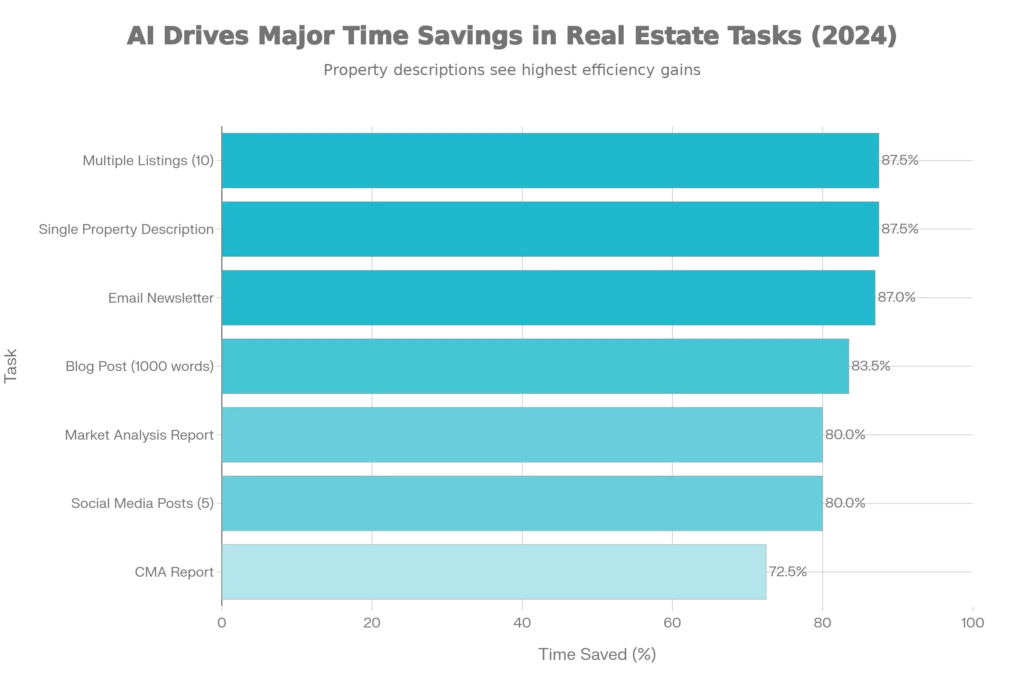
The efficiency gains from AI property descriptions extend far beyond description writing itself. When agents automate property descriptions, they recover 50-55 minutes per listing—time that can be redirected to client calls, property showings, negotiations, and lead follow-up. For an agent managing 10 listings monthly, this represents approximately 8-9 hours of recovered time each month, or 100+ hours annually.
The compounding effect becomes apparent when you consider broader marketing tasks:
- Single property description: Manual (45-60 min) vs. AI-assisted (5-10 min) = 85-90% time savings
- Five social media posts: Manual (75-110 min) vs. AI-assisted (15-20 min) = 75-85% time savings
- Email newsletter: Manual (2 hours) vs. AI-assisted (15 min) = 87% time savings
- Comparative Market Analysis: Manual (1-2 hours) vs. AI-assisted (30 min) = 70-75% time savings
This efficiency translates directly to business growth. Agents using AI-driven marketing report 25-40% increases in closed transactions and 30-50% reductions in cost per lead, according to industry analysis. The mathematics are compelling: if you value your time at $75/hour (conservative for productive agents), saving 20 hours weekly through AI automation represents $78,000 in annual time value recovered.
How AI Property Descriptions Improve Search Rankings and Buyer Engagement
Real estate search has fundamentally changed. 90% of homebuyers now use the internet to search for homes, making search visibility a critical revenue driver. AI-generated descriptions inherently improve search performance through several mechanisms:
Natural Keyword Integration
Modern AI tools analyze successful real estate listings and understand how keywords naturally fit into property descriptions without sounding forced or spammy. Rather than stuffing phrases like “luxury homes” and “waterfront property,” AI-generated descriptions organically weave location keywords, property features, and buyer-focused language together. Listings with high-quality descriptions and photos receive 20% more views than those without detailed copy.
An effective AI-generated description for a suburban family home might read: “Welcome to this beautifully renovated four-bedroom family home in the heart of Riverside, just minutes from top-rated Lincoln Elementary School and the scenic parks district. Recently updated kitchen with stainless steel appliances opens into a spacious family room—perfect for entertaining or cozy family nights. The private backyard features mature landscaping and a new deck, ideal for outdoor living.” This description naturally incorporates keywords (location, schools, updated kitchen, family home) that search algorithms reward, while compelling readers emotionally.
Metadata and Title Optimization
AI tools generate not just body descriptions but optimized titles and meta descriptions—the HTML elements that appear in Google search results and influence click-through rates. A meta-optimized title might be: “4 Bed, 2 Bath Family Home Near Top Schools in Riverside – New Updates” rather than the generic “4 Bedroom House for Sale.” This specificity improves both search ranking and click-through rates.
Mobile-First Content Formatting
AI tools generate descriptions optimized for mobile devices, where most property searches occur. Shorter paragraphs, effective use of line breaks, and bullet points for key features make descriptions readable on smartphones—a critical ranking factor for Google’s search algorithm.
Virtual Staging: The AI Feature Multiplying Property Inquiry Rates
Beyond property descriptions, AI virtual staging has emerged as one of the most impactful AI real estate tools, particularly for homes requiring renovation or empty properties. Virtual staging uses AI to digitally furnish and style rooms, allowing buyers to visualize a property’s full potential without physical staging costs.
The impact is extraordinary: AI-enhanced virtual staging increases property inquiries by up to 200% compared to traditional photography, and staged properties receive 40% more online views. More importantly, virtually staged homes reduce days-on-market from 90 days to just 24 days—a 73% reduction—while commanding 5-23% higher sale prices.
The financial case for virtual staging is compelling. Traditional physical staging costs $500-$5,000 depending on property size and required furniture rental. AI virtual staging generates multiple room variations in 24-48 hours at a fraction of the cost. With ROI figures ranging from 500% to 3,650%, virtual staging quickly pays for itself by accelerating sales.
Agents using platforms like Virtuance, Collov AI, or Styldod report that after adding virtual staging images to long-sitting properties, offers arrive within one week—a dramatic reversal from months without interest.
Fair Housing Compliance: The Non-Negotiable Requirement
While AI dramatically accelerates property description writing, agents must never publish descriptions without human review. AI systems can inadvertently include language that violates Fair Housing laws through coded discrimination, even without intentional bias. Common compliance risks include:
- Language suggesting age-appropriateness (“perfect for active seniors” or “great for young families”)
- References to protected characteristics (“near Hispanic community” or “Muslim-friendly”)
- Assumptions about physical abilities (“wheelchair-friendly” can imply targeting to disabled individuals)
- Neighborhood descriptors that correlate with race (“urban,” “diverse,” “urban renewal”)
Best practice is using AI as a first-draft generator, then conducting a human compliance review focused on identifying potential Fair Housing violations. ListingAI and similar platforms include automated compliance monitors that flag risky language and suggest alternatives—a safeguard that should be standard in your workflow.
Building Your AI-Powered Workflow: Implementation Strategy
Successfully integrating AI property descriptions into your daily workflow requires structured approach:
Step 1: Select Your Primary Tool
If you’re budget-conscious, start with ChatGPT Free or Epique—both are free and deliver solid descriptions in 5 minutes. If you manage 10+ monthly listings, investing in Write.Homes ($8-15/month) or ListingAI ($25-49/month) pays for itself through time savings and superior SEO performance.
Step 2: Develop Your Prompt Template
Create a standardized prompt structure that you use for every property. For example:
“Write a compelling property description for [Type] at [Address] in the [Neighborhood] area. This property features [3-5 key features]. The ideal buyer is [target demographic]. Use a [tone] tone, keep it under 200 words, and ensure it reads naturally for both [Online platform – MLS/Zillow/etc] and social media. Include keywords: [primary keywords].”
Step 3: Input Property Data Systematically
Gather verified details before prompting the AI: square footage, year built, number of rooms, recent renovations, lot size, neighborhood amenities, school district information, and unique features. More detailed input produces better output—garbage in, garbage out applies to AI as much as traditional writing.
Step 4: Generate Multiple Variations
Most agents generate 2-3 versions from the same prompt, then select the strongest. Some variations emphasize lifestyle (cozy family home), others emphasize investment potential (strong rental market area), still others emphasize luxury features. Testing variations helps identify which style resonates with your buyer base.
Step 5: Human Review and Personalization
Review the AI draft for accuracy (confirm all details match property specs), compliance (scan for Fair Housing risks), tone (ensure it matches your brand voice), and completeness (verify nothing important is missing). Add personal touches reflecting your property walkthrough: “The afternoon light streaming through the west-facing windows is stunning” or “The owners clearly invested in this home—every detail reflects care.”
Step 6: Optimize for Your Listing Platform
Adjust descriptions for platform-specific requirements. MLS has character limits, Zillow rewards detailed descriptions, Instagram Reels require brevity. AI can quickly generate platform-specific variations—take advantage of this.
Measuring Success: Key Metrics to Track
When implementing AI property descriptions, track these metrics to quantify impact:
- Days-on-market before/after AI adoption: Target 15-20% reduction
- Inquiry rate per listing: Target 30-40% increase
- Showing requests per listing: Target 25-35% increase
- Time spent on description writing: Target 85-90% reduction
- Listing sell price premium: Track whether AI descriptions correlate with higher final prices
- Search visibility: Monitor rankings for location + property keywords in Google
According to industry benchmarks, agents implementing AI see these realistic improvements within 30-60 days of adoption.
The Future Trajectory: What’s Coming Next
The AI real estate market is advancing rapidly. Generative AI in real estate was valued at $351.9 million in 2022 and is projected to reach $1,047 million by 2032—a 11.52% compound annual growth rate. The platforms being developed today hint at tomorrow’s capabilities:
Automated Multi-Variation Generation: Future AI will automatically create different description versions for different buyer personas—one emphasizing schools for families, another highlighting investment metrics for investors, a third stressing luxury features for high-end buyers. One property input produces 5-10 optimized variations instantly.
Dynamic Pricing Intelligence: AI will integrate property descriptions with pricing analytics, automatically suggesting description emphasis based on comparable sales analysis. If similar homes in your area appreciate when marketed as “renovated,” the AI prioritizes renovation details.
Predictive Days-on-Market Analysis: AI will analyze your description against market comps and predict how long the property will take to sell, suggesting description adjustments to improve timeline.
Integration with Virtual Staging and 3D Tours: Property descriptions will integrate with virtual staging images, virtual tours, and augmented reality features, creating seamless buyer experiences across multiple platforms.
Conclusion: The Professional Edge is Now AI-Powered
The question is no longer whether to use AI for property descriptions—it’s which tool best matches your workflow, market, and budget. Agents who adopt AI property description tools save 20-30 hours weekly while increasing inquiries by 34% and accelerating sales cycles by 8%. This represents a rare combination: labor savings coupled with revenue improvement.
The competitive landscape has shifted. Real estate agents not using AI tools for property descriptions are essentially accepting longer selling times, fewer inquiries, and lower final prices—a competitive disadvantage that compounds monthly. Your local competitors are likely already using these tools. The decision to adopt AI isn’t about gaining an edge anymore; it’s about keeping pace with the market evolution that’s already happening.
Whether you start with free tools like ChatGPT and Epique or invest in real estate-specific platforms like Write.Homes and ListingAI, the time to implement is now. Your first week of AI-assisted descriptions will demonstrate the value immediately—faster listing creation, improved search visibility, and more serious buyer inquiries. From there, the momentum builds naturally as recovered time enables you to expand your reach, market more aggressively, and ultimately close more deals.
Read More:Zapier + OpenAI: The Ultimate Playbook for Automating Your Entire Business Workflow
Source: K2Think.in — India’s AI Reasoning Insight Platform.