The landscape of artificial intelligence development in 2025 is increasingly defined by a pivotal question: which powerful reasoning models are genuinely open source? As developers worldwide seek alternatives to proprietary systems, K2-Think has emerged as a compelling contender from the United Arab Emirates, promising both cutting-edge performance and unprecedented transparency. But what does “open source” really mean when applied to this 32-billion parameter reasoning system, and how does its licensing compare to other AI models on the market?
This comprehensive guide examines the open-source credentials of K2-Think, explores its licensing terms, compares it to both proprietary and open alternatives, and provides developers with actionable insights into deployment, customization, and real-world applications.
Understanding K2-Think: A Breakthrough in Parameter-Efficient Reasoning
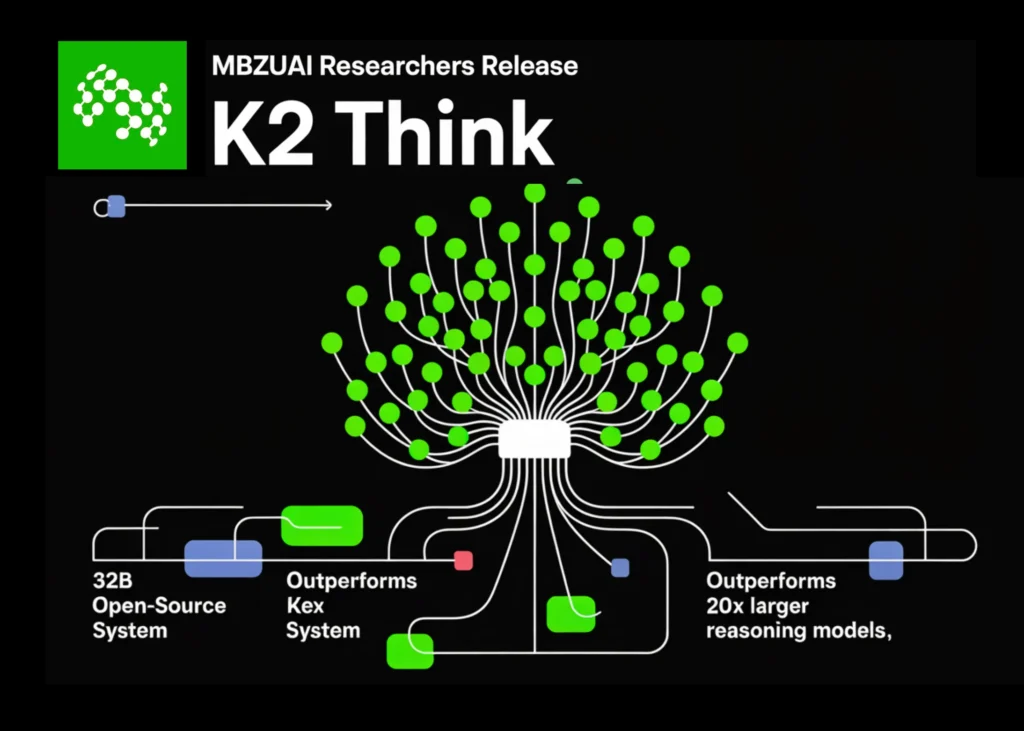
K2-Think represents a significant milestone in AI development. Built by the Mohamed bin Zayed University of Artificial Intelligence (MBZUAI) in collaboration with G42, this reasoning system demonstrates that smaller, strategically engineered models can compete with—and sometimes surpass—systems that are 20 times larger.
At its core, K2-Think is a 32-billion parameter model constructed on the Qwen2.5 base architecture. What distinguishes it from competitors is not raw size but rather an integrated approach combining six key technical innovations: long chain-of-thought supervised fine-tuning, reinforcement learning with verifiable rewards (RLVR), agentic planning prior to reasoning, test-time scaling techniques, speculative decoding, and inference-optimized hardware deployment.
The model excels particularly in mathematical reasoning tasks, achieving an impressive 81.24% on the AIME 2025 benchmark and 73.75% on HMMT 2025, while maintaining strong performance across coding (63.97% on LiveCodeBench) and scientific reasoning (71.08% on GPQA-Diamond). These results position K2-Think as the top-performing open-source model for complex mathematical problem-solving, rivaling proprietary frontier models despite its comparatively modest parameter count.
Read More: K2-Think Use Cases Explored: Practical AI Reasoning Solutions
The Open Source Credentials: What K2-Think Actually Releases
The question “Is K2-Think open source?” requires nuanced examination. Unlike many AI models that claim openness while releasing only model weights, K2-Think represents a genuinely comprehensive open-source initiative.
What Is Publicly Available
MBZUAI and G42 have released an unprecedented level of transparency for K2-Think, encompassing three critical components that define true open-source AI:
Model Weights and Architecture: The complete 32-billion parameter model weights are freely available on Hugging Face under the repository LLM360/K2-Think. Developers can download, inspect, and deploy these weights without restriction.
Training Data and Datasets: K2-Think provides access to the datasets used in its development, including the Guru dataset comprising nearly 92,000 verifiable prompts across Math, Code, Science, Logic, Simulation, and Tabular tasks. This data transparency is rare in the AI industry, where most competitors guard their training data as proprietary.
Source Code and Implementation: The complete codebase for supervised fine-tuning, reinforcement learning, inference optimization, and test-time scaling is publicly accessible through GitHub repositories including MBZUAI-IFM/K2-Think-SFT and MBZUAI-IFM/K2-Think-Inference.
This three-pronged approach to openness allows developers to not merely use K2-Think but to understand, replicate, and extend every aspect of its reasoning capabilities—from data lineage through training methodology to deployment optimization.
The Apache 2.0 License: Permissions and Implications
K2-Think is released under the Apache License 2.0, one of the most permissive open-source licenses available. This licensing choice carries significant practical implications for developers and enterprises considering adoption.
The Apache 2.0 license grants users broad freedoms:
Commercial Use: Developers can incorporate K2-Think into commercial products and services without restriction. Companies can build proprietary applications, charge customers, and generate revenue using K2-Think as a foundation.
Modification and Distribution: The license permits users to modify the source code, create derivative works, and distribute both original and modified versions. Importantly, derivative works need not be released under the same license—developers retain the option to apply different licensing terms to their modifications.
Patent Protections: Apache 2.0 includes explicit patent grants, ensuring contributors cannot later bring patent claims against users based on contributed code. This provision provides legal protection that many other permissive licenses lack.
Attribution Requirements: Users must preserve original copyright notices, include a copy of the license, document any modifications made to files, and maintain attribution to the original creators. These modest requirements ensure transparency without imposing significant burdens.
Unlike restrictive copyleft licenses such as GPL, Apache 2.0 does not require derivative works to remain open source. This flexibility makes K2-Think particularly attractive for enterprise deployments where proprietary integrations and customizations are necessary.
K2-Think vs. Kimi K2 Thinking: Clarifying the Confusion
The AI landscape features two distinct but related models that developers frequently confuse: K2-Think (from MBZUAI/G42) and Kimi K2 Thinking (from Moonshot AI in Beijing). Understanding the differences is essential for making informed deployment decisions.
K2-Think (MBZUAI/G42)
K2-Think is the 32-billion parameter reasoning system from the United Arab Emirates, released under Apache 2.0, focused on mathematical reasoning and parameter efficiency, and designed for transparent, reproducible research.
Kimi K2 Thinking (Moonshot AI)
Kimi K2 Thinking represents Moonshot AI’s approach to reasoning models, featuring 1 trillion total parameters with 32 billion active per token using a Mixture-of-Experts (MoE) architecture, native INT4 quantization for efficient inference, and a 256K token context window enabling extended reasoning sessions.
Licensing Differences: While K2-Think uses the permissive Apache 2.0 license, Kimi K2 Thinking employs a Modified MIT License with an additional commercial use clause. Under this modified license, developers using Kimi K2 in commercial products or services with more than 100 million monthly active users or generating more than $20 million per month in revenue must prominently display “Kimi K2” attribution in their user interface.
This distinction matters significantly for scalability planning. Small to mid-sized deployments face no additional restrictions beyond standard MIT requirements, but enterprises approaching these thresholds must factor attribution requirements into their user experience design.
The Advantages of Open Source AI for Developers
The open-source nature of K2-Think delivers concrete benefits that extend far beyond ideological preferences, fundamentally transforming how developers and organizations approach AI deployment.
Cost-Effectiveness and Economic Accessibility
Open-source AI eliminates licensing fees, subscription costs, and usage-based pricing that characterize proprietary alternatives. Developers can download K2-Think, deploy it on their own infrastructure, and scale without incurring per-query charges. This economic model particularly benefits startups, research institutions, and organizations in emerging markets where budget constraints might otherwise preclude access to frontier AI capabilities.
Transparency and Security
With publicly accessible source code and model weights, security researchers and developers can scrutinize K2-Think for vulnerabilities, biases, and potential flaws. This transparency stands in stark contrast to proprietary “black box” models where the training data, architecture decisions, and reasoning mechanisms remain hidden. Organizations subject to regulatory compliance requirements—such as the EU AI Act—find open-source models like K2-Think particularly valuable because every component can be audited and documented.
Customization and Domain Adaptation
Open-source models enable developers to fine-tune systems for specialized domains, optimize inference for specific hardware configurations, and integrate AI seamlessly into existing workflows. A financial services firm can train K2-Think on domain-specific terminology and compliance requirements; a healthcare organization can adapt the model for medical literature analysis while maintaining HIPAA compliance on-premises.
Community-Driven Innovation
The global developer community accelerates improvement through collective effort. Platforms like GitHub and Hugging Face host thousands of contributors who identify bugs, propose enhancements, and share optimizations. This collaborative ecosystem ensures models remain at the cutting edge of technological advancement while distributing the innovation burden across a diverse talent pool.
Vendor Independence
Open-source AI liberates organizations from vendor lock-in, allowing them to maintain control over their technology stack without dependency on a single provider’s ecosystem or pricing model. Companies can self-host K2-Think, maintain data residency in specific jurisdictions, and avoid the strategic risks associated with proprietary dependencies.
Real-World Applications and Use Cases
K2-Think’s reasoning capabilities translate into practical applications across multiple domains, with early adopters reporting significant productivity gains and cost reductions.
Mathematical and Scientific Research
K2-Think excels at complex mathematical problem-solving, making it valuable for academic research, competitive mathematics preparation, and engineering calculations. Its ability to generate transparent reasoning chains allows researchers to understand and verify computational logic.
Software Development and Code Analysis
The model achieves strong performance on coding benchmarks, supporting tasks including automated code review, bug detection, documentation generation, and algorithm optimization. Development teams use K2-Think to accelerate software engineering workflows while maintaining code quality.
Data Analysis and Business Intelligence
Organizations deploy K2-Think for automated report generation, trend identification in large datasets, predictive analytics, and decision support systems. The model’s ability to execute 200+ sequential tool calls enables complex analytical workflows that previously required manual coordination.
Content Creation and Research Synthesis
K2-Think supports research-intensive content workflows including competitive analysis, multi-source information synthesis, structured report generation, and citation-backed writing. Users report time-to-first-draft reductions of 40-45% compared to manual processes combined with generic language models.
Educational Applications
The model’s transparent reasoning makes it valuable for educational contexts where understanding the problem-solving process matters as much as the final answer. Educators use K2-Think to generate step-by-step explanations, create practice problems, and provide personalized learning support.
Deployment Considerations and Getting Started
Deploying K2-Think requires careful consideration of infrastructure requirements, deployment patterns, and operational best practices.
Hardware Requirements
K2-Think’s 32-billion parameter footprint demands substantial computational resources. For local deployment, developers typically need 16-24 GB of VRAM for comfortable inference with 8K context windows using quantized models (Q4/Q5). Multi-GPU configurations or cloud-based GPU instances (AWS G5 with A10G, or G4dn with T4) provide optimal performance for production deployments.
Deployment Options
Developers can choose from multiple deployment patterns based on their use case:
Local Deployment via Ollama: The simplest approach for prototyping and personal use, requiring 10-20 minutes of setup time and beginner-level technical skills.
Docker Containerization: Provides reproducible, portable environments ideal for team collaboration and CI/CD integration, requiring 20-40 minutes of setup with intermediate technical skills.
Cloud GPU Runtimes: Platforms including RunPod, Modal, Replicate, and Vast.ai offer managed GPU instances at approximately $0.40-$1.20 per hour, enabling autoscaling and shared access without infrastructure management overhead.
Self-Managed Cloud VMs: AWS, GCP, and Azure provide maximum control and customization, requiring intermediate-to-advanced skills but offering flexibility for enterprise integration.
API Access
For developers preferring not to manage infrastructure, K2-Think is available through hosted API endpoints at k2think.ai. Additionally, the model runs on Cerebras’ Wafer-Scale Engine, delivering unprecedented inference speeds of approximately 2,000 tokens per second—10 times faster than typical GPU-based deployments.
Getting Started: First Steps
Developers new to K2-Think should follow this recommended progression:
Start with Hugging Face to explore the model card, review documentation, and understand capabilities. Install dependencies including transformers, torch, and relevant inference frameworks. Download model weights using the Hugging Face CLI or programmatically via Python. Test locally using the provided quickstart code to verify installation and basic functionality. Optimize for your use case by adjusting quantization, context length, and sampling parameters. Scale to production by containerizing the application, implementing monitoring, and establishing rate limiting.
Limitations, Challenges, and Realistic Expectations
Despite its impressive capabilities, K2-Think exhibits limitations that developers should understand before committing to production deployments.
Performance Challenges
Latency Trade-offs: K2-Think’s thinking mode consistently produces 15-35% slower responses compared to non-reasoning modes, with token usage increasing by 1.2-1.6× on comparable tasks. This latency overhead accumulates in batch workflows and high-volume applications.
Creative Rigidity: The model favors logical coherence over creative surprise, performing well for reports and structured analysis but showing limitations in fiction writing, brainstorming sessions, and tasks requiring lateral thinking.
Long-Context Fatigue: While K2-Think handles extended contexts, multi-turn projects that accumulate context over several sessions show degradation in specificity, with entities and dates becoming less precise over time.
Benchmark Controversies
Independent evaluations have raised concerns about the model’s reported performance. Analysis from ETH Zurich’s SRI Lab identified several methodological issues including data contamination (50% of Omni-Math test questions present in training data), unfair comparisons using best-of-N sampling versus single-pass evaluation for competitors, and outdated baseline comparisons that understate competitor capabilities by up to 20%.
When evaluated under consistent methodologies, K2-Think demonstrates competent performance but falls short of matching DeepSeek V3.1 or GPT-OSS 120B—a notable gap compared to the authors’ original claims. Developers should approach published benchmarks critically and conduct domain-specific evaluations before production deployment.
Real-World vs. Benchmark Performance
Practical testing reveals gaps between benchmark scores and applied performance. Tool parameter selection sometimes lacks optimization (requesting 10 emails when 3 would suffice), UI component choices trail models like GPT-4o and Claude Sonnet 3.5, and certain reasoning-intensive benchmarks show K2-Think performing below expectations despite strong agentic tool-use metrics.
Safety and Security Considerations
K2-Think demonstrates strong performance in refusing harmful requests (0.83) and maintaining consistency in multi-turn interactions (0.89). However, cybersecurity resilience scores only 0.56, leaving the system susceptible to prompt extraction and indirect jailbreak attempts. Organizations deploying K2-Think in security-sensitive contexts should implement additional safeguards including input validation, output filtering, and monitoring for attempted exploits.
The Future of Open Source Reasoning Models
K2-Think represents a broader trend toward democratized AI access, with open-source models closing the performance gap against proprietary alternatives while maintaining transparency and community governance.
Industry Trends in 2025
The open-source AI landscape is evolving rapidly. Platforms like Hugging Face host thousands of community-contributed models, accelerating innovation through collaborative development. Organizations across sectors report that 78% are using AI in at least one business function in 2024, up from 55% the previous year, with open-source models driving much of this adoption.
The performance differential between open and closed models continues narrowing. DeepSeek-R1, Qwen3-235B-Instruct, and other open-weight reasoning models now achieve near-parity with proprietary leaders in reasoning and cost efficiency.
Strategic Implications
K2-Think validates a crucial principle: advanced AI capabilities need not depend on massive parameter counts or proprietary training techniques. Strategic engineering—combining efficient architectures, focused training methodologies, and inference-time optimizations—can enable smaller, more accessible models to compete at the frontier.
This paradigm shift has profound economic implications. If 32-billion parameter models can rival 600-billion parameter systems, the computational requirements, energy consumption, and deployment costs of advanced AI may decrease substantially, expanding access to organizations and regions previously excluded from the AI revolution.
Community Development and Ecosystem Growth
The K2-Think ecosystem continues expanding. Developers contribute deployment guides, optimization techniques, and domain-specific fine-tunes through platforms like GitHub and Hugging Face. MBZUAI hosts hackathons and collaborative events where teams build applications leveraging K2-Think’s reasoning capabilities, accelerating the transition from research artifact to production tool.
Conclusion: K2-Think’s Open Source Promise and Practical Reality
K2-Think is genuinely open source, providing comprehensive access to model weights, training data, and implementation code under the permissive Apache 2.0 license. This transparency distinguishes it from competitors that claim openness while withholding critical components.
For developers and organizations evaluating AI reasoning systems, K2-Think offers compelling advantages: zero licensing costs, freedom to customize and deploy on owned infrastructure, transparency enabling security audits and compliance verification, and a vibrant community accelerating innovation and support.
However, realistic expectations matter. K2-Think exhibits limitations in creative tasks, shows latency trade-offs in thinking mode, and has faced scrutiny regarding benchmark methodology. Developers should conduct domain-specific testing, implement appropriate safeguards for security-sensitive deployments, and maintain awareness of the model’s evolving capabilities.
The emergence of K2-Think signals a future where advanced AI reasoning need not remain the exclusive domain of well-resourced technology giants. By proving that parameter efficiency, strategic training, and open collaboration can rival brute-force scaling, MBZUAI and G42 have contributed not merely a model but a roadmap for democratized AI development.
For developers ready to explore K2-Think, the path forward is clear: review the technical documentation at k2think.ai, experiment with the model through Hugging Face or hosted APIs, evaluate performance on domain-specific tasks relevant to your use case, and engage with the community to share insights and contribute improvements.
The open-source AI movement is rewriting the rules of innovation, replacing proprietary gatekeeping with collaborative advancement. K2-Think stands as both evidence that this vision can succeed and an invitation for developers worldwide to participate in shaping the next generation of AI reasoning systems.
Source: K2Think.in — India’s AI Reasoning Insight Platform.