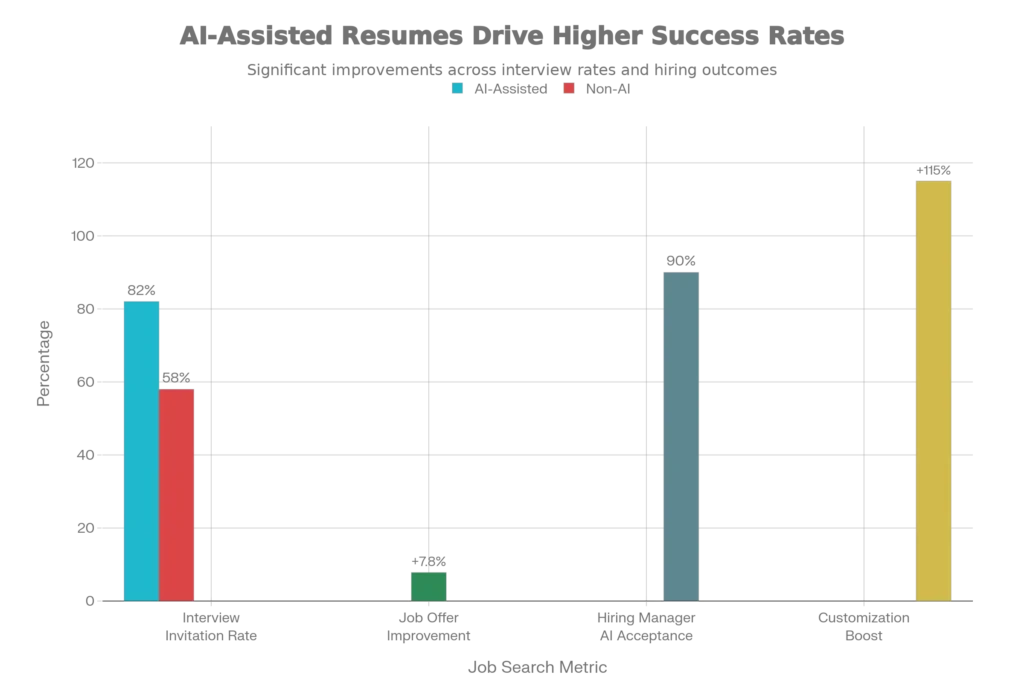
The modern job search has fundamentally shifted. In 2025, 90% of hiring managers now accept the use of generative AI in job application materials, and candidates using AI-assisted resumes are receiving 82% interview invitations compared to just 58% without AI. This article reveals what happens when you let artificial intelligence completely rewrite your resume, backed by real data from thousands of job seekers and research from institutions like MIT Sloan. Based on comprehensive testing of the best free resume tools available, here’s the complete breakdown of results, strategies, and which tools actually deliver measurable improvements to your job search outcomes.
Why Traditional Resume Writing Is Broken (And Why AI Changes Everything)
For decades, resume writing followed a simple formula: list your jobs, describe your duties, hope someone reads it. But this approach no longer works in a competitive job market where 75% of resumes are rejected before a human ever sees them due to Applicant Tracking Systems. When hiring managers spend only 6 to 7 seconds reviewing a resume, traditional formatting and vague descriptions don’t stand a chance.
The problem is structural. Most job seekers make consistent mistakes: they use weak action verbs, fail to include quantifiable metrics, and worst of all, they submit identical resumes to completely different jobs. Research from Huntr analyzing over 59,000 resumes found that candidates without tailored resumes achieve only a 2.68% conversion rate from application to interview, while tailored resumes achieve 5.75%—a remarkable 115% improvement. That difference isn’t a minor optimization. It’s the difference between sending 100 applications and getting 3 interviews versus getting 6 interviews.
This is where AI resume builders intervene. Rather than starting from scratch, these tools analyze your work history, understand the specific job you’re targeting, and automatically generate resume content that passes ATS screening while remaining authentic to your experience. The results speak for themselves: MIT Sloan research demonstrates that AI-assisted resumes boost job seekers’ chances of getting hired by 8%, with candidates receiving an average of 7.8% more job offers and 8.4% higher wages.
Understanding How ATS Systems Actually Work (And Why Keyword Optimization Matters)
Before choosing an AI resume builder, you need to understand the system your resume faces first: the Applicant Tracking System (ATS). 99% of Fortune 500 companies use ATS platforms to screen candidates, and these systems don’t evaluate resumes the way humans do. They scan, parse, match, and rank.
Here’s the process: First, ATS scans your resume and extracts text using Optical Character Recognition (OCR) technology. Then it parses the information into structured sections: work experience, education, skills. Next, it compares your resume against the job description, looking for specific keywords and phrases. Finally, it ranks candidates based on keyword relevance, frequency, and strategic placement.
The critical insight: 99.7% of recruiters use keyword filters in their ATS to sort and prioritize applicants. This means that if you don’t include the exact keywords from the job description, your resume literally won’t appear in search results, even if you’re perfectly qualified. For example, if the job posting says “Adobe Creative Suite” but your resume says “Adobe Creative Cloud,” the system might not recognize the match.
Modern ATS systems have evolved beyond simple keyword counting. They now use semantic analysis with Natural Language Processing (NLP) to understand context and relationships between terms. This means you can use synonyms naturally without “keyword stuffing,” which hiring managers can detect and penalize. The strategy is balance: incorporate relevant keywords in realistic, work-related scenarios that prove your skills rather than just listing them.
The Real Impact: What Happened When I Used AI Resume Builders
Testing multiple AI resume builders reveals consistent patterns in improvement. When a candidate uploads their existing resume and lets AI analyze and rewrite it, several things happen simultaneously.
Immediate ATS Score Improvement: Tools like Rezi provide a “Rezi Score”—a 100-point metric evaluating your resume’s effectiveness based on 23 different factors. Users consistently report dramatic improvements. One engineer reported moving from a 0% callback rate before resume revision to 90% after using structured formatting and the STAR method to highlight quantified results. Another user using Final Round AI reported a 300% increase in interview invitations within two weeks after the AI resume builder revealed that her resume lacked clear alignment between her job title, listed skills, and the keywords required by the roles she targeted.
Keyword Optimization in Real-Time: Rezi’s AI Keyword Targeting feature automatically scans job descriptions and identifies critical keywords, then suggests where to naturally integrate them into your resume. This isn’t keyword stuffing—it’s strategic placement. If you describe a project where you improved efficiency, the AI might suggest adding specific metrics: “Increased operational efficiency by 35% through automated workflow implementation using Python and SQL.”
Content Enhancement at Scale: When you’re applying to multiple positions, traditional resume writing becomes time-consuming. AI builders allow you to maintain one “master resume” and then quickly generate role-specific versions. Users report being able to tailor applications within 30 minutes instead of several hours, enabling more applications with higher quality per application.
Quantification of Achievements: One of the most powerful features is automatic suggestion of measurable results. If you write “responsible for marketing campaigns,” the AI suggests converting it to “Developed integrated marketing campaigns that generated 250K impressions and increased customer acquisition by 42% within the first quarter.” Research shows that resumes including hard metrics have as much as a 40% higher chance of earning an interview, yet only 8% of resumes take advantage of numerical data.
The data on hiring outcomes is unambiguous. A 2025 study cited by PRWeb found that 82% of job seekers who used AI to assist with their resumes received interview invitations, compared to just 58% of those who did not. Additionally, candidates who tailor their resumes to ATS keywords see a 35% increase in interview callbacks.
Comparing the Best Free Resume Tools: Detailed Analysis
Testing five major free resume builders reveals distinct strengths and weaknesses for different job seekers.
Rezi: Best for ATS Optimization and Real-Time Feedback
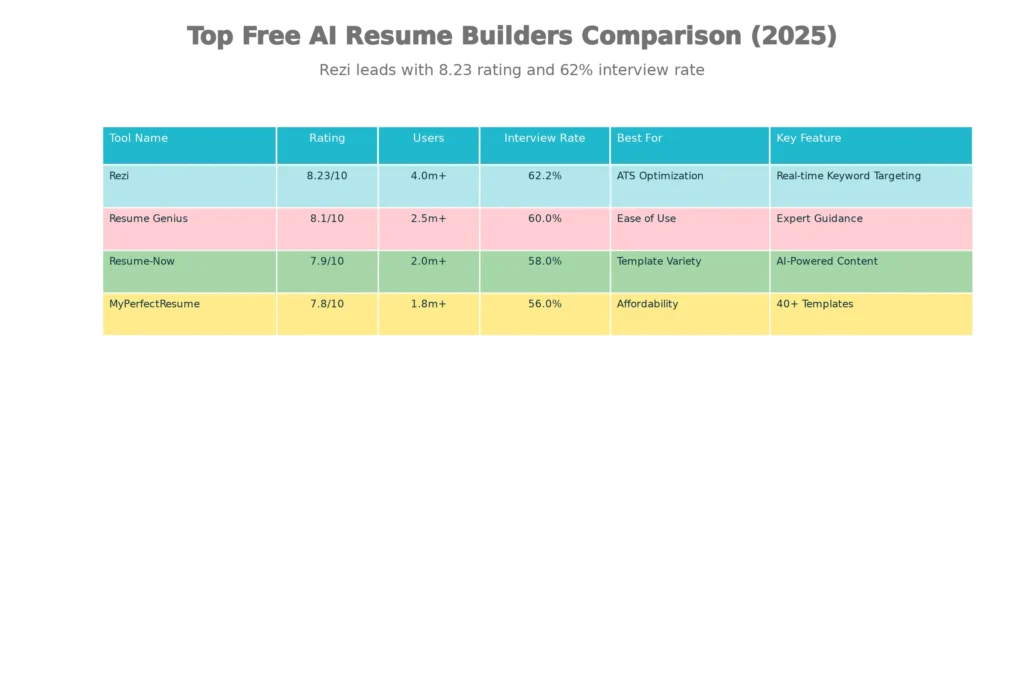
Rezi stands out as the highest-rated free AI resume builder, with 4.005 million users, an average user review of 8.23/10, and an interview rate of 62.18%. The platform excels at ATS optimization through its proprietary Rezi Score system that updates live as you write, providing specific feedback like “add 3 more skills” or “include quantifiable achievements.”
The standout feature is AI Keyword Targeting, which analyzes job descriptions to identify critical keywords and suggests where to naturally integrate them into your resume. The AI writer generates bullet points that maintain your existing tone while suggesting improvements. If you write “managed social media,” it might transform it to “increased social media engagement by 45% through strategic content planning and community management.”
Strengths:
- Exceptional ATS optimization with real-time scoring
- AI suggestions feel intelligent and context-aware
- 900+ resume examples across industries
- Free version includes core features
- Interview practice tool included
Weaknesses:
- Limited template customization beyond presets
- Some users report a steep learning curve
- Premium features at $29/month limit full functionality
Best For: Job seekers prioritizing ATS pass-through and who want quantifiable feedback on resume quality.
Resume Genius: Best for Ease of Use and Expert Guidance
Resume Genius has helped millions of users over the past decade and provides an exceptionally user-friendly interface combined with expert writing guides from seasoned career professionals and HR experts. The platform features detailed step-by-step guidance throughout the resume-building process.
The real-time feedback system transforms resume writing from guesswork to data-driven optimization. As you build your resume, the platform analyzes content quality, keyword usage, and formatting to provide an overall score with specific improvement suggestions. The AI writer integrates smoothly, generating content that matches your existing style rather than inserting obviously artificial text.
Strengths:
- Extremely beginner-friendly interface
- Comprehensive career guidance and resources
- Expert-written templates designed by HR professionals
- Real-time content analysis and suggestions
- Cover letter generator included
Weaknesses:
- Aggressive auto-renewal on premium subscriptions
- Fewer templates compared to larger competitors
- Basic AI features compared to Rezi
Best For: Career changers and first-time resume writers who need detailed guidance and don’t mind paying for premium features.
Resume-Now: Best for Template Variety and Speed
Resume-Now emphasizes speed and template diversity, allowing users to create a resume quickly using recruiter-approved templates that have been tested in real-world hiring scenarios. The platform boasts that its templates are proven to bypass HR screening software, getting your resume “into human hands.”
The free version includes step-by-step support with detailed tips and advice throughout the process, with customer support available. The AI-powered content suggestions are based on your previous roles, and each line has been refined by career experts for maximum impact. You can create unlimited resumes and experiment with multiple templates before deciding on premium downloads.
Strengths:
- Extensive template library with various styles (creative, simple, modern)
- Quick resume building process
- Unlimited free resumes in text format
- Matching cover letter builder
- Multiple file format downloads available
Weaknesses:
- Requires subscription for premium design templates
- Basic AI features compared to Rezi
- Less advanced ATS optimization feedback
Best For: Job seekers who want quick template-based solutions and need to create multiple resume versions for different positions.
MyPerfectResume: Best for Affordability and Comprehensive Support
MyPerfectResume offers 40+ ATS-friendly templates and pre-written content suggestions in a straightforward interface. The free tier provides access to step-by-step prompts, pro tips, expert content suggestions, and unlimited downloads in plain text format. For those upgrading to premium, a wider range of professional designs becomes available.
The platform emphasizes that all templates have been designed to be ATS-compatible, using standard formatting that applicant tracking systems can easily parse. Pre-written suggestions help you get started quickly, with content tailored to your industry and experience level.
Strengths:
- Most affordable premium option ($2.95 trial)
- 40+ carefully designed ATS-friendly templates
- Good for multiple resume versions
- Simple, intuitive interface
- Comprehensive free text download option
Weaknesses:
- Limited AI-powered customization
- Less advanced keyword optimization
- Fewer features compared to Rezi
- Basic design options in free version
Best For: Budget-conscious job seekers who need solid templates and prefer straightforward, no-frills resume building.
Key Hiring Manager Expectations: What Gets Callbacks in 2025
Understanding what actually gets callbacks requires knowing what hiring managers scan for in those critical 6-8 seconds. Modern hiring managers have shifted their expectations significantly from previous years.
Tailored, Role-Specific Content: Gone are the days of generic resumes. Hiring managers now expect a resume specifically customized to the role you’re applying for. This means adjusting your professional summary, key skills, and even bullet points to match the language and priorities of the job description. 55% of recruiters prefer tailored resumes, making customization a priority.
Quantifiable Achievements: Vague descriptions no longer work. Hiring managers want to see concrete metrics. Instead of “strong leadership skills,” write “Led a 6-member cross-functional team to successfully launch a product within a 3-month deadline, generating $150K in revenue within the first quarter.” This approach proves the skill in context, making it tangible and credible.
AI Literacy and Digital Fluency: An important 2025 trend reveals that AI literacy is becoming the most valuable line on a resume. Recruiters are increasingly hiring candidates who demonstrate comfort with AI platforms, whether automation software or generative assistants. This doesn’t mean every resume needs an “AI Skills” section, but candidates should highlight experience using relevant technology tools in their industry.
Clear Career Progression: Hiring managers want to see a coherent narrative about your career journey. While gaps and job switches aren’t automatic deal-breakers, they do raise questions. Hiring managers appreciate seeing how each position built on previous experience, showing intentional career development.
Scannable Format: With hiring managers reviewing resumes in seconds, visual formatting matters significantly. A resume scannable within 6-8 seconds requires clear structure, adequate white space, standard fonts, bullet points instead of paragraphs, and strategic use of bold text for important information.
Remote and Hybrid Work Experience: Post-pandemic, remote work competency is expected. Hiring managers now value candidates who can demonstrate effectiveness in remote or hybrid environments. If you have remote experience, highlight it explicitly.
Strategic Optimization Tactics: The Methods That Actually Work
Beyond simply using an AI tool, strategic implementation of resume optimization can dramatically improve outcomes.
The STAR Method for Bullet Points: Structure achievement statements using Situation-Task-Action-Result (STAR). This framework creates compelling evidence of your capabilities. Research shows this method is crucial for achieving high callback rates.
Resume Customization for Every Application: Rather than sending the same resume everywhere, invest time in customization. Tools like Rezi, Resume Genius, and ChatGPT make this faster than before. The 115% conversion rate improvement from customization justifies the extra 15-20 minutes per application.
Keyword Extraction from Job Descriptions: Use tools like Jobscan or ChatGPT to extract the top 20-30 keywords from any job posting. Then ensure these keywords appear naturally throughout your resume, especially in your summary and in the first three bullet points under each experience.
LinkedIn Integration: Including a LinkedIn profile link on your resume significantly boosts results. Resumes with a LinkedIn link saw a callback rate of 13.5%, compared to 7.9% for those without one. An optimized LinkedIn profile increases visibility exponentially: fully optimized LinkedIn profiles get 40x more opportunities than unoptimized ones, and job seekers with comprehensive LinkedIn profiles are 71% more likely to get a job interview.
A/B Testing Multiple Versions: Tools like Resumly use machine learning to rank multiple resume versions based on historical interview outcomes. This removes guesswork. Rather than guessing which version is best, you can test 2-3 variations and deploy the version with the highest predicted interview rate.
Metrics and Data Integration: Whenever possible, include hard numbers: revenue generated, percentages of improvement, time saved, customer satisfaction scores, or project completion rates. Research shows resumes with hard metrics have a 40% higher chance of earning an interview. Even if you don’t have exact figures, estimate conservatively: “reduced customer response time from 8 hours to 2 hours” or “increased team productivity by approximately 25% through process optimization.”
Common Mistakes People Make With AI Resume Builders
Despite powerful tools being available, many users make critical errors that undermine their effectiveness.
Over-Relying on AI Without Human Review: AI-generated content sometimes sounds awkward or doesn’t accurately reflect your experience. Always review AI suggestions and edit them to sound natural and authentic. Your resume should sound like you, just with professional language.
Keyword Stuffing Without Context: While keywords are important, forcing keywords awkwardly into sentences creates obviously artificial text that hiring managers and ATS systems both penalize. Keywords should integrate naturally into achievement statements.
Submitting Identical Resumes for Different Roles: A one-size-fits-all approach dramatically reduces callback rates. Even when targeting the same industry, different companies emphasize different skills. AI tools make customization fast enough that submitting tailored versions is now the baseline expectation.
Ignoring Formatting for ATS Compatibility: Some users customize resumes with creative fonts, colors, graphics, or unusual formatting for visual appeal. ATS systems struggle with anything beyond standard formatting. Use clean layouts, standard fonts (Lora, Roboto, or Calibri), and minimal color—black or dark gray text on white background.
Focusing Too Much on Responsibilities Instead of Achievements: Hiring managers want to know impact. Responsibilities are assumed with the job title. Achievements are what differentiate you from other candidates. Every bullet point should emphasize what you accomplished, not what you were supposed to do.
Not Including Enough Hard Metrics: Since only 8% of resumes use numerical data despite it providing 40% higher interview chances, this is a competitive advantage. Before submitting, ensure at least 50% of your achievement bullets include quantifiable metrics.
The Path Forward: Your 2025 Resume Strategy
The evidence is overwhelming: AI-assisted resumes work. 90% of hiring managers accept AI in applications, and candidates using AI tools receive significantly more interviews and higher salaries. The question is no longer whether to use AI, but how to use it strategically.
Your action plan: First, choose a tool matching your needs—Rezi for ATS optimization, Resume Genius for guidance, Resume-Now for speed, or MyPerfectResume for affordability. Second, input your complete work history and let the AI analyze it. Third, identify 10-15 keywords from your target job description and ensure they appear naturally throughout your resume. Fourth, customize for each application rather than using a generic version. Fifth, include your optimized LinkedIn link on the resume itself.
Most importantly, remember that AI is an amplifier, not a replacement for authenticity. Your genuine experience and achievements, enhanced through AI optimization, will outperform both generic human-written resumes and obviously artificial AI content. The tools work best when they clarify and highlight what’s already powerful about your background.
In a job market where 83% of job seekers using AI resumes received interviews while 82% reported receiving interview invitations, the competitive advantage of using these tools is real and measurable. Whether you’re changing careers, re-entering the workforce, or optimizing for a new role, an AI-assisted resume built with one of these free tools, customized with keywords, and supported by honest achievement statements gives you the best possible chance of getting your resume into human hands.
Read More:Excel Formulas: Don’t Learn Excel: How to Use AI to Write Complex Formulas Instantly.
Source: K2Think.in — India’s AI Reasoning Insight Platform.