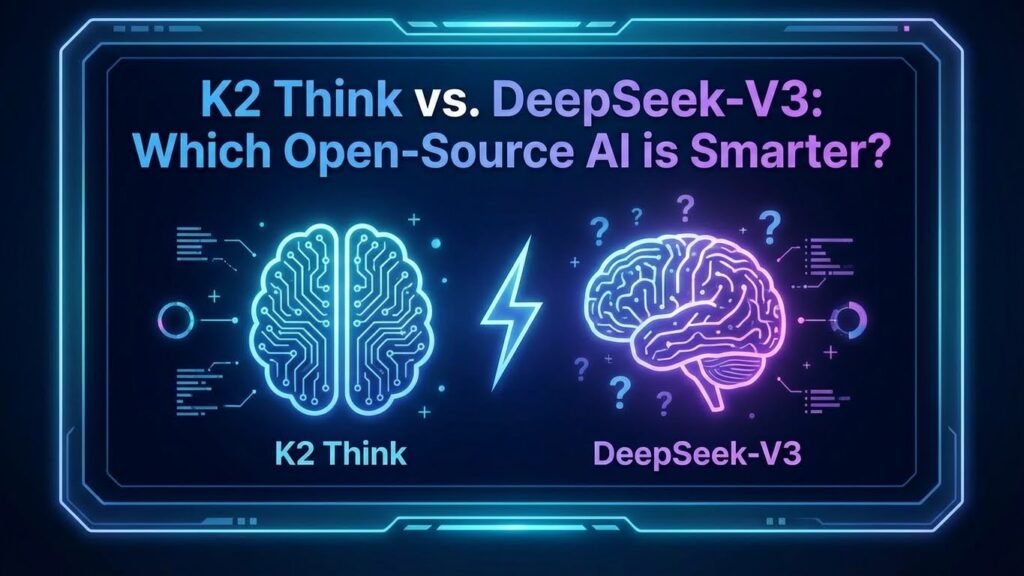
K2 Think stands as the parameter-efficient champion of open-source reasoning in 2025, delivering state-of-the-art mathematical performance with just 32 billion parameters—matching models over 20 times larger while running 6x faster. DeepSeek-V3, with 671 billion parameters (37 billion active), excels in general-purpose coding and long-context reasoning but trails K2 Think on pure mathematical competition benchmarks. The choice between them depends on your specific priorities: unmatched parameter efficiency and speed for K2 Think, or versatile general-purpose capability for DeepSeek-V3.
Understanding the Reasoning Revolution of 2025
The artificial intelligence landscape transformed dramatically in September 2025 when Mohamed bin Zayed University of Artificial Intelligence (MBZUAI) and G42 released K2 Think, a 32-billion parameter reasoning system that fundamentally challenged conventional wisdom about AI model scaling. For years, the industry operated under a simple assumption: larger models perform better. DeepSeek-V3’s 671-billion parameter architecture seemed to validate this approach, and many assumed bigger was always smarter. K2 Think proved this wrong.
Both models represent the cutting edge of open-source AI reasoning, yet they embody completely different philosophical approaches to building intelligent systems. K2 Think prioritizes parameter efficiency through advanced training techniques, while DeepSeek-V3 pursues capability scaling through architectural innovation. Understanding which model suits your needs requires examining their specific strengths, weaknesses, and real-world performance metrics.
K2 Think: The Parameter-Efficient Reasoning Champion
Architecture and Core Design Philosophy
K2 Think builds upon the Qwen2.5-32B foundation, making it the most compact reasoning system in the current era. What makes this compact model extraordinary isn’t its size—it’s the sophisticated post-training recipe that transforms a relatively modest architecture into a mathematical reasoning powerhouse. The model combines six core technical pillars: long chain-of-thought supervised fine-tuning, reinforcement learning with verifiable rewards (RLVR), agentic planning before reasoning, test-time scaling, speculative decoding, and inference-optimized hardware deployment.
The supervised fine-tuning phase is particularly elegant. Unlike traditional fine-tuning that treats all tasks equally, K2 Think learns on curated chain-of-thought traces where each reasoning step follows a verified path to the correct answer. This teaches the model not just what to think, but how to think through complex problems step-by-step. The process shows rapid improvement in the first 0.5 epoch on mathematical benchmarks like AIME 2024 and AIME 2025, then plateaus—indicating that the model quickly absorbs the core reasoning patterns.
Mathematical Reasoning Performance: Where K2 Think Dominates
The benchmark results are striking. K2 Think achieves a 67.99% micro-average score across all mathematical competition tasks, surpassing DeepSeek-V3.1’s 64.43% despite being 20 times smaller. Breaking down the specific results:
- AIME 2024: 90.83% (compared to 88.4% for DeepSeek-V3.1)
- AIME 2025: 81.24% (compared to 81.8% for DeepSeek-V3.1)
- HMMT25: 73.75% (Harvard-MIT Mathematics Tournament)
- Omni-MATH-HARD: 60.73% (the most difficult questions from competitive mathematics)
These aren’t marginal improvements—K2 Think outperforms much larger models specifically on the hardest mathematical problems. The AIME 2024 result of 90.83% means the model correctly solves 9 out of 10 problems from one of the world’s most challenging mathematics competitions. For context, even many professional mathematicians would struggle to achieve this score.
The secret lies in the reinforcement learning approach. K2 Think uses verifiable rewards, where the model receives clear feedback for mathematics problems: either the answer is correct or it isn’t. This differs fundamentally from subjective feedback. The model learns to optimize for correctness, not for sounding confident or producing lengthy explanations. This efficiency in learning represents a breakthrough in training methodology.
Inference Speed: The Real-World Game Changer
Raw benchmark scores tell only part of the story. The true competitive advantage emerges in practical deployment. K2 Think runs at 2,000 tokens per second on Cerebras Wafer-Scale Engine infrastructure, delivering a full 32,000-token response in approximately 16 seconds. This speed isn’t theoretical—it’s delivered through hardware-optimized inference using speculative decoding, a technique that predicts future tokens while computing current ones, effectively reducing latency.
Compare this to typical cloud deployments: a standard setup for K2 Think achieves approximately 200 tokens per second, delivering the same 32,000-token response in 160 seconds. For real-time applications like tutoring systems, code assistants, and research copilots, this 10x difference between consumer deployment and cutting-edge infrastructure matters significantly.
DeepSeek-V3.1, deployed on NVIDIA infrastructure, achieves respectable speeds but cannot match K2 Think’s optimization for its specific parameter efficiency. The larger model requires more computational resources per inference token, making it costlier to operate at scale.
Code and Science: Respectable But Not Dominant
K2 Think doesn’t dominate every category. On coding tasks (LiveCodeBench), it scores 64.0%, respectable but not exceptional. On science reasoning (physics and biology), it achieves 71.1%, solid performance but trailing pure scientific specialists. The model was explicitly optimized for mathematics, and this specialization shows: it competes poorly with models that received equal training emphasis on diverse domains.
For pure code generation and debugging across multiple programming languages, DeepSeek-V3.1 shows more balanced strength. This isn’t a weakness of K2 Think as much as evidence that the development team made conscious trade-offs: maximize mathematics performance rather than chase mediocre competence across all domains.
DeepSeek-V3: The Versatile Scaling Champion
Architectural Innovation: Mixture of Experts at Scale
DeepSeek-V3’s 671-billion total parameters activate only 37 billion per token through a sophisticated Mixture-of-Experts (MoE) architecture. The model features 256 routed experts per layer, with only 2 selected per token, plus 3 fully-activated layers that process all tokens through all experts. This sparse activation means the model achieves massive capacity while keeping actual computational cost reasonable—remarkable engineering given that training consumed only 2.788 million H800 GPU hours.
The MoE architecture includes innovation in load balancing. Rather than using auxiliary loss functions that compromise performance, DeepSeek-V3 employs dynamic bias adjustment to ensure experts receive balanced training data loads without accuracy degradation. This technical choice eliminated a common limitation where auxiliary loss hurts model quality.
Additionally, DeepSeek-V3 pioneers Multi-Token Prediction (MTP) as a training objective, where the model learns to predict multiple future tokens simultaneously rather than just the next token. This increases sample efficiency—the model needs fewer training examples to reach the same performance level.
Real-World Versatility and Tool Integration
DeepSeek-V3.1 (the improved 2025 variant) demonstrates superior versatility in practical applications. On BrowseComp, where models must navigate real websites and extract answers, V3.1 achieves 30% accuracy while R1 reaches only 9%. This gap widens dramatically when evaluated in Chinese: V3.1 reaches 49% versus R1’s 36%.
For retrieval-augmented generation tasks, DeepSeek-V3.1 consistently outperforms R1-based alternatives. On xbench-DeepSearch (cross-source synthesis from multiple documents), V3.1 reaches 71% accuracy versus 55% for R1. This means DeepSeek-V3.1 handles complex workflows involving web search, document retrieval, and multi-step planning more effectively than pure mathematics-optimized alternatives.
The model demonstrates similar strength on the GPQA Diamond benchmark (80.1%), a graduate-level exam spanning science, engineering, and humanities. K2 Think shows less balanced performance across such diverse domains.
Mathematical Performance: Strong But Not Dominant
On AIME 2025, DeepSeek-V3.1 achieves 88.4% accuracy while using approximately 30% fewer tokens than necessary. This efficiency is remarkable—the model generates shorter reasoning chains that reach correct answers, suggesting more direct logical paths compared to more verbose alternatives.
However, DeepSeek-V3.1 falls slightly behind K2 Think on pure competition mathematics (64.43% micro-average versus 67.99% for K2 Think). The gap narrows on some benchmarks and widens on others, but the pattern is consistent: K2 Think optimized more aggressively for mathematical competition problems.
Cost and Deployment: The Infrastructure Barrier
DeepSeek-V3.2 (the latest 2025 iteration) achieves remarkable cost-effectiveness at $0.28 per million input tokens and $0.48 per million output tokens. These prices represent massive reductions from proprietary models. However, running DeepSeek-V3.1 at scale still requires more computational resources than K2 Think due to higher parameter counts and active token usage.
A 2025 cost-benefit analysis reveals that organizations with very high token volumes (≥50 million tokens monthly) benefit from on-premise DeepSeek deployment, while smaller operations often find API-based K2 Think more economical. The mathematics favors K2 Think for most use cases: less infrastructure, faster inference, lower operational overhead.
Direct Comparison: The Hard Numbers
| Metric | K2 Think | DeepSeek-V3.1 |
|---|---|---|
| Total Parameters | 32B | 671B |
| Active Parameters | 32B per token | 37B per token |
| AIME 2024 Score | 90.83% | 88.4% |
| AIME 2025 Score | 81.24% | 81.8% |
| Math Micro-Average | 67.99% | 64.43% |
| LiveCodeBench (Code) | 64.0% | Higher (exact varies) |
| Inference Speed (Cloud) | ~200 tokens/sec | ~100-150 tokens/sec |
| Training Cost | Not publicly disclosed | 2.788M H800 hours |
| Best Suited For | Mathematics, fast inference | General-purpose, tool use |
Real-World Use Cases: Where Each Model Excels
K2 Think Dominates In:
Math Tutoring and Competition Preparation: With 90.83% on AIME 2024, K2 Think serves as an exceptional tool for students preparing for mathematics competitions. The model provides step-by-step reasoning that matches how human mathematicians think through problems.
Research Mathematics Assistance: Mathematicians and researchers working on proofs benefit from K2 Think’s chain-of-thought transparency. The model generates explicit reasoning paths, making it useful for exploring approaches to difficult problems.
Cost-Constrained Deployments: Startups and smaller organizations with bandwidth constraints gain significant value. Operating K2 Think requires 5-10% of the infrastructure needed for DeepSeek-V3, yet delivers superior mathematical performance.
Real-Time AI Applications: The 2,000 tokens/second throughput on Cerebras infrastructure enables live tutoring, interactive math problem solvers, and responsive AI assistants—applications where latency matters.
DeepSeek-V3.1 Dominates In:
General-Purpose Chatbots and Assistants: When organizations need one model handling customer support, creative writing, coding, research synthesis, and math equally well, DeepSeek-V3.1 provides better balanced capability.
Web-Based Research Agents: The superior browsing and document retrieval performance (30% on BrowseComp vs 9% for R1) makes DeepSeek-V3.1 ideal for autonomous research systems, market analysis tools, and information gathering agents.
Multi-Language Production Systems: DeepSeek-V3.1 demonstrates exceptional multilingual capability, particularly in Chinese, making it essential for organizations serving non-English speaking populations.
Long-Context Document Analysis: With 128,000-token context window support and optimized inference, DeepSeek-V3.1 handles analysis of research papers, legal documents, and technical specifications without context fragmentation.
Software Engineering Assistance: While K2 Think’s code performance is respectable, DeepSeek-V3.1 shows superior coding ability across diverse programming languages and frameworks.
The Training Philosophy Difference
The fundamental divergence between these models reflects distinct answers to a central question: Should we optimize for universal capability or specialized excellence?
K2 Think embraces specialization. The training focused heavily on mathematical reasoning using verifiable rewards—the model knows when its answers are right or wrong because mathematics has unambiguous correctness criteria. This laser-focused optimization produced extraordinary results in mathematics while accepting lower performance in other domains.
DeepSeek-V3 embraces generalization. The training incorporated diverse datasets spanning mathematics, code, science, and general knowledge, using both verifiable rewards (where available) and self-critique rewards (for subjective tasks). This broader approach produced a more balanced model, stronger overall but less exceptional in any single domain.
The Mathematics Test: Examining Real Benchmark Problems
To understand the performance difference concretely, consider AIME problem types. Algebraic manipulation problems like recursive sequences require careful symbolic reasoning—exactly what K2 Think’s training optimizes for. The model learns to construct step-by-step solutions where each step demonstrably moves toward the solution.
Combinatorics problems involving counting and probability similarly benefit from K2 Think’s reasoning optimization. These problems demand structured logical thinking, which the supervised fine-tuning on verified solution paths cultivates explicitly.
For geometry problems requiring spatial reasoning and visualization, both models show reasonable performance, though K2 Think’s pure mathematical focus provides slight advantage.
The AIME 2024 benchmark specifically shows that K2 Think reaches 90.83%—meaning it correctly solves roughly 91 of 100 problems across multiple years and versions. DeepSeek-V3.1 at 88.4% means missing approximately 12 problems instead of 9—a meaningful difference on a competitive exam.
However, the real story emerges when examining Omni-MATH-HARD (Olympiad-level problems). K2 Think scores 60.73%, while most other open-source models score below 50%. This indicates the model genuinely understands advanced mathematics rather than memorizing patterns.
Inference Optimization: How K2 Think Achieves Speed
Understanding K2 Think’s 2,000 tokens-per-second performance requires examining its inference techniques. Speculative decoding predicts multiple future tokens while computing the current token, effectively amortizing compute costs across several token positions. For a 32,000-token response, this technique dramatically reduces wall-clock time.
The Cerebras Wafer-Scale Engine deployment optimizes at the hardware level. Rather than distributing computation across GPU clusters (which introduces network latency), Cerebras uses a single massive processor with extraordinary memory bandwidth, eliminating communication bottlenecks that plague distributed inference.
DeepSeek-V3, even with excellent engineering, cannot match this specialized inference optimization. The larger model requires more computational resources per token, and distributed GPU inference introduces latency that monolithic processors avoid.
2025 Landscape: Emerging Context and Implications
The 2025 AI landscape shows clear patterns: parameter efficiency increasingly matters more than raw parameter count. K2 Think exemplifies this shift. Where 2023-2024 favored scaling (“bigger always better”), 2025 favors engineering and training quality (“smarter engineering beats bigger parameters”).
Microsoft’s Phi-3-mini demonstrates this principle across domains: a 3.8-billion parameter model from 2024 reached performance thresholds that required 540-billion parameters in 2022. This 142-fold reduction happened through training innovation, not luck.
K2 Think continues this trajectory. A 32-billion parameter model competing with 671-billion parameter alternatives proves that architecture, training methodology, and inference optimization matter at least as much as parameter count.
Cost-Effectiveness Analysis for Organizations
For organizations evaluating which model to deploy, the decision matrix depends on usage patterns:
If your organization processes <5 million tokens monthly: K2 Think’s faster inference and lower per-token latency favor local deployment, making the model economically superior.
If your organization requires multilingual support or code-heavy workloads: DeepSeek-V3.1’s balanced capability justifies the higher infrastructure cost.
If your organization optimizes for API cost: Both models are open-source and deployable locally, but K2 Think’s parameter efficiency makes local hosting more practical.
If your organization builds mathematics-specific applications: K2 Think’s 90.83% AIME performance makes it the obvious choice despite broader capability gaps.
The Parameter Efficiency Breakthrough
K2 Think’s success represents a fundamental shift in AI development philosophy. For years, researchers assumed that capability emerged primarily from parameter count. K2 Think proves that six key technical pillars—long chain-of-thought training, RL with verifiable rewards, agentic planning, test-time scaling, speculative decoding, and hardware optimization—can rival and surpass brute-force scaling.
This breakthrough has immediate practical implications: developers can deploy K2 Think on a single GPU machine where DeepSeek-V3 requires GPU clusters. Organizations can use K2 Think in bandwidth-constrained environments impossible for larger models. Educational institutions can run K2 Think on modest servers while benefiting from frontier-level mathematical reasoning.
The broader implication: AI systems in 2025 increasingly optimize for efficiency and specialization rather than universal capability. This shift democratizes AI—the cutting-edge reasoning now runs on hardware accessible to smaller organizations, researchers, and educational institutions.
Conclusion: Choosing the Right Model for Your Needs
K2 Think wins decisively on parameter efficiency, inference speed, and mathematical competition benchmarks. If your priority is deploying powerful reasoning with minimal infrastructure, K2 Think is unambiguously superior.
DeepSeek-V3.1 wins on versatility, multilingual capability, and balanced general-purpose performance. If your organization needs one model handling diverse tasks from customer support to research assistance to coding, DeepSeek-V3.1’s broader excellence justifies accepting higher computational costs.
The remarkable fact is that both models are open-source, freely available, and represent humanity’s collective progress in AI reasoning. The competition between them drives innovation forward. Organizations benefit from having multiple options optimized for different purposes—specialization (K2 Think) and versatility (DeepSeek-V3.1) are complementary approaches, not competitors.
As AI moves from research laboratories into production deployments, K2 Think and DeepSeek-V3.1 represent the frontier of what open-source systems can achieve. K2 Think proves that parameter efficiency can match parameter scaling. DeepSeek-V3.1 proves that open-source can match proprietary capability across diverse tasks. Together, they validate the 2025 thesis that the future of AI belongs to open systems, efficient engineering, and specialized optimization rather than unlimited scaling.
Read More:Top 10 K2-Think Prompts for Complex Problem Solving
Source: K2Think.in — India’s AI Reasoning Insight Platform.