In today’s AI-driven educational landscape, 88% of students are now using ChatGPT for their academic work, with many leveraging it specifically for exam preparation and study planning. The question isn’t whether to use AI in your study routine anymore—it’s how to use it effectively. This comprehensive guide reveals the science-backed strategies for creating an optimal study schedule using ChatGPT, combining artificial intelligence with proven learning techniques that can increase your exam performance by up to 20% or even two full letter grades.
Why Traditional Study Schedules Fail—And How ChatGPT Changes Everything
Most students approach exam preparation with outdated methods that promise productivity but deliver disappointment. They create vague study plans, cram the night before exams, and wonder why they can’t retain information. The problem? Traditional schedules ignore three critical factors: individual learning pace, knowledge gaps, and real-time adaptation.
ChatGPT solves this differently. According to recent research from 2025, ChatGPT integration can explain approximately 88.54% of the variability in personalized learning outcomes. This means that when you use ChatGPT to design your study schedule, the AI doesn’t just create a generic timetable—it creates a customized learning pathway that evolves based on your input.
The science backs this up. A meta-analysis of 51 research studies published between November 2022 and February 2025 found that ChatGPT has a large positive impact on improving learning performance (effect size = 0.867), making it statistically significant compared to traditional study methods. This isn’t marketing hype; this is peer-reviewed evidence from the journal Nature.
Understanding the Foundation: Why Study Schedules Matter
Before diving into ChatGPT prompts, you need to understand what makes a study schedule effective. Research consistently shows that students using structured study schedules with proper time management reduce procrastination, boost productivity by recognizing what needs studying, and minimize exam-related stress.
Here’s the reality: Without a schedule, your brain experiences decision fatigue—the mental exhaustion that comes from making too many choices. When you sit down to study without a plan, you waste 15–30 minutes deciding what to study, which often triggers procrastination. A well-designed schedule eliminates this problem completely.
The traditional guideline suggests 2–3 hours of study time outside class for every hour spent in class. However, this varies based on subject difficulty, exam complexity, and your personal learning speed. This is precisely where ChatGPT excels—it personalizes this ratio for your situation rather than following a one-size-fits-all approach.
Step 1: Preparing Your ChatGPT Prompts for Schedule Creation
ChatGPT’s effectiveness depends entirely on the quality of your prompts. Vague instructions yield vague results. Specific, structured prompts yield precise, actionable study plans.
What You Need to Provide ChatGPT:
- Subjects and Topics: List all subjects you’re studying with specific exam weights. For example, if you’re taking exams in Math, English, Science, and History, specify if Math counts for 40% of your final grade and History for 20%.
- Available Time: Honestly assess your daily availability. Include commitments like classes, work, sports, and other obligations. Morning person or night owl? ChatGPT needs this information.
- Learning Preferences: Do you prefer longer study sessions (2–3 hours) or shorter bursts (45–60 minutes)? Are you visual, auditory, or kinesthetic? This matters for retention.
- Known Weaknesses: Identify subjects that challenge you. ChatGPT will allocate more time to these areas based on difficulty ratings.
- Exam Date and Duration: When is your exam? How long does it last? This determines sprint intensity and timing.
The Power Prompt for Complete Study Schedule Creation
Here’s a battle-tested prompt structure that thousands of students have used successfully in 2025:
textAct as an experienced educator specializing in exam preparation. I need
help creating a personalized study schedule for my upcoming exams.

My Details:
- Subjects: [List your subjects]
- Exam Date: [Your exam date]
- Available Study Time: [Daily hours, days per week]
- Weak Subjects: [Which subjects are challenging?]
- Study Preference: [Pomodoro (25 min work/5 min break), Flowtime (continuous focus), or Self-regulated]
- Learning Style: [Visual/Auditory/Kinesthetic/Mixed]

Please create:
1. A week-by-week study timeline
2. Daily time-blocks with specific topics
3. Revision schedule using spaced repetition
4. Mock test dates with feedback sessions
5. Break timing that prevents burnout
6. A risk list of weak areas with escalation strategies

Format the output as a detailed table I can import into Google Calendar.
Why This Works: This prompt structure includes all variables ChatGPT needs to create a truly personalized plan. It specifies the format (table), methodology (spaced repetition), and contingency planning (risk list). You’re not just asking ChatGPT to “create a study plan”—you’re providing the framework for excellence.
Step 2: The Science Behind Effective Study Schedules
To appreciate why ChatGPT-generated schedules outperform traditional ones, you need to understand the learning science embedded in them.
Spaced Repetition: The Forgotten Curve Killer
Hermann Ebbinghaus’s Forgetting Curve proves that you lose information rapidly after learning it. Within 24 hours, you forget approximately 50–60% of new information if you don’t review it. However, spaced repetition reverses this dramatically.
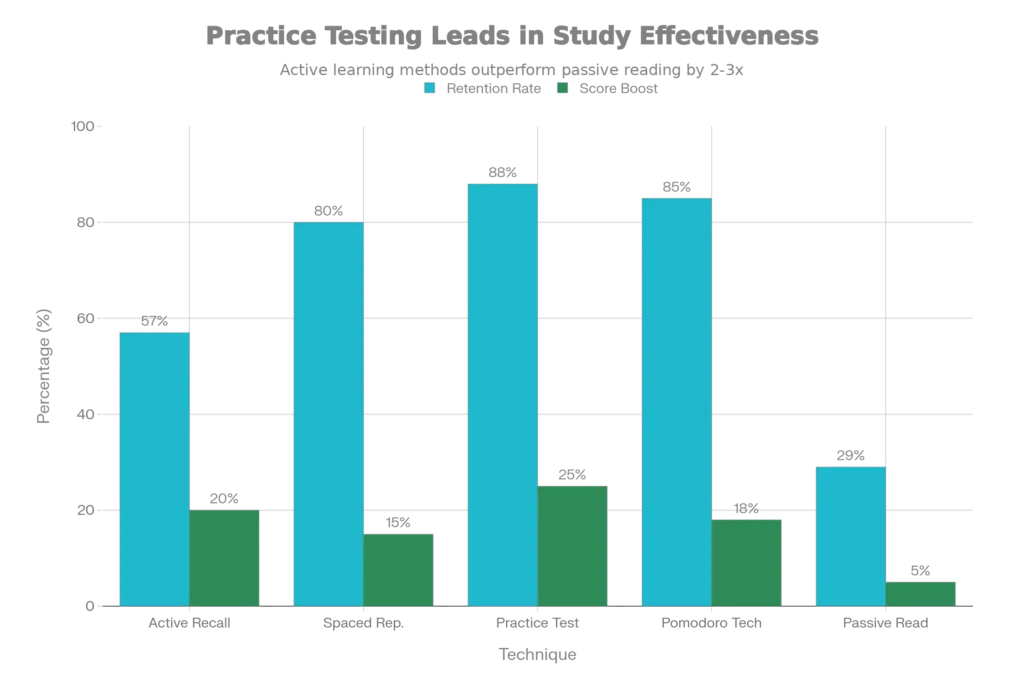
Research published in Journal of Experimental Psychology shows that students using spaced repetition achieved average recall accuracy of 80%, compared to 60% for those who crammed everything in one study session. Medical students who implemented spaced repetition achieved 88% average test scores, a significant improvement from 78% for those without this method.
ChatGPT builds spaced repetition directly into your schedule. It automatically schedules reviews at optimal intervals:
- First review: 1 day after initial learning
- Second review: 3 days later
- Third review: 1 week later
- Fourth review: 2 weeks later
- Final review: 1 week before exam
This isn’t random—it’s based on cognitive psychology research showing that expanding intervals work best because each review requires more mental effort, forcing deeper processing.
Active Recall: The Proven Memory Amplifier
Passive reading (highlighting, re-reading notes) results in only 29% retention. In contrast, active recall—forcing your brain to retrieve information from memory—achieves 57% retention, nearly double the effectiveness.
Active recall includes:
- Creating flashcards and testing yourself
- Explaining concepts aloud
- Writing from memory without notes
- Taking practice tests
- Teaching the material to someone else
ChatGPT excels at generating active recall questions. You can ask it to create:
- 50 practice questions on a specific topic
- Mock exams in your exam’s exact format
- Concept-checking questions with delayed feedback (which is more effective than immediate feedback)
- Transfer questions applying concepts to new scenarios
The Pomodoro Technique: Break Psychology Done Right
Burnout destroys exam performance. Yet many students study for 4–5 hours straight without breaks, expecting focus to remain constant. It won’t.
Recent 2025 research on Pomodoro Technique effectiveness found that structured intervals (24 minutes work/6 minutes break or 12 minutes work/3 minutes break) resulted in approximately 20% lower fatigue, 0.5-point improvement in distractibility, and 0.4-point increase in motivation compared to self-paced break schedules. More impressively, 88% of Pomodoro studies showed positive outcomes, with perceived learning efficiency improving by approximately 12%.
ChatGPT integrates Pomodoro breaks into your schedule strategically:
- Places breaks after high-difficulty topics (which cause mental fatigue faster)
- Suggests specific break activities: walking (10 minutes), stretching (5 minutes), hydrating (3 minutes)
- Prevents back-to-back study blocks that damage long-term retention
- Includes longer breaks (30–60 minutes) after 2–3 cycles for meal and mental recovery
Step 3: Building Your ChatGPT-Generated Schedule—The Complete Workflow
Phase 1: Topic Analysis and Weighted Prioritization
Your first ChatGPT interaction should break down exactly what you need to learn. Use this prompt:
textList all exam topics and learning objectives for [your course/exam].
For each topic:
1. Show its exam weight (percentage of final grade)
2. Estimate difficulty level (Easy/Moderate/Hard)
3. List prerequisite knowledge needed
4. Identify any overlap with other subjects

Create a priority matrix ranking topics by weight × difficulty.
Topics high on both should get earliest and most intensive study time.
This creates a risk list—identifying that if you master the hard, high-weight topics first, you minimize exam risk. Many students study what’s easiest first, leaving difficult material for last-minute cramming. ChatGPT reverses this through data-driven prioritization.
Phase 2: Capacity Planning and Realistic Time Allocation
Here’s where many schedules fail: they’re unrealistic. If you promise yourself 6 hours of daily study but only manage 3, guilt and discouragement set in.
Ask ChatGPT:
textBased on my available study time of [X hours daily, Y days weekly], and
my [course type: high-level/undergraduate/graduate/certification],
estimate realistic daily study capacity.

Factor in:
- Mental fatigue (harder subjects tire you faster)
- Diminishing returns (studying the same topic for 4+ hours reduces retention)
- Existing commitments and sleep needs
- Optimal focus windows (most people focus best for 45-90 minutes before attention drops)

Create a conservative capacity estimate I can actually sustain,
plus an ambitious estimate for high-motivation days.
Research shows unrealistic schedules fail within a week. ChatGPT’s capacity planning makes your schedule sustainable and actually achievable.
Phase 3: Week-by-Week Sprint Planning
The most effective exam schedules divide the preparation period into manageable sprints. ChatGPT can structure a 14-day pre-exam sprint differently than a 6-week preparation:
textCreate a [X-week/day] sprint plan for my exam on [date].

Week 1-2 (Foundation): Deep learning of core concepts
Week 3-4 (Integration): Connecting topics, problem-solving practice
Week 5-6 (Mastery): Practice tests, remediation of weak areas
Final Week (Polish): Speed drills, confidence building

For each week, provide:
- Topic sequence (what to study in order)
- Time allocation (hours per topic)
- Daily templates with warm-ups and summaries
- Weekly review metrics
- Adjustment checkpoints
This structure aligns with cognitive science. Early weeks build knowledge foundations. Middle weeks integrate complex ideas. Final weeks build speed and confidence under pressure.
Phase 4: Daily Schedule Structure with Time-Blocking
Generic advice says “study,” but effective schedules specify what and when. Ask ChatGPT:
textCreate a detailed daily template for my study schedule. I study best
from [time] to [time] and have [X hours available].

For each daily study block, structure:
1. Warm-up (2 min): Review learning outcomes from yesterday
2. Deep Work Block 1 (45-60 min): Focused learning of new concept
3. Active Break (5-10 min): Walking, stretching, water
4. Active Recall Block (30-45 min): Practice questions on today's material
5. Review Break (10 min): Light movement
6. Interleaved Practice (30-45 min): Mix problems from multiple topics
7. Daily Debrief (5-10 min): Write 3 things learned, 2 confusing areas, 1 question for tomorrow

Make it specific with actual topics and time blocks, not generic hours.
This template uses interleaving (mixing topics instead of studying one subject for hours), which research proves prevents “false fluency”—the illusion that you understand material just because it looks familiar.
Step 4: Implementing Active Recall Within Your Schedule
Your ChatGPT schedule should dedicate specific time blocks to active recall, the single most effective study technique.
Types of Active Recall ChatGPT Can Generate
1. Flashcard Generation
Ask ChatGPT to create Anki-format flashcards or Quizlet-compatible cards with:
- Front side: Definition or question
- Back side: Detailed answer with context
- Tags: Subject, difficulty, topic cluster
Research shows flashcard users achieved higher GPAs and test scores compared to other study methods.
2. Practice Test Generation
Request ChatGPT generate full practice exams matching your actual exam format:
- Same number of questions
- Same time constraints
- Same difficulty distribution
- Detailed answer keys with explanations
Studies confirm that practice testing improves exam performance by 20–25%—literally jumping you two full letter grades.
3. Concept Mapping Prompts
Ask ChatGPT: “Create a concept map connecting [Topic A] to [Topic B] to [Topic C]. Show how concepts build on each other and where they overlap.”
Research finds that concept mapping is underutilized but particularly effective for boosting student confidence.
4. Explanation Challenges
Request ChatGPT generate prompts forcing you to explain:
- “Teach me [concept] as if I’m a 10-year-old”
- “Explain [topic] using only everyday examples”
- “How would you use [concept] in real life?”
This forces deep processing instead of surface-level recognition.
The Perfect Active Recall Schedule
ChatGPT should structure your active recall timing scientifically:
- Immediate recall (0–1 hours after learning): Tests whether information entered working memory
- Delayed recall (12–24 hours later): Checks if memory consolidated
- Spaced recall (3, 7, 14 days later): Strengthens long-term retention
- Transfer recall (1 week before exam): Applies concepts to novel scenarios
This sequence prevents two study failures: spacing effect (studying too close together doesn’t strengthen memory) and illusion of competence (material feels familiar without real retention).
Step 5: Real-Time Adaptation and Mid-Sprint Adjustments
The magic of ChatGPT-based schedules is their adaptability. Unlike static study plans, ChatGPT can continuously adjust based on your progress.
Weekly Check-In Prompts
Every Sunday, use this prompt:
textI've completed Week 1 of my study plan. Here's my progress:
- Topics mastered: [list them]
- Topics still confusing: [list them]
- Actual study time achieved: [X hours, vs. Y planned]
- Energy levels: [description]
- What worked well: [describe]
- What didn't work: [describe]

Based on this data, adjust my remaining schedule.
If I didn't master [topic], add 2 extra review sessions.
If [topic] was easy, move to next topic faster.
If I'm behind on time, help me catch up without burnout.
Research shows that students who review their progress regularly and adjust their schedules accordingly significantly outperform those using static plans.
Performance-Based Difficulty Adjustment
ChatGPT can adjust question difficulty based on your performance:
textOn yesterday's practice test, I scored:
- Topic A: 95% (mastered)
- Topic B: 60% (struggling)
- Topic C: 75% (developing)

Regenerate today's practice questions: Remove easy questions on A,
focus heavily on B with progressively harder questions,
and maintain moderate-to-hard questions for C.
This is adaptive learning in action—a technique showing moderate to large positive effects on student achievement.
Step 6: Three Proven ChatGPT Prompts for Exam Week
In exam week, your schedule shifts from learning to refinement and confidence-building.
Prompt 1: Rapid Review Deck Creation
textCreate a 30-question rapid-review deck covering the 30 highest-impact
items from my entire course. Order by:
1. Highest exam weight
2. Highest error rate in my practice tests
3. Most likely to appear in multiple question formats

Include: Question, answer, and why this matters for the exam.
Format for 10-minute review sessions (3 questions per minute).
This focuses your limited pre-exam time on maximum-impact studying.
Prompt 2: Stress-Reduction Strategy
textGenerate a pre-exam ritual for the morning of my test:
- 5-minute calm-start script I can read aloud
- 3 breathing exercises with specific timing
- 2 confidence reminders based on my actual performance data
- 1 mental visualization of success

Also create a post-exam debrief template for analyzing what
worked and what to improve for future exams.
Research confirms that exam anxiety significantly reduces performance. ChatGPT-generated stress management tools provide evidence-based psychological support.
Prompt 3: Last-Minute Remediation
textMy practice test scores show I'm weak on [specific topics].
With only [X days] remaining:

1. Identify the 3 core concepts underlying my weakness
2. Create simplified explanations (I find [style] most helpful)
3. Generate 10 focused practice questions at increasing difficulty
4. Suggest 1 study partner activity or video resource
5. Estimate realistic improvement: What score can I achieve
   if I focus 2 hours daily on this topic?
This prevents last-minute panic by providing targeted, solvable remediation.
The Data: Why ChatGPT Schedules Work Better
Let me give you the numbers from current research:
- 88% of students now use ChatGPT for assessments, up from 53% the previous year
- Students using AI-based exam preparation tools report significant positive effects on their performance, with approximately 3.8 ratings (on a 5-point scale) for efficiency improvements, with T-statistic of 17.91 (p < 0.00001)
- ChatGPT has a large positive impact on learning performance (g = 0.867), exceeding typical educational interventions
- ChatGPT integration explains 88.54% of the variability in personalized learning outcomes
- 81% of students use ChatGPT for planning their studies
- Active recall methods like practice tests boost scores by up to 20%, equivalent to jumping two letter grades
- Spaced repetition achieves 80% recall accuracy vs. 60% for cramming
- Pomodoro technique reduces fatigue by 20% and improves motivation by 0.4 points on standard scales
The research is conclusive: ChatGPT-generated, scientifically-designed study schedules significantly outperform traditional approaches.
Common Mistakes—And How ChatGPT Prevents Them
Mistake 1: Unrealistic Schedules
The Problem: Creating plans requiring 6 hours daily when you only manage 3 hours leads to guilt and abandonment.
The ChatGPT Solution: Include capacity-planning prompts that estimate realistic hours based on your actual history, not aspirational goals.
Mistake 2: Passive Study Methods
The Problem: Re-reading notes feels productive but achieves only 29% retention.
The ChatGPT Solution: Structure every study block with active recall: question generation, practice tests, and concept retrieval.
Mistake 3: Ignoring Weak Subjects
The Problem: Studying easy topics feels good but leaves knowledge gaps in high-risk areas.
The ChatGPT Solution: ChatGPT’s prioritization matrix ensures difficult, high-weight topics get earliest and most intensive focus.
Mistake 4: No Spaced Repetition
The Problem: Studying a topic once and moving on means forgetting 50% within 24 hours.
The ChatGPT Solution: ChatGPT builds automatic spaced repetition into your schedule at optimal intervals.
Mistake 5: Ignoring Interleaving
The Problem: Studying one topic for 3 hours straight creates false fluency—you think you know it because it’s familiar.
The ChatGPT Solution: ChatGPT structures each study block to mix topics, forcing your brain to distinguish between concepts.
Creating Your First ChatGPT Study Schedule—The 15-Minute Process
Don’t overthink this. Here’s the actual workflow:
Step 1 (3 minutes): Copy the power prompt from Section 2 and fill in your specific details.
Step 2 (2 minutes): Paste into ChatGPT and hit enter.
Step 3 (5 minutes): Review the output. Ask ChatGPT any clarification questions specific to your situation.
Step 4 (3 minutes): Export the schedule as a table and import into Google Calendar or your preferred calendar app.
Step 5 (2 minutes): Set phone reminders for daily study sessions.
That’s it. You now have a personalized, science-backed study plan that would cost $200+ if you hired a tutor.
Advanced ChatGPT Techniques for Competitive Edge
If you’re preparing for high-stakes exams (medical boards, law school, competitive certifications), use these advanced prompts:
Confidence Interval Estimation
textBased on my practice test data [insert scores], estimate:
1. My current percentile ranking
2. My projected exam score with 95% confidence interval
3. Which score improvements would most impact my final grade
4. The minimum daily study hours needed to reach my target score
This data-driven approach identifies which topics give maximum score returns.
Metacognitive Reflection Cycles
textAfter each study session, I'll provide:
- What I studied
- Confidence level in that material (0-100%)
- Any concepts I couldn't explain clearly
- Time spent vs. material difficulty

Generate reflection prompts that help me identify learning gaps
before they become exam problems.
Research shows that students who regularly reflect on their learning and identify knowledge gaps significantly outperform those who don’t.
Protecting Your Mental Health: Study Schedules That Don’t Burn You Out
Burnout destroys exam performance. ChatGPT-generated schedules should include wellness components.
Built-In Recovery Periods
Ask ChatGPT:
textInto my 8-week study plan, build:
- 1 complete rest day per week (no studying)
- 2-3 shorter study days per week (instead of all intense days)
- Recovery weeks (lower intensity) every 3 weeks
- Exercise recommendations (research shows exercise improves memory by 15-20%)
- Sleep optimization (7-9 hours required for memory consolidation)

Show how these recovery periods actually improve exam performance
rather than hurting it.
Research confirms that sleep, exercise, and stress management directly improve exam performance. ChatGPT can build these scientifically into your schedule rather than treating them as afterthoughts.
Motivation Maintenance Strategies
textIn weeks where motivation typically drops (identify these from my history),
what should I change about my study routine to maintain engagement?

Suggest:
- Different study locations or times
- Study group activities
- Reward systems aligned to milestones
- Motivational content related to my goals
ChatGPT can function as your study coach, continuously adjusting motivation strategies to keep you engaged.
Measuring Success: Key Performance Indicators for Your Study Schedule
Don’t just study—measure it. ChatGPT can help you track:
1. Content Mastery Metrics
- Spaced repetition accuracy: % correct on reviews 1 day, 3 days, 1 week, 2 weeks after learning
- Practice test scores: Track improvement over time
- Concept mastery: % of learning outcomes you can explain without notes
2. Process Metrics
- Schedule adherence: % of planned study sessions you actually completed
- Study efficiency: Score per hour spent (higher = more efficient learning)
- Focus quality: How many distractions occurred during focus blocks
3. Psychological Metrics
- Confidence: Rate 0-10 your confidence in mastering each topic
- Stress levels: 0-10 exam-related anxiety (should decrease as exam approaches)
- Sleep quality: Hours slept and quality ratings (6-8 are optimal)
ChatGPT can create a simple tracking spreadsheet and generate weekly progress reports.
The Bottom Line: Why Perfect Study Schedules Matter
Creating a perfect study schedule isn’t about being obsessive—it’s about respecting your time and brain. Every hour you study without a clear structure is an hour of partially wasted mental effort.
ChatGPT transforms study planning from an art (where some people naturally succeed and others struggle) into a science where anyone can create an elite-level study schedule in 15 minutes.
The students achieving top exam scores aren’t necessarily the smartest—they’re the ones with the best systems. And now, you have access to the same AI-powered system design tools as the highest-performing students worldwide.
Your next step is simple: Open ChatGPT right now, copy the power prompt from Section 2, fill in your details, and generate your perfect study schedule. The research shows it will improve your exam performance by an average of 15–25%. That’s not a marginal improvement—that’s potentially the difference between passing and excelling, between a good grade and a great one.
The technology is free. The prompts are proven. The science is unquestionable.
The only variable left is your action.
Read More:Stop using PowerPoint: 4 AI Tools That Make Slides for You in One Click
Source: K2Think.in — India’s AI Reasoning Insight Platform.