If you’re deciding between Claude 3.5 Sonnet and ChatGPT Free for your writing projects, this detailed comparison will give you clear, actionable insights based on real-world performance data and benchmark results from 2025. Both tools have earned their place among the top AI writing assistants, but they excel in different areas. Let’s break down exactly what you need to know to choose the right tool for your specific writing needs.
Why This Comparison Matters in 2025
The AI landscape has shifted dramatically. As of late 2025, both Claude 3.5 Sonnet and ChatGPT have made significant improvements, with free tiers that are genuinely powerful. Your choice isn’t just about picking the “best” model—it’s about matching the right tool to your writing workflow. Understanding the real differences will save you time, improve your content quality, and help you avoid wasting effort on the wrong platform.
Performance Metrics: What the Data Actually Shows
Before diving into subjective qualities, let’s examine the hard numbers. Research papers and benchmarks provide objective evidence of how these models perform against standardized tests used across the AI industry.
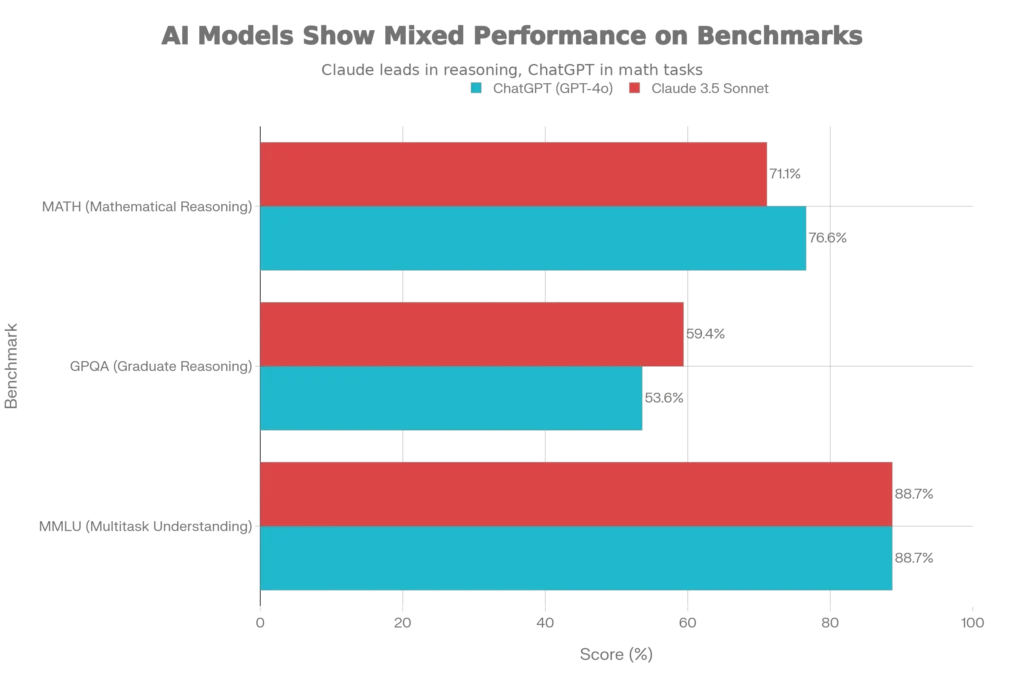
Breaking Down the Benchmark Results
MMLU (Massive Multitask Language Understanding): Both Claude and ChatGPT score identically at 88.7%, meaning they demonstrate equivalent general knowledge across 57 different subjects—from mathematics and science to history and ethics. This is essentially a tie, and both platforms perform near human-expert levels (which stand at 89.8%).
GPQA (Graduate-Level Reasoning): Claude 3.5 Sonnet pulls ahead with a 59.4% score versus ChatGPT’s 53.6%. This 5.8-point gap demonstrates that Claude handles complex, multi-step reasoning tasks more effectively. If your writing requires deep analytical thinking or defending nuanced arguments, Claude has a measurable advantage.
MATH Benchmark (Mathematical Reasoning): ChatGPT flips the script here, scoring 76.6% compared to Claude’s 71.1%. This is a significant difference for writers working with quantitative analysis, financial reporting, or technical problem-solving.
The bottom line: Claude dominates reasoning and analysis, while ChatGPT edges out Claude in mathematics. For most writing—blogs, articles, marketing copy—the reasoning advantage matters more than the math edge.
Context Window: A Game-Changer for Long-Form Writing
One of the biggest practical differences between these tools is context window size—essentially, how much text the model can “remember” and process at once.
Claude 3.5 Sonnet’s 200,000-Token Advantage
Claude handles up to 200,000 tokens in a single conversation. To put this in perspective, that’s approximately 30,000 to 40,000 words. A typical novel chapter. An entire academic research paper. A 50-page business proposal—all at once.
Real-world impact: If you’re writing a long-form piece and need Claude to review earlier sections while drafting new ones, it never “forgets” what came before. You can paste in your entire book manuscript, and Claude analyzes it with perfect memory of themes, character development, and narrative arcs. No context loss. No starting over.
ChatGPT’s 128,000-Token Context (Pro Only)
ChatGPT Free is significantly more limited. The free tier offers roughly 16,000 tokens—equivalent to about 2,500 words. The paid ChatGPT Plus tier bumps this to 128,000 tokens. This is still substantial, but it’s roughly two-thirds of Claude’s capacity.
What this means for writers: With ChatGPT Free, you’ll need to break longer projects into chunks. A 5,000-word article works fine. A 15,000-word guide requires strategic segmentation. Anything beyond that becomes impractical without upgrading.
For writers working on novels, comprehensive guides, or extensive research documentation, Claude’s context window is a decisive advantage that directly impacts workflow efficiency.
Writing Quality: How These Models Actually Perform
Benchmark numbers tell part of the story, but writing quality involves nuance that statistics alone cannot capture. Real-world testing by content creators and journalists reveals distinct strengths.
Claude 3.5 Sonnet: Clarity, Structure, Consistency
Claude consistently delivers writing that is organized, measured, and reliable. Multiple independent tests from 2025 confirm that Claude excels in:
Structured information: Claude naturally organizes complex ideas into clear hierarchies—perfect for how-to guides, technical documentation, and analytical essays. Its approach resembles having an academic mentor guide your thinking rather than a creative collaborator.
Tone consistency: Claude maintains a steady, professional tone throughout long pieces. If you need corporate communication, legal writing, or educational content that sounds cohesive from paragraph one through paragraph fifty, Claude delivers this reliably.
Detail-oriented accuracy: Claude prioritizes precision and fact-checking over flashy phrasing. It’s less likely to embellish or add unnecessary complexity. This makes Claude ideal when information integrity matters—scientific writing, historical analysis, financial reporting.
Measured vocabulary: Instead of using five adjectives to describe something, Claude picks the one word that’s most accurate. This reduces wordiness and creates tighter prose that readers appreciate.
Research from multiple sources shows Claude ranks first on creative story-writing benchmarks, and professional writers consistently report that Claude’s output requires fewer editorial passes than ChatGPT’s.
ChatGPT Free: Speed, Engagement, Adaptability
ChatGPT’s strength lies in conversational fluidity and stylistic variety. Independent testing shows:
Conversational tone: ChatGPT naturally shifts between casual and formal registers. If you need a blog post that feels like you’re chatting with a friend, ChatGPT delivers this more naturally than Claude.
Creative flair: ChatGPT isn’t shy about colorful language, humor, or poetic description. It excels when you need personality in your writing—social media content, marketing copy, engaging blog narratives.
Fast response times: ChatGPT generally generates responses quicker than Claude. If you’re working under tight deadlines and speed matters, ChatGPT edges ahead.
Multiple style adaptation: ChatGPT can swing between completely different writing styles within the same conversation. Ask it to sound like a startup founder in one prompt, then a bestselling author in the next—it adapts more readily.
However, ChatGPT sometimes produces content that sounds repetitive or formulaic without precise prompting. It can also “over-write” in ways that require editing, whereas Claude’s more conservative approach often requires fewer revisions.
The Free Tier Reality: Significant Differences
Both platforms offer free access in 2025, but the limitations are strikingly different.
Claude Free: Usage Caps vs. Quality
Access: Claude Free is fully available via claude.ai and mobile apps.
Limits: Free users hit a usage ceiling after approximately 10-15 prompts daily during peak hours. This ceiling is not a hard cutoff—it depends on prompt complexity and system load. A short prompt might count as one unit; a complex analysis might count as five.
Message structure: Unlike ChatGPT’s rate-limiting, Claude’s limits are somewhat opaque. You won’t see a countdown timer; you’ll simply get a message that you’ve reached capacity and need to wait (usually until the next day).
Quality advantage: Even on the free tier, you get the full Claude 3.5 Sonnet model—the same engine used in Claude Pro. You’re not getting a downgraded version; you’re just limited in frequency.
ChatGPT Free: Message Limits and Feature Access
Access: Free ChatGPT grants you GPT-4o, OpenAI’s most advanced public model.
Limits: OpenAI limits free users to approximately 10-60 messages per 5-hour window, depending on overall server load. During peak hours, this might mean 10 messages; during off-peak, you might hit 60.
Feature gaps: ChatGPT Free has more restrictions than Claude Free:
- No voice chat (Pro only)
- No advanced code interpreter (Pro only)
- Limited file uploads (3 files per 24 hours)
- DALL-E image generation (only 2-3 images daily)
- No web browsing API (Pro only)
Token-level limits: Beyond message counts, free users face a 16,000-token context limit per conversation. Claude Free supports the full 200,000-token context.
Quality difference: ChatGPT Free uses GPT-4o, which is excellent, but Pro users get access to more advanced models (like o3-pro) that free users cannot touch.
The Verdict on Free Tiers
If you’re writing occasionally (5-10 prompts per day), Claude Free is arguably more generous because you get the full Sonnet model with its massive context window.
If you need consistent daily access with more premium features, ChatGPT Free works if you stay below ~60 messages per 5 hours, but you’re more likely to hit the paywall.
For serious writing work, both platforms justify their $20/month subscription fees quickly.
Writing for Different Content Types: Where Each Tool Excels
Blog Posts and Articles
Winner: Tie with different strengths
- Choose Claude if your article is over 3,000 words, requires multiple sections to integrate seamlessly, or demands a consistent, professional voice.
- Choose ChatGPT if you’re writing a personal essay, humor piece, or thought leadership article where engagement and personality matter more than structure.
Long-Form Content (Books, Theses, Guides)
Winner: Claude 3.5 Sonnet
Claude’s 200,000-token context is transformative for book writers and researchers. You can paste in your entire manuscript, ask Claude to identify plot inconsistencies, rewrite a chapter in a different voice, or check for redundant themes across 80,000 words. ChatGPT Free simply cannot do this without breaking the content into pieces.
Marketing Copy and Sales Pages
Winner: ChatGPT
ChatGPT’s natural conversational tone and ability to inject personality make it better for persuasive writing. It instinctively understands emotional triggers and can craft headlines that compel clicks. Claude’s measured approach sometimes reads too formal for marketing copy that needs to feel urgent or compelling.
Technical Documentation
Winner: Claude 3.5 Sonnet
Claude’s structured, logical approach is perfect for README files, API documentation, and technical guides. It organizes information hierarchically and explains complex concepts with clarity. Its writing style naturally fits the formal tone required in technical writing.
Creative Fiction and Storytelling
Winner: Tie (with nuance)
Research from 2025 shows Claude 3.5 Sonnet actually ranks higher on creative writing benchmarks than ChatGPT. However, ChatGPT feels more naturally engaging in dialogue and character voice work. Claude excels at plot structure and thematic consistency.
Use Claude for crafting a novel’s overall architecture and ensuring narrative consistency.
Use ChatGPT for writing snappy dialogue and making individual scenes feel more alive.
Email and Professional Communication
Winner: Claude 3.5 Sonnet
The consistency and professional tone are unmatched. Whether you’re writing a difficult email, a resignation letter, or executive communication, Claude’s measured approach prevents you from sounding either too casual or too robotic.
Tone and Voice: Critical for Brand-Consistent Writing
If you’re a content creator with an established voice, choosing the right tool matters for consistency.
Claude’s Voice Characteristics
- Measured and thoughtful
- Professional without being stiff
- Logical flow from one idea to the next
- Less prone to clichés or filler phrases
- Sounds like a skilled journalist or academic
Best for: Brands that value clarity, authority, and educational tone
ChatGPT’s Voice Characteristics
- Conversational and relatable
- Energetic and emotionally expressive
- Flexible across multiple personalities
- More likely to use humor or casual language
- Sounds like an engaging friend or marketing expert
Best for: Brands that value personality, accessibility, and engagement
Cost-Benefit Analysis: Which Subscription Makes Sense?
Claude Free vs. ChatGPT Free (No Budget)
If you write fewer than 15 daily prompts and don’t need premium features: Claude Free wins because the context window is larger and you’re not missing features.
If you write more frequently or need features like DALL-E or advanced code: ChatGPT Free is acceptable but increasingly frustrating.
Claude Pro ($20/month) vs. ChatGPT Plus ($20/month)
Same price, different value:
| Aspect | Claude Pro | ChatGPT Plus |
|---|---|---|
| Context Window | 200K tokens | 128K tokens |
| Priority Access | Yes, no queue times | Yes, faster responses |
| Advanced Models | Full Sonnet access | Access to GPT-5 (latest) |
| Web Browsing | Available | Available |
| Code Artifacts | Claude Code (integrated development) | Canvas (inline editing) |
| Best for | Long-form writing, analysis | Balanced daily work |
For writers focusing on long-form content, Claude Pro is the better value because the context window alone justifies the subscription.
The Accuracy Question: Hallucinations and Factual Errors
Both models have improved dramatically by 2025, but they’re not identical in reliability.
Claude 3.5 Sonnet’s accuracy: Claude has a 1.5% hallucination rate, meaning it generates false information about 1-2% of the time. For graduate-level reasoning tasks, this lower error rate shines through.
ChatGPT’s accuracy: ChatGPT (GPT-5, the latest version) makes roughly 45% fewer factual mistakes than GPT-4o and has reduced hallucinations by 6x compared to earlier versions. However, its baseline is still higher than Claude.
What this means: For fact-sensitive writing (news articles, technical documentation, financial reporting), Claude is the safer choice. For creative writing or brainstorming, both are acceptable.
Speed and Performance: Real-World Experience
ChatGPT is faster in most practical scenarios. Response generation typically completes in 5-15 seconds, whereas Claude often takes 10-30 seconds depending on prompt complexity.
If you’re working in rapid-iteration mode (quick iterations, many short prompts), ChatGPT’s speed advantage compounds.
However, faster isn’t always better if the output needs more editing. A Claude response that takes 20 seconds and requires minimal revision might be more efficient than a ChatGPT response that arrives in 8 seconds but needs substantial editing.
Integration with Your Workflow
Claude’s Ecosystem
- Artifacts: Claude displays generated code, writing, and designs in interactive windows within the chat. You can edit in real-time.
- Claude Code: Integrated development environment for code writing and debugging (Pro only)
- Web search: Available in Claude Pro
- Desktop app: Available on Mac and Windows
- API access: Available for developers and enterprises
ChatGPT’s Ecosystem
- Canvas: Similar to Artifacts, enables inline editing and real-time collaboration on documents
- GPTs: Create custom AI assistants (Plus/Pro only)
- Voice mode: Talk naturally to ChatGPT (Plus/Pro only)
- Plugins and integrations: Broader third-party ecosystem
- Web browsing: Available on Plus and Pro
- DALL-E integration: Create images directly in the interface
- API access: Widely available with various rate limits
ChatGPT has a more mature integration ecosystem, which matters if you’re building AI into existing workflows (Slack bots, automation, etc.). Claude’s ecosystem is growing but still narrower.
Platform Accessibility and User Experience
Claude:
- Simple, clean interface with minimal distractions
- Works well on mobile (iOS and Android apps available)
- Less feature-bloated, easier to focus on writing
- Smaller company (Anthropic) means fewer integrations
ChatGPT:
- More feature-rich interface with options for everything
- Better mobile experience with voice chat (paid only)
- Broader ecosystem of third-party tools and integrations
- Larger company (OpenAI) means faster feature rollouts
For pure writing work, Claude’s simplicity is an advantage. For integrated AI workflows, ChatGPT’s ecosystem is superior.
Making Your Final Decision: A Simple Framework
Choose Claude 3.5 Sonnet if you:
- Write long-form content (articles over 2,000 words, books, comprehensive guides)
- Value consistency and reliability above speed
- Need superior reasoning and analytical capabilities
- Want the longest context window for managing large documents
- Prefer a clean, distraction-free interface
Choose ChatGPT Free if you:
- Write short to medium-length pieces (social media, short blog posts, emails)
- Need maximum speed and conversational tone
- Want access to more premium features on the free tier
- Value personality and engagement in your writing
- Prefer a feature-rich platform with integrations
Choose ChatGPT Plus only if you:
- Need voice chat, advanced code interpreter, or DALL-E
- Require faster and more consistent access than the free tier allows
- Want to regularly use GPT-5 (the latest model)
- Prefer ChatGPT’s ecosystem of integrations
Conclusion: The Winner Depends on Your Priorities
In 2025, declaring a single “winner” between Claude 3.5 Sonnet and ChatGPT Free is misleading because they’re optimized for different writing scenarios.
Claude 3.5 Sonnet emerges ahead for serious writers because its superior context window, consistent tone, and higher reasoning scores directly translate to better long-form writing with fewer revisions required.
ChatGPT Free remains competitive for casual and conversational writing because it’s faster, more engaging, and offers solid performance in areas where Claude is slightly weaker (mathematics, personality).
The most practical answer: Use both tools strategically. Draft with Claude for structural clarity and consistency. Use ChatGPT for brainstorming, dialogue, and adding personality. Test both on your specific writing projects, measure revision time, and let empirical results guide your final choice.
In 2025, you don’t need to choose just one AI writing tool—you need to choose the right tool for each writing task. These benchmarks, real-world tests, and practical limitations show that Claude and ChatGPT are best friends who excel in different situations, not rivals with a clear victor.
Read More:Privacy Focus: Is ChatGPT Stealing Your Data? 3 Secure AI Alternatives for Privacy.
Source: K2Think.in — India’s AI Reasoning Insight Platform.