
As a business owner managing customer support in 2025, you’re facing a critical choice: invest in a ready-made AI solution like Intercom Fin, or build a custom AI agent tailored to your exact needs. Both paths promise to reduce costs and improve customer satisfaction, but the reality is far more nuanced. This article cuts through the marketing noise and gives you the unbiased, data-driven comparison you need to make the right decision.
The Current State of AI in Customer Support
The shift to AI-powered support is no longer optional—it’s becoming mandatory for competitive advantage. By 2025, 95% of customer interactions will be handled by AI, according to industry forecasts. The top question isn’t whether to use AI; it’s which solution fits your business model best.
Here’s what we know from 2025 data: companies implementing AI achieve ROI of up to 7.5x their initial investment, with every dollar spent generating $3.50 in return. AI-enabled support teams save 45% of time on calls, resolve issues 44% faster, and handle 13.8% more inquiries per hour without additional staffing. But this is where the divergence happens—the platform you choose determines whether you capture these gains or fall short of them.
The research shows a clear trend: 80% of customer service organizations plan to implement generative AI by 2025, but 60% of those implementations struggle with accuracy, hallucinations, and integration complexity. The solution isn’t just “pick an AI tool”—it’s matching the tool to your use case, budget, and technical capacity.
Understanding Intercom Fin: The SaaS AI Agent
Intercom Fin is Intercom’s proprietary AI agent, built on OpenAI’s GPT-4 and trained specifically for customer support conversations. It launched in January 2025 and claims to resolve up to 50% of support queries instantly without human intervention.
How Intercom Fin Works
Fin operates on a content-constrained architecture. Rather than generating answers from general knowledge, it pulls exclusively from your support content—help articles, FAQs, Zendesk articles, or custom URLs you provide. This design choice is deliberate: it dramatically reduces hallucinations (AI fabricating false information) because Fin has no freedom to invent answers.
When Fin encounters a query outside its knowledge base, it does something human agents do—it says “I don’t know” and escalates to your support team with full context. This transparency is rare in the AI world, where many competing systems confidently provide incorrect information, eroding customer trust.
Real-world deflection data from Intercom customers shows:
- 50% of conversations fully resolved by Fin without escalation
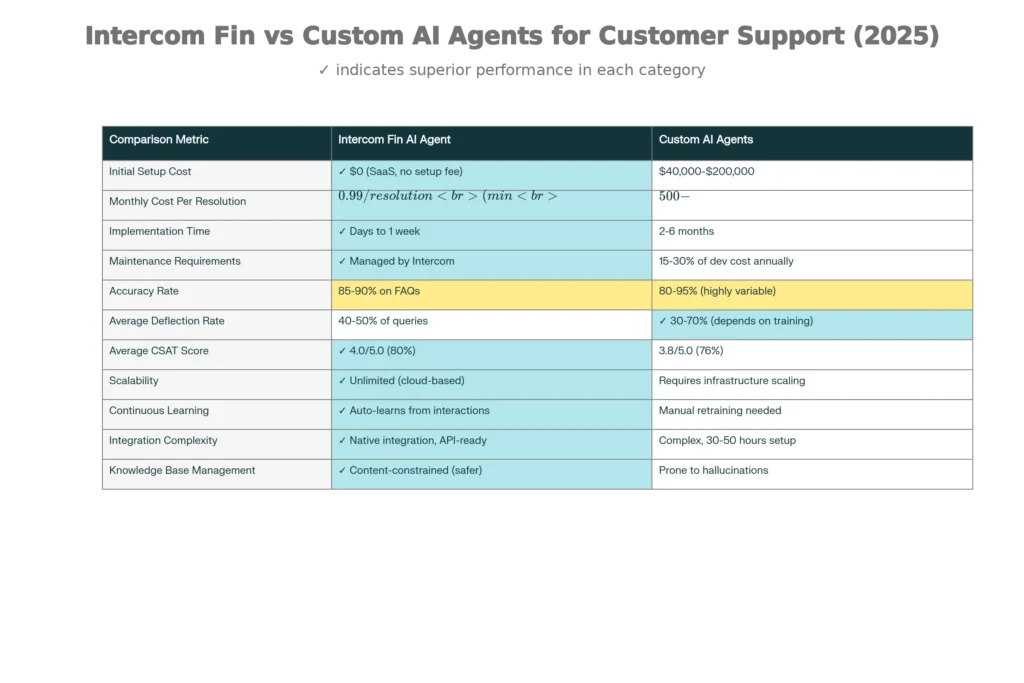
- 40-50% deflection rate on average (queries never reaching human agents)
- 65% resolution rate for some enterprise deployments
- Involvement in 90% of conversations across channels, with approximately 50% resolving autonomously
Intercom Fin Pricing Structure
This is where Intercom’s model gets complex. You don’t pay a flat monthly fee for Fin—you pay $0.99 per resolved conversation, with a minimum of 50 resolutions per month ($49.50/month baseline).
Real-world cost example:
- Base Intercom subscription: $29–$132 per agent per month
- Fin add-on: $0.99 × (number of AI resolutions per month)
- If you get 500 AI resolutions monthly: $495 in Fin costs + base subscription = $500+/month for a small team
For high-volume businesses (10,000+ monthly queries), costs escalate rapidly: 10,000 resolutions × $0.99 = $9,900/month just for Fin, before base subscription fees.
The hidden cost issue: This usage-based pricing lacks volume discounts or caps. Successful AI implementation (more resolutions) directly increases your bill with zero economy of scale—a pricing model that penalizes your success.
Strengths of Intercom Fin
1. Zero setup complexity: Fin launches in days. You point it to your knowledge base, preview the configuration, and activate. No coding, no AI expertise required.
2. Hallucination prevention: Because Fin operates within guardrails (your support content only), it avoids the 10-30% hallucination rates plaguing open-ended LLM chatbots. One research study found generative AI systems hallucinating at rates reaching 79% for complex queries, while Fin’s constraint-based design minimizes this.
3. Omnichannel coverage: Fin works across chat, email, SMS, WhatsApp, social media, and voice (coming soon). Customers don’t need to repeat themselves or switch platforms.
4. Content-driven improvement: As you update your knowledge base, Fin automatically gets smarter. No retraining cycles, no model updates.
5. High CSAT scores: Fin achieves 80% customer satisfaction on average, matching human agent performance for routine queries. One case study reported 95% CSAT during rollout with 38% instant resolution of queries.
6. Enterprise integration: Fin respects your existing Intercom workflows, automations, and ticketing processes. It’s designed to slot seamlessly into established support operations.
Weaknesses of Intercom Fin
1. Knowledge base dependency: Fin is only as good as your documentation. Outdated, incomplete, or poorly organized help articles directly tank Fin’s resolution rate. One Intercom metric shows that content with low resolution rates indicates missing, inaccurate, or ambiguous information.
2. Pricing scales negatively with success: The $0.99-per-resolution model incentivizes keeping AI resolution rates low (to minimize costs), which contradicts the goal of automating support. High-volume businesses face exponential cost growth without volume discounts.
3. Limited context for complex issues: While Fin handles routine FAQs well, edge-case and nuanced questions still drop accuracy significantly. Almost half of Fin-involved conversations still require human escalation for complex cases.
4. Lock-in risk: Switching away from Intercom means losing Fin. Your support history, workflows, and automation rules aren’t easily portable to competitors.
5. Limited customization: You can’t fine-tune Fin’s behavior for your specific domain (e.g., financial compliance, medical advice, or highly technical troubleshooting). It operates within pre-built parameters.
Understanding Custom AI Agents: The Build-Your-Own Path
Custom AI agents are purpose-built systems developed by your team or external AI development partners. Unlike Intercom Fin’s off-the-shelf approach, custom agents are trained on your specific data, integrated deeply into your business systems, and designed for your exact use case.
How Custom AI Agents Work
Custom agents operate differently from Fin. They’re trained on large datasets—your past support tickets, product documentation, internal knowledge, customer interaction history, and domain-specific information. They use reinforcement learning, continuous feedback loops, and fine-tuned models to improve autonomously.
Because custom agents access multiple systems (CRM, billing, inventory, ticketing), they can take multi-step actions: process refunds, adjust subscriptions, generate shipping labels, or transfer context to the right department—all without human intervention. This is a level of autonomy Fin cannot achieve because Fin is deliberately constrained to information retrieval only.
Performance benchmarks for well-built custom agents:
- 80% of customer issues resolved autonomously (ServiceNow deployment)
- 52% reduction in time to resolve complex cases
- 86% success rate on customer questions (industry average for mature deployments)
- 87.58% CSAT when properly trained, outperforming human email support (61%) and phone support (44%)
Custom AI Agent Development Costs
This is where the financial reality hits hard. Building a custom AI agent is expensive, and cost estimates vary wildly depending on scope, complexity, and team expertise.
Real-world cost breakdown (2025 data):
| Development Level | Cost Range | Timeline | What You Get |
|---|---|---|---|
| MVP/Basic | $10,000–$30,000 | 4-8 weeks | Simple FAQ bot with limited integrations, basic NLP |
| Mid-Level | $40,000–$100,000 | 2-3 months | Multi-channel agent, CRM integration, limited learning |
| Advanced | $80,000–$250,000+ | 3-6 months | Enterprise-grade, multi-system orchestration, advanced learning |
Beyond development, ongoing costs are substantial:
| Cost Category | Annual Expense |
|---|---|
| Cloud infrastructure & hosting | $500–$3,000/month |
| API/LLM token usage | $1,000–$5,000/month |
| Model maintenance & retraining | 15-30% of initial dev cost/year ($6,000–$75,000 annually) |
| Data storage & compliance | $5,000–$15,000/year |
| Technical support staff | $80,000–$150,000/year (salary) |
| Total first-year cost | $100,000–$400,000+ |
Real-world example from research: A healthcare provider implementing a custom AI agent spent $120,000 upfront and budgets $18,000/year in ongoing maintenance. Over 3 years: $174,000 total investment for 40% improvement in support efficiency.
Strengths of Custom AI Agents
1. Deep system integration: Custom agents access your CRM, billing system, inventory, ticketing platform, and internal workflows. They can execute refunds, create orders, update records—not just provide information.
2. Domain expertise: Unlike general-purpose Fin, custom agents are trained on your specific domain. A healthcare agent understands medical terminology, compliance requirements, and patient data protocols. A fintech agent understands regulatory constraints and financial logic.
3. Autonomous decision-making: Custom agents reason through multi-step problems. They diagnose issues, check inventory, process exceptions, and escalate intelligently—behavior that requires true autonomy, not just retrieval.
4. Continuous learning: Custom agents improve over time through reinforcement learning, feedback loops, and retraining. They adapt to new products, processes, and customer trends without waiting for vendor updates.
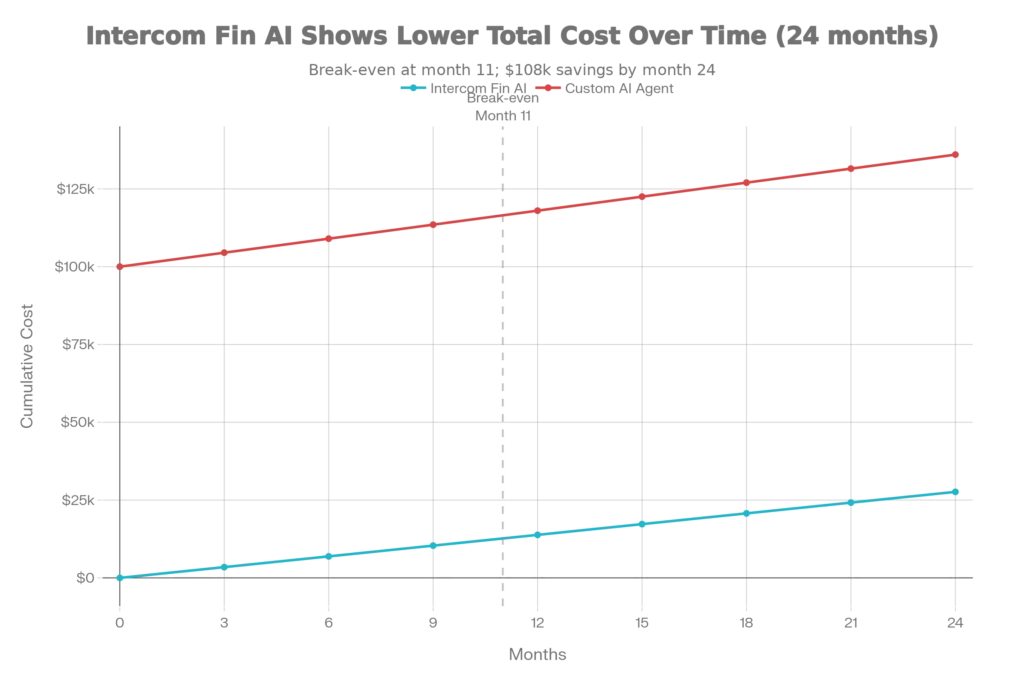
5. Cost efficiency at scale: For organizations handling 10,000+ monthly support interactions, custom agents eventually become cheaper than usage-based SaaS. Your costs plateau after scaling, while Intercom Fin’s costs grow linearly.
6. Competitive advantage: Custom agents reflect your competitive strategy. They’re difficult for competitors to replicate and become a defensible moat around your customer experience.
Weaknesses of Custom AI Agents
1. Hallucination risks: Without guardrails like Fin’s content-constraint architecture, custom agents hallucinate—confidently providing false information. Research from 2025 shows hallucination rates ranging from 10% to over 30% for complex queries. One study found agents hallucinating 33% of the time on QA benchmarks and 79% on general knowledge questions.
2. High upfront and ongoing costs: $100,000–$400,000 initial investment plus 15-30% annual maintenance creates a multi-year commitment.
3. Long implementation time: 2-6 months to launch vs. Intercom Fin’s days. Your support team operates in legacy mode during development, missing immediate automation gains.
4. Technical risk: You own all bugs, performance issues, model drift, and integration failures. A poorly trained model tanks customer satisfaction directly.
5. Talent scarcity: Building and maintaining custom agents requires deep AI expertise, fine-tuning experience, and MLOps infrastructure. The talent market is tight and expensive.
6. Regulatory liability: Hallucinations in regulated industries (healthcare, finance, legal) create compliance risks and liability exposure. If your custom agent provides medical advice incorrectly or financial guidance fraudulently, your company faces lawsuits.
Head-to-Head: Performance Metrics That Matter
Deflection Rate and Resolution Speed
Deflection rate is the percentage of customer inquiries resolved without human agent involvement. Higher deflection = lower support costs.
- Intercom Fin: 40–50% deflection rate (documented across case studies)
- Custom AI agents: 30–70% (highly variable; depends entirely on training quality)
What this means in real numbers: If your business gets 1,000 monthly support inquiries:
- Intercom Fin resolves 400–500 without agents ($396–$495/month at $0.99 per resolution)
- Custom AI might resolve 300–700, with total monthly cost ~$1,500 (maintenance + infrastructure)
For 500 resolutions, Fin costs $495. For 700 resolutions, Fin costs $693—linearly more expensive for better performance.
Response time: Intercom Fin resolves queries in seconds to under 1 minute. Custom agents similarly operate in 1-3 seconds once deployed, but setup time differs dramatically.
Accuracy and Hallucination Rates
This metric determines whether customers trust the AI or abandon the interaction.
Intercom Fin accuracy: 85–90% on FAQ-type questions (because content-constrained). Accuracy drops sharply outside the knowledge base, by design.
Custom AI agent accuracy: 80–95% (highly variable). Well-trained agents on domain-specific data reach 95%+, but untrained models hallucinate 20–30% of the time.
The hallucination crisis: Research from OpenAI and independent evaluators shows newer reasoning models hallucinate at alarming rates:
- GPT-4o hallucination rate: ~2%
- GPT-o3 (advanced reasoning): 33% on QA benchmarks, 51% on general questions
- DeepSeek-R1: 14.3% hallucination rate
Custom agents using these models inherit these risks unless carefully architected with fact-checking, validation loops, and content constraints.
Customer Satisfaction Scores (CSAT)
- Intercom Fin: 80% CSAT on average, 95% on well-deployed instances
- Custom agents (mature deployments): 87.58% CSAT, outperforming human email (61%) and phone support (44%)
- Human agents alone: 91% CSAT (still the baseline)
The interesting finding: Custom agents, when properly trained, achieve higher CSAT than Intercom Fin, but only after 2-3 months of optimization.
When to Choose Intercom Fin
You should choose Intercom Fin if:
- You’re a startup or small business (under 50 agents) with a tight budget and no in-house AI expertise
- You need AI running in days, not months—time-to-value matters more than perfection
- Your support volume is under 500 queries/month—usage-based pricing remains competitive
- You have mature, well-organized support documentation—Fin works best with high-quality knowledge bases
- You prioritize hallucination prevention over advanced autonomy—you need to know Fin won’t invent information
- You already use Intercom as your helpdesk—native integration eliminates friction
- Your queries are primarily FAQ-type—routine, information-retrieval, not complex multi-step workflows
ROI timeline with Intercom Fin: 3-6 months. You see cost savings and deflection rate improvements immediately because setup is fast.
When to Build a Custom AI Agent
You should build custom AI if:
- Your business handles 5,000+ monthly support interactions—scale tips the cost-benefit in your favor
- Your support needs are complex—multi-step workflows, system integrations, domain-specific reasoning
- You have technical in-house talent or budget to hire external AI development teams
- You need agents to take autonomous actions—process refunds, adjust subscriptions, generate documents
- Your business operates in regulated industries requiring audit trails, explainability, and compliance controls
- You want a defensible competitive advantage reflected in your support experience
- Long-term cost savings matter more than upfront investment—3-year ROI is your planning horizon
ROI timeline with custom agents: 18-36 months. Heavy upfront investment, but ROI compounds as you scale.
The Hybrid Approach: Growing Beyond Either Option
Here’s what smart companies do in 2025: They start with Intercom Fin or a lightweight SaaS bot to handle deflection quickly and cost-effectively. Simultaneously, they identify high-value, repetitive workflows where custom automation delivers outsized ROI.
Example strategy:
- Months 1-6: Deploy Intercom Fin for FAQ deflection (40-50% of volume)
- Months 3-9: Build custom agent for high-value workflows (refunds, subscription changes) representing 20-30% of remaining volume
- Months 9+: Gradually migrate low-complexity Fin use cases to custom agent as it matures
Results from this hybrid approach:
- 52% reduction in resolution times (combined AI + human)
- 25% reduction in overall support costs
- 85%+ CSAT (AI for simple issues, humans for complex/emotional)
Companies like Jumia (e-commerce platform) implemented this hybrid model and achieved 95.24% first-response-rate, 94.46% CSAT, 76% increase in satisfaction within 3 months.
Critical Success Factors Regardless of Choice
1. Knowledge Base Quality is Non-Negotiable
Whether you choose Fin or custom agents, AI quality mirrors knowledge base quality. Invest heavily in documentation, FAQs, and internal wikis before deploying AI.
Metric to track: Content utilization rate. If Fin pulls from an article that resolves <30% of queries, rewrite that content.
2. Monitor Deflection Rate AND Resolution Accuracy
Don’t optimize for deflection alone. A 70% deflection rate that frustrates 40% of customers is worse than 40% deflection with 95% satisfaction.
Industry benchmark: Aim for 20-40% deflection rate with >85% CSAT.
3. Set Up Escalation Workflows Before Launch
Even Intercom Fin resolves only 40-50% of queries. Your escalation path determines whether satisfied customers turn frustrated when handed to humans.
4. Plan for Continuous Optimization
AI isn’t “set and forget.” Mature deployments track metrics like:
- Resolution rate (% of AI conversations fully resolved)
- Fallback rate (% needing human help)
- CSAT per channel (chat vs. email vs. voice)
- First contact resolution (FCR) improvement
5. Address the Hallucination Problem Upfront
Whether custom or Fin, hallucinations erode trust. Implement validation layers:
- Fact-checking against your knowledge base (Fin does this inherently)
- User feedback loops to flag incorrect answers
- Sentiment analysis to catch frustrated escalations early
2025 Industry Data You Need to Know
Adoption rates:
- 80% of companies either using or planning to adopt AI chatbots by 2025
- 86% of organizations have implemented Gen AI, pilots, or are exploring it in customer service
- 45% of support teams actively using AI in 2025
Performance improvements achieved:
- 87% reduction in average resolution times
- 45% reduction in call handling time
- 13.8% increase in inquiries handled per hour
- 37% drop in first response time
- 52% faster ticket resolution
Cost savings:
- 25-30% reduction in customer service costs with AI
- $300 billion projected contact center labor cost savings by 2026 (Gartner)
- $0.50 cost per chatbot interaction vs. $6.00 for human interaction (12x difference)
Emerging challenges:
- Only 25% of call centers have successfully integrated AI automation into daily operations
- 47% of enterprise AI users made decisions based on hallucinated content in 2024-2025
- Hallucination rates in advanced reasoning models increased (OpenAI o3-mini: 48-79% in certain benchmarks)
Conclusion: Making Your Decision
The verdict is clear: Intercom Fin wins for speed, simplicity, and hallucination prevention. Custom AI agents win for scale, autonomy, and long-term ROI. Most businesses don’t have to choose one or the other—smart implementation uses both, starting with Fin while building custom capabilities in parallel.
Your decision framework:
- Today: Deploy Intercom Fin or similar SaaS if you need immediate deflection and have <500 queries/month
- Next 6 months: Assess which high-value workflows justify custom development
- 12+ months: Shift automation to custom agents as they mature, keep Fin for FAQ deflection
- Ongoing: Track deflection rate, CSAT, and hallucination incidents religiously
The companies winning in customer support in 2025 aren’t choosing between these paths—they’re orchestrating both, leveraging speed where it matters and building depth where it drives revenue.
Read More:AI for HR: Can AI Really Write Better Job Descriptions?
Source: K2Think.in — India’s AI Reasoning Insight Platform.