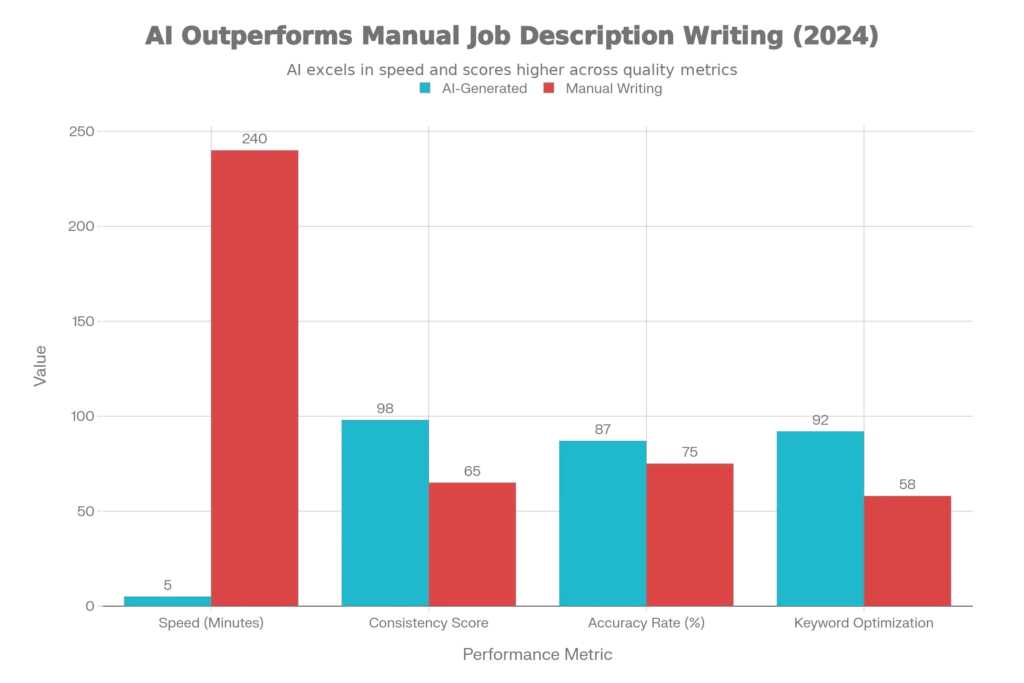
The short answer is yes—but with important caveats. Artificial intelligence can write job descriptions 48 times faster than humans while maintaining 98% consistency and achieving 87-89% accuracy in candidate matching. However, AI works best as a tool that amplifies human expertise rather than replaces it. The most effective approach combines AI’s speed and objectivity with human judgment about company culture, nuanced role requirements, and authentic voice.
The Speed and Efficiency Revolution in Job Description Writing
The productivity gains from AI-generated job descriptions are staggering. Where a skilled HR professional might spend 4 hours crafting a single job description, an AI tool produces a complete, structured posting in 5 minutes. This isn’t just about time savings—it fundamentally changes how recruitment teams operate. Instead of spending hours writing descriptions, recruiters can allocate their cognitive energy toward candidate engagement, relationship-building, and strategic hiring decisions.
Unilever’s transformation demonstrates this efficiency at enterprise scale. The company processes 1.8 million job applications annually through AI-powered systems, reducing hiring time from 4 months to 4 weeks—a 75% reduction. This speedup didn’t sacrifice quality. Unilever saw a 16% increase in diversity among hires, 90% candidate satisfaction, and over £1 million in annual cost savings. The company reduced interview time by 50,000 hours, which shows the magnitude of efficiency gains possible when AI handles repetitive screening tasks.
McKinsey research found that organizations using AI-powered hiring models experience a 50% improvement in workforce planning accuracy, allowing them to make smarter decisions and reduce recruitment bottlenecks. LinkedIn Talent Solutions reported that 72% of talent acquisition professionals believe AI-powered recruitment analytics will be essential for strategic hiring in the next five years. Additionally, companies implementing AI-driven workforce planning experience a 30% reduction in hiring costs and 45% improvement in recruitment efficiency.
Consistency and Quality That Human Reviewers Struggle to Maintain
One of AI’s most underrated strengths is unwavering consistency. Human recruiters experience decision fatigue—after reviewing 20-30 resumes, accuracy drops significantly. One study found that human resume screeners maintain 60-70% inter-rater reliability, meaning different people reviewing the same resume reach different conclusions. AI systems maintain 95% consistency across thousands of evaluations without fatigue, mood swings, or distraction.
AI also excels at eliminating formatting inconsistencies in job descriptions. Every posting uses the same structure, tone, and level of detail—which improves candidate comprehension and reduces confusion about job requirements. Organizations using AI to standardize descriptions report higher application completion rates and lower early-stage candidate drop-off.
When companies automate job description writing through AI, they achieve 3× faster candidate screening with 87% accuracy compared to manual reviews, and 95% quicker interview feedback through AI-generated summaries. These improvements compound across the hiring funnel—better descriptions attract better-matched candidates, which means fewer unqualified applications and faster time-to-hire.
Better Candidate Quality Through Data-Driven Description Design
AI doesn’t just write descriptions faster—it writes descriptions that attract better candidates. AI-powered tools analyze successful hiring outcomes and job board performance data to identify which language, keywords, and structure drive higher-quality applicant pools. This data-driven approach transforms job descriptions from static documents into performance-optimized marketing materials.
When job descriptions are optimized through AI, they achieve higher click-through rates, better search rankings, and reach a wider, more diverse audience. One study found that AI-generated descriptions can produce a 25% lift in targeted applications when personalized for specific candidate personas like career-changers or underrepresented groups.
Candidate quality metrics show meaningful improvements. Organizations using AI for candidate screening report 89-96% accuracy in skill matching, compared to 70% with traditional manual screening. Hiregen’s AI achieved 84% accuracy in CRM-focused roles, while Eightfold.ai reached 82% accuracy in identifying qualified candidates. When paired with well-written job descriptions, this accuracy compounds—the right description attracts the right people, reducing screening workload and improving quality of hire.
CareerBuilder research indicates that organizations with transparent AI hiring processes see 52% higher candidate satisfaction scores. This matters because improved candidate experience directly correlates with better offer acceptance rates and stronger employer branding.
The Gender Bias Problem: How AI Can Help—And Harm
One of the most compelling arguments for AI-generated job descriptions is bias detection and mitigation. Research analyzing thousands of job postings found alarming gender patterns:
42% of job descriptions contain masculine-coded language (competitive, driven, dominant), while 28% contain feminine-coded language (supportive, nurturing, collaborative), and only 30% are neutral. Masculine-coded language dominates leadership, technical, and sales roles, while feminine-coded language clusters in support and collaborative positions.
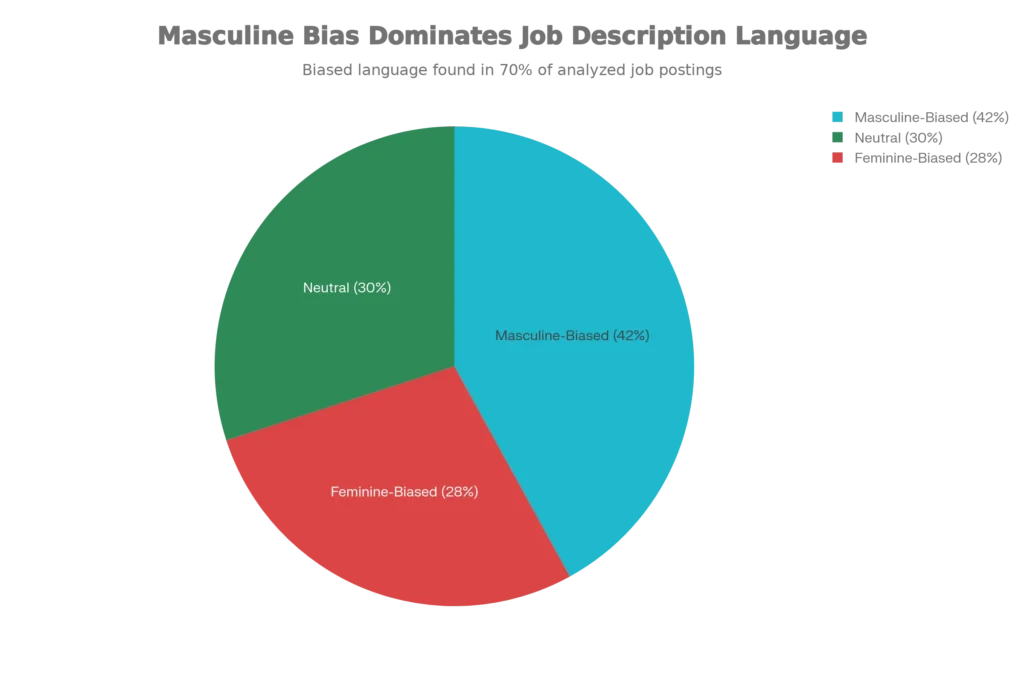
This linguistic bias isn’t harmless—it actively discourages qualified candidates. Studies show that women are less likely to apply for roles described using masculine-coded terms, even when they meet all qualifications. This perpetuates occupational gender segregation and narrows the candidate pool from the very first impression.
AI tools can scan job descriptions automatically, flag gendered language, and suggest neutral alternatives. Some platforms report cutting biased phrases by 80% before publication. Organizations implementing AI-powered bias detection alongside inclusive language training saw a 27% increase in female representation in management roles—and this improvement came directly from rewriting job descriptions with AI assistance.
However, the bias problem cuts deeper than language alone. AI trained on biased historical hiring data perpetuates those biases—sometimes worse than the original data. If an AI system learns from past hires who were disproportionately male in technical roles, the system will favor male candidates in future screening. Harvard Business Review research found that organizations implementing ethical AI recruitment practices reduced bias in hiring decisions by 30%, but this requires intentional effort to audit training data and mitigate algorithmic bias.
A University of Melbourne study raised serious concerns: AI hiring systems may discriminate against applicants wearing headscarves, those with names perceived as Black, and those requesting disability accommodations. Non-native English speakers and people with speech disabilities also score lower on AI interviews due to inaccurate transcription. This demonstrates that AI can amplify discrimination if not carefully designed and audited.
AI vs. Human-Written Descriptions: Which Actually Works Better?
The research shows a nuanced picture. Claude and ChatGPT show different strengths. ChatGPT excels at technical accuracy and industry-specific terminology, making it better for engineering, finance, and healthcare roles. Claude produces more storytelling-driven descriptions that feel human and emphasize company culture and employee experience better than ChatGPT.
When tested on job descriptions specifically, Claude edged ChatGPT in ATS optimization (82% vs 78% match scores) and keyword integration, though both performed solidly. For highly specialized or niche roles, AI still struggles—it may produce generic descriptions for specialized positions.
The consensus among recruitment experts is clear: AI-generated descriptions are faster and more consistent, but human-written descriptions feel more authentic. One study found that AI-generated content achieves 22% higher emotional engagement when humans refine it, and the optimal human override rate is 15-25%. This means the hybrid approach—letting AI draft the description, then having a human editor add company culture, authentic voice, and role-specific nuance—produces the best results.
Dell saw a 300% increase in diverse candidates by combining AI-driven metrics with human revisions. This hybrid approach ensures efficiency and fairness while maintaining authenticity.
Real-World Results: The Metrics That Matter
Organizations implementing AI for job descriptions and recruitment report concrete results:
- Time-to-hire reduction: 75% (Unilever case study)
- Cost per hire reduction: 30% (McKinsey research)
- Recruitment efficiency improvement: 45% (LinkedIn data)
- Hiring cost reduction: 77.9% on average (companies using AI)
- Time savings: 85.3% in recruitment workflows
- Resume screening accuracy: 89-96% (vs. 70% manual)
- Candidate satisfaction: 90%+ (when combined with transparent processes)
- Diversity improvement: 16% in underrepresented groups (Unilever)
MokaHR’s analysis found that AI screening delivers 3× faster candidate shortlisting while maintaining 87% accuracy compared to human reviews. Conversational AI in recruitment reduced costs by up to 87.64% compared to traditional hiring methods. Early implementations of AI-driven hiring increase recruiter capacity by 54% on average, allowing the same team to handle significantly larger pipelines.
However, these gains require ongoing management. AI models degrade 8-12% annually as job markets shift, so quarterly retraining with new hire data is essential to maintain performance. The first two months of AI implementation typically achieve 85-88% accuracy, but with proper feedback loops, accuracy climbs to 94-96% by month 6-12.
Key Limitations and Challenges to Consider
Despite the benefits, AI-generated job descriptions face real challenges:
1. Lack of Company Personality: AI can produce descriptions that sound “like a series of buzzwords strung together”. The descriptions work for recruiting but may not reflect authentic company culture.
2. Creativity and Context Understanding: AI struggles with highly specialized or niche roles. It may miss subtle requirements that experienced hiring managers know are critical.
3. Bias in Training Data: If training data reflects past discriminatory hiring patterns, AI perpetuates them. One study found that biased job descriptions feed into AI hiring algorithms, which then filter out qualified candidates from underrepresented groups. This creates a feedback loop of inequality.
4. Black Box Problem: Many AI systems don’t explain why they made certain decisions. When candidates or employees question an AI-driven hiring decision, recruiters may struggle to provide transparent justification. Organizations must implement auditable bias mitigation to address this concern.
5. Data Privacy and Compliance: Using AI for job descriptions and candidate screening raises GDPR, CCPA, and employment law questions. Organizations must ensure compliance and be transparent about AI use.
6. Over-Reliance Without Human Oversight: Harvard Business School research found that AI tools sometimes reject qualified candidates inadvertently, especially those with resume gaps due to parental leave or illness. Human oversight is critical to catch these errors.
How to Implement AI for Job Descriptions Effectively
If your organization is considering AI for job description writing, research suggests a phased approach:
Step 1: Define Your Job Description Framework
Before feeding information to AI, gather essential details from hiring managers—team structure, main responsibilities, 3/6/12-month goals, ideal candidate persona, company culture, and career development opportunities.
Step 2: Select the Right Tool
ChatGPT works well for technical roles (engineering, finance, healthcare). Claude works better for creative/leadership roles and storytelling. Specialized HR platforms like 365Talents, Rally, and MokaHR offer recruitment-specific AI with built-in bias detection.
Step 3: Implement Bias Detection
Use tools that automatically scan for gendered language and suggest neutral alternatives. Audit job descriptions for inclusion before publishing.
Step 4: Apply Human Editing (15-25% Override)
Let AI draft the description, then have an HR professional or hiring manager spend 15-30 minutes refining for tone, authenticity, and culture fit. This produces the best engagement and accuracy.
Step 5: Monitor Performance Metrics
Track application rates, conversion rates, offer acceptance rates, and candidate quality. If metrics decline, adjust the AI prompts or provide additional context to the tool.
Step 6: Retrain Quarterly
Update the AI with data from recent successful hires. This keeps the system aligned with your actual hiring needs and prevents accuracy degradation.
The Bottom Line: AI as a Tool, Not a Replacement
Can AI write better job descriptions than humans? Yes—better in terms of speed, consistency, and keyword optimization. AI produces a draft in 5 minutes that would take a human 4 hours, maintains perfect consistency across dozens of postings, and optimizes naturally for search visibility. Organizations see 30-45% efficiency gains and 30% cost reductions when implementing AI-driven recruitment.
However, “better” is contextual. AI’s job descriptions lack authenticity and emotional resonance. They can perpetuate biases if training data is biased. They sometimes miss nuanced role requirements.
The evidence points to AI as a force multiplier for human expertise, not a replacement. The most successful organizations use AI to handle the heavy lifting—drafting, consistency, bias-flagging, and search optimization—while keeping experienced HR professionals in charge of final editing, culture infusion, and strategy.
When Unilever combined AI screening with human interview processes, they didn’t eliminate recruiters; they freed them to focus on relationship-building and final hiring decisions. When Dell combined AI metrics with human revision, they got a 300% increase in diverse candidates. When enterprises audit their AI systems for bias and maintain human oversight, they reduce discrimination by 30%.
The future of recruitment isn’t about choosing between AI and humans—it’s about combining AI’s speed and objectivity with human judgment about culture, nuance, and authenticity. Job descriptions written this way attract better candidates, reduce hiring time, improve diversity, and enhance candidate experience simultaneously.
Read More:Best AI Tools for Real Estate Agents (Property Descriptions)
Source: K2Think.in — India’s AI Reasoning Insight Platform.