Building a profitable software business no longer requires years of development experience or massive funding rounds. In 2025, the convergence of AI, no-code platforms, and accessible monetization tools has democratized SaaS creation to the point where solo founders can launch production-ready products in weeks. The global AI SaaS market is projected to reach $775.44 billion by 2031, growing at a compound annual growth rate of 38.28%. More importantly, 69% of SaaS founders now use AI to eliminate bottlenecks, while 84% of developers are either using or planning to use AI in their development process. This comprehensive guide walks you through every step—from validating your idea to achieving profitability—without writing a single line of code.
The AI-Powered SaaS Revolution: Why Now Is Your Moment
The traditional path to building SaaS required a technical co-founder, significant capital for infrastructure, and months of development before launching an MVP. That world has fundamentally changed. AI is now embedded in how small teams build and operate SaaS products, shifting momentum from large enterprises to solo founders and small teams shipping focused products faster.
The numbers tell the story: 50% of active indie SaaS makers have built AI-powered products, and those products grow approximately 2× faster than traditional solutions. Products with AI features achieve profitability at similar rates to non-AI products (58% vs. 59% at or above breakeven), but the critical difference is speed—AI compresses months of work into days. A McKinsey survey found that startups using automation and large language models achieved 30–50% faster feature delivery.
What’s even more compelling for non-technical entrepreneurs: Gartner estimates that over 80% of SaaS apps will include some AI capability by 2026. This isn’t a trend for tech companies anymore—it’s the baseline expectation. The competitive advantage has shifted from “building AI from scratch” to “embedding AI effectively and understanding your customer’s needs.”
Understanding Micro-SaaS: The Entrepreneur’s Sweet Spot
Before diving into the how-to, let’s clarify what makes micro-SaaS different from traditional SaaS. Micro-SaaS businesses solve specific, niche problems for a well-defined audience, typically generating between $1,000 and $30,000 in monthly recurring revenue with solo or small founding teams. The global SaaS industry is projected to reach $295.08 billion by 2025, growing at approximately 20% annually, but the real excitement is in vertical and micro-SaaS segments.
Vertical SaaS (tools built for specific industries) is surging at a CAGR of 23.9%, reaching a market size of $157.4 billion. Micro-SaaS within these verticals is outgrowing traditional SaaS with annual growth rates of approximately 25%, driven by focus, speed, and unmatched relevance to niche markets.
The profitability story is equally compelling. According to analysis of 1,000+ micro-SaaS products, 95% achieve profitability within their first year—a stark contrast to traditional SaaS startups that often take 2-5 years. Here’s the real revenue distribution:
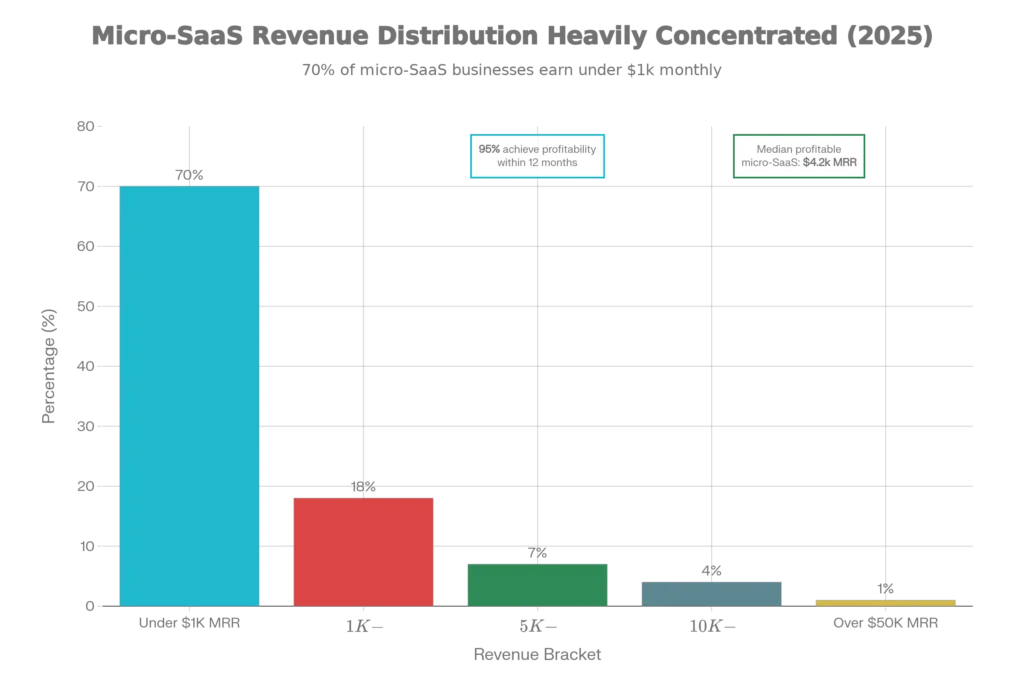
70% of micro-SaaS businesses generate under $1,000 monthly revenue, using that phase to validate product-market fit. The median profitable micro-SaaS makes about $4.2K MRR, enough to fund ongoing development without external capital. The top 1% exceed $50,000 MRR (roughly $600K ARR)—often run by teams of one to three people. These aren’t hobby projects; they’re sustainable, bootstrapped businesses that generate real income.
Step 1: Validate Your Idea Before Building Anything
The biggest mistake aspiring SaaS founders make is building first and asking questions later. Validation is not about eliminating all risk—it’s about making calculated bets based on evidence rather than gambling on assumptions. The validation-first mindset prevents you from wasting months building products nobody wants.
The Three Proven Validation Methods
Landing Pages — Your 48-Hour Litmus Test
A landing page is your idea’s first impression. You describe your solution, communicate the value proposition, and invite potential customers to express interest through an email signup or waitlist. You can go from idea to data in 48 hours. Here’s how:
Create a simple one-page website describing your solution using tools like Carrd ($19/year), Webflow ($14-$39/month), or even free alternatives like Notion. The page should clearly state the problem you solve, your unique solution, and a call-to-action button (email signup or pre-order). Drive traffic using targeted social media posts, relevant communities, or small paid ads ($20-$50). Track signups and conversion rates—a landing page that converts 2-5% of visitors signals genuine interest.
Pre-Sales — Direct Validation with Real Commitment
Pre-sales validation involves offering early access at a discount and collecting payment commitments before you build. This separates casual interest (“that sounds nice”) from genuine demand (“I’ll pay for this”). Reach out to your network, post in relevant communities, or use your landing page to offer founder pricing—typically 30-50% off annual plans—in exchange for patience and feedback.
The psychology matters here: people who pay, even discounted rates, take you seriously and provide higher-quality feedback. You might collect $500-$2,000 in pre-sales revenue from just 10-20 committed customers. This money then funds your development.
Customer Interviews — Uncovering Hidden Needs
Talk directly to 10-20 potential customers. Ask open-ended questions: “What’s your biggest challenge with [problem]?” “How are you currently solving this?” “What would an ideal solution look like?” Don’t pitch; listen. These conversations reveal pain points your target market doesn’t consciously recognize yet.
The beauty of interviews is that they expose whether you’re solving a “want” or a genuine “need.” A founder might think their target audience wants Feature X, but interviews reveal they actually struggle with Problem Y. This insight prevents building the wrong solution.
The Validation Stack: Using All Three Methods in Sequence
The most sophisticated approach combines all three methods:
- Landing page → collect 50-100 interested signups (signals market demand)
- Pre-sales → convert 5-10 of those signups into paid commitments (signals willingness to pay)
- Customer interviews → deep-dive with 10-15 people to understand needs (shapes product direction)
If all three give you positive signals, you’ve done more validation than 90% of micro-SaaS founders. You’ve earned the right to start building with confidence.
Pro Tip: Don’t delay your MVP to exhaustion. Validation doesn’t require perfection—it requires evidence. If you have 50 signups and 10 pre-sales, that’s enough validation to start building.
Step 2: Choose Your No-Code AI Platform Stack
This is where execution speed multiplies. You’re not choosing a single tool—you’re assembling an ecosystem where each platform handles one part of your SaaS. Think of it like building with Lego blocks instead of manufacturing from raw materials.
The Platform Options
For Rapid Full-Stack Apps (No-Code First Approach)
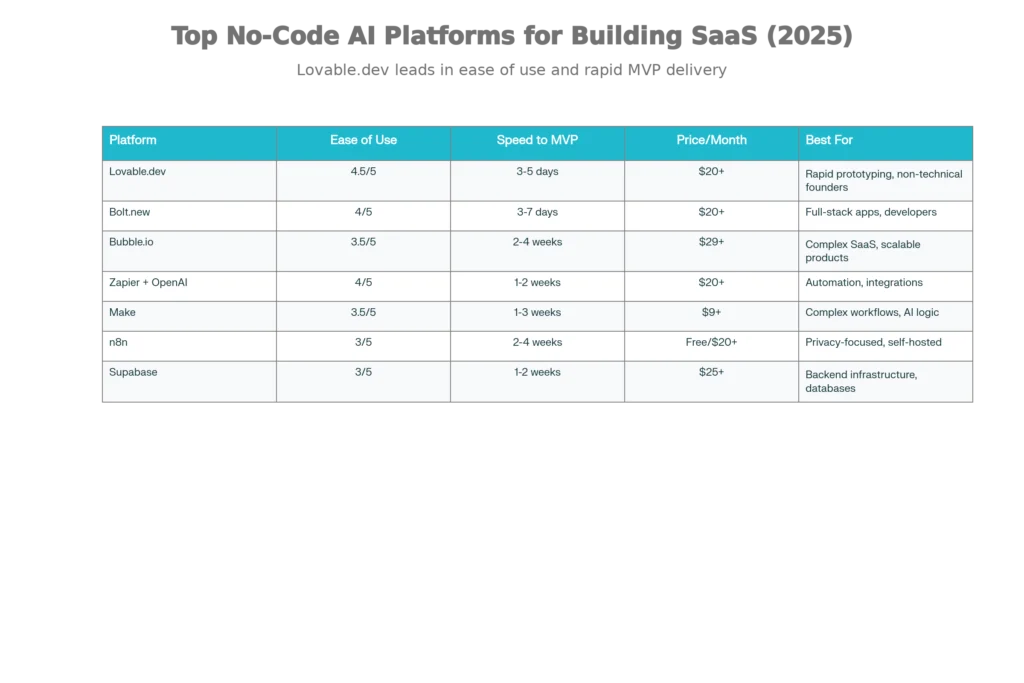
Lovable.dev and Bolt.new represent the newest generation of AI builders. They turn plain-English prompts into working applications in minutes. Lovable focuses on structured workflows and detailed planning, making it ideal for non-technical founders. Bolt.new excels in quick code generation with direct browser editing, better for founders who want to refine code as they iterate.
Speed matters here: Lovable can deliver a functional web demo in under 10 minutes for typical apps. Bolt.new scaffolds projects in 8-10 minutes after you choose a tech stack. Both platforms come with built-in hosting, so you don’t worry about deployment infrastructure.
Pricing: Both start at approximately $20/month. The token-based pricing can increase if you iterate heavily, but for initial MVPs, the cost is minimal.
Best for: Non-technical founders building SaaS MVPs, solo makers prototyping ideas, anyone who values speed over customization.
For Scalable Production Apps (Visual Builder Approach)
Bubble.io is a full-stack visual development platform that scales from MVP to enterprise-grade software. It has a steeper learning curve than Lovable or Bolt, but offers unmatched flexibility and customization. Bubble includes a database, user authentication, workflows, and API integrations out of the box.
Pricing: Starts at $29/month with additional charges for computing units (WUs) and collaborators. A moderately complex SaaS might cost $100-$300/month depending on usage.
Best for: Founders building complex SaaS products with multiple features, custom workflows, and complex logic who plan to scale beyond an MVP. If your product will have tens of thousands of users, Bubble is a safer architectural choice than Lovable.
For Backend Infrastructure & Databases
Supabase provides the backbone of your app—a PostgreSQL database with built-in user authentication, real-time features, and file storage. It’s production-ready and designed to scale to millions of users.
Unlike Airtable (which is excellent for simple projects but hits performance ceilings), Supabase is built specifically to be a database. It integrates seamlessly with any frontend builder, making it the perfect pair for Lovable, Bolt, or Bubble.
Pricing: Starts at $25/month with usage-based scaling. Free tier includes generous limits (up to 500MB storage).
Best for: Any SaaS that needs to scale beyond a few thousand records, requires user authentication, or demands relational database logic.
For Workflow Automation & AI Logic
Zapier connects thousands of apps and now integrates directly with AI models like OpenAI’s GPT-4. You can automate customer support responses, lead scoring, email personalization, and data enrichment without code.
Make (formerly Integromat) is a visual automation tool that handles complex multi-app flows with powerful data transformation. It excels at scenarios requiring conditional logic and sophisticated error handling.
n8n is open-source, self-hostable, and ideal for privacy-conscious founders. It supports over 400 integrations and lets you keep customer data private.
Pricing: Zapier starts at $20/month, Make at $9/month, n8n is free (open-source) or $20/month (cloud).
Best for: Automating repetitive tasks, connecting your SaaS to third-party tools, adding AI-powered features without custom code.
Assembling Your Stack: Real Example
Imagine you’re building an AI-powered customer review analyzer for small businesses. Here’s a practical stack:
- Frontend: Lovable.dev (build the dashboard in days)
- Backend: Supabase (store reviews, manage users, authentication)
- Automation: Zapier + OpenAI (automatically analyze new reviews, generate summaries)
- Payments: Stripe (integrated into Lovable)
- Email: SendGrid (connected via Zapier)
Total monthly cost: $100-$200 for a production-ready SaaS supporting hundreds of users. No engineers required.
Step 3: Design Your Product with AI-First Thinking
AI should sit at the core of your infrastructure, not tacked on as an afterthought. This distinction matters enormously for both speed and user value.
Where AI Creates Real Leverage
Developer Assistance & Content Creation
Use AI to draft support replies, generate documentation, create onboarding materials, and write marketing copy. Tools like ChatGPT, Claude, or Gemini compress tasks that would take hours into minutes. 69% of SaaS founders use AI for these bottlenecks.
First-Line Customer Support Automation
Instead of hiring support staff, deploy an AI chatbot powered by Zapier + OpenAI or specialized tools like Intercom. Train it on your product documentation and common questions. It handles 70-80% of routine queries, escalating complex issues to humans.
Predictive Analytics & Churn Detection
Use no-code tools like Obviously.ai to analyze customer usage data and predict who’s likely to cancel next month. You can then trigger automated retention campaigns—personalized emails, win-back offers, or urgent human outreach.
Personalization at Scale
AI can recommend features, content, or upgrades based on user behavior. This increases average revenue per user (ARPU) and reduces churn because customers get more value from your product.
The Critical Distinction: Infrastructure vs. Feature
Here’s what sets successful founders apart: They use AI first to reduce operational burden, then second to enhance user value. Some founders rush to add AI features customers didn’t ask for, wasting development time.
The data bears this out. 58% of SaaS products with AI features are at or above breakeven, compared to 59% without AI features. The difference is negligible because AI success depends on product fundamentals—market fit, pricing, and execution—not the presence of AI itself.
Use AI to ship faster and operate leaner. Only add AI-powered features when customers clearly demand them and you can charge for them.
Step 4: Build Your Minimum Viable Product (MVP)
An MVP is whatever you need to validate your idea—not necessarily a functioning prototype. However, with modern no-code tools, building a functioning MVP is so fast that you might as well.
Timeline: 7 Days to Functional MVP
Days 1-2: Database & Backend Setup
Use Supabase to create your data model. Define your core entities (users, customers, data records) and relationships. This takes 2-4 hours if you’ve done your homework. Supabase generates REST and GraphQL APIs automatically—you don’t need to write a single backend function.
Days 3-4: Frontend Build
Use Lovable.dev or Bolt.new to generate the user interface. Describe your desired screens: “Create a dashboard showing customer metrics” or “Build a form for users to upload documents.” The AI generates a working interface in hours. Connect it to your Supabase backend using API integrations.
Days 5-6: Payment Integration
Add payment processing using Stripe (for subscriptions) or Paddle (for simpler billing). Both integrate seamlessly into no-code builders via webhooks. This handles recurring billing automatically.
Day 7: Beta Test with Real Users
Deploy to a live URL and share it with your 10-20 pre-sales customers. Collect feedback on usability, feature requests, and bugs. Record this feedback systematically—it shapes your next sprint.
Real Timeline Evidence
Multiple founders have documented their actual launch timelines:
- SketchLogo AI (AI logo generator) reached $31,000 MRR in 4 months
- ExcelFormulaBot (AI Excel helper) hit $40,000 MRR in a year
- DocuSketch (insurance claims tool) achieved $90,000 MRR as a solo founder
These founders didn’t have years of experience. They had clarity on their problem, focus on a niche, and ruthlessness about shipping fast.
Step 5: Choose Your Monetization Model
Pricing is a strategic growth lever, not an afterthought. The 2025 SaaS market has fundamentally shifted toward flexibility, and micro-SaaS founders who understand this gain a competitive advantage.
The Monetization Landscape
Usage-Based Pricing Is Winning
According to the 2025 Monetization Monitor, 59% of software companies expect usage-based pricing to grow as a percentage of overall revenue—an 18% increase from 2023. 91% of mid-market SaaS companies report using some form of usage-based pricing, with 67% relying fully on usage-based models and 24% using hybrid approaches.
Why? Usage-based pricing aligns customer payment with actual value received. A small business using your tool 10 times/month pays less than one using it 1,000 times/month. This feels fair and removes barriers to entry—customers can start small and expand naturally as they realize value.
Hybrid Models Drive Revenue
Companies using hybrid models (base subscription + usage expansion) report the highest median growth rate (21%). Customers pay a predictable monthly base fee, then overage charges kick in as usage increases. This balances revenue predictability with incentives for customers to expand within your product.
Example structure for an analytics SaaS:
- Starter: $49/month (up to 10,000 page views/month)
- Pro: $149/month (up to 100,000 page views/month)
- Enterprise: Custom pricing (unlimited, plus dedicated support)
- Overage: $2 per 10,000 additional page views
Customers can start on the free trial, upgrade to Starter when ready, and grow to Pro or Enterprise as their usage increases—without surprise bills.
Annual Billing Drives Profitability
Annual upfront plans cut churn by 30% and lift LTV by 27%. Encourage annual billing with a 15-20% discount. This improves cash flow and reduces churn because customers who’ve paid annually are psychologically committed.
Specific Pricing for Different SaaS Types
Analytics Dashboards: $29-$99/month (tiered by data volume or users)
AI Tools (Writing, Design, Code): $9-$49/month (usage-based on API calls or generations)
Customer Management Tools: $49-$199/month (tiered by contacts or features)
Process Automation: $99-$299/month (based on workflow complexity and data volume)
Data Integration Tools: $49-$149/month (tiered by records processed)
The pattern: start conservative (make sales), then let pricing testing drive your growth. Pricing experimentation is the #1 growth lever for bootstrapped founders.
Step 6: Go to Market Without a Budget
Paid advertising is unreliable for micro-SaaS. Among founders who run ads, 57% either wait 7+ months to see ROI or can’t tell whether ads are working. Bootstrapped founders have discovered something bigger: growth from ecosystems beats growth from ads.
Channels That Actually Work
Community-Led Growth
Spend time in Reddit communities, Discord servers, Facebook groups, and forums where your customers hang out. Participate genuinely—answer questions, provide value, and occasionally mention your product when relevant. 50% of founders lean on communities and referrals, reporting stronger LTV.
For example, if you’re building an SEO tool for agencies, hang out in:
- r/SEO
- r/agencylife
- Digital Marketing Facebook groups
- SEO-specific Discord communities
Provide genuine insight. When someone asks a related question, your tool becomes the natural solution.
Integrations & Ecosystem
47% of founders report that integrations, partnerships, and communities became a more dependable source of growth than paid advertising. Getting listed in WordPress plugin directories, Shopify app stores, or Zapier’s marketplace puts you in front of users actively looking for solutions.
A Zapier integration literally means your tool appears in thousands of automation workflows without you spending a dollar on ads. Users discover you through their existing tools.
Content & SEO
Write blog posts solving your audience’s problems. Target long-tail keywords with low competition. For a tool that helps e-commerce store owners reduce cart abandonment, write: “How to Reduce Shopping Cart Abandonment: 7 Proven Strategies” and mention your tool where relevant.
SEO compounds over time. A single blog post ranking #1 for a relevant keyword can generate thousands of free signups over years.
Organic Social Media
Share your journey publicly on Twitter/X or LinkedIn. Document your progress, failures, and learnings. The idea itself has viral potential—if you’re building something genuinely useful, it resonates.
Post your MVP, ask for feedback, and engage genuinely. You don’t need 100,000 followers—you need authentic, niche engagement. A tweet to 500 followers in your niche often outperforms ads to 50,000 random people.
Direct Outreach
Email 10 potential customers daily with a personal, specific message. Not a sales pitch—a genuine “I’m building a solution to X problem. Would you be open to a quick chat?” Most will ignore it, but 2-3 responses per day is enough to gather feedback and identify early customers.
This “grinding” approach feels unsexy, but it works. You’ll personally acquire 5-10 paying customers through direct outreach, each of whom provides feedback that shapes your product.
The Hard Truth: Free Trials Beat Freemium
Only 17% of SaaS products maintain a freemium tier. The rest have switched to free trials. Here’s why:
| Entry Model | Conversion Rate |
|---|---|
| Freemium → Paid | 3-4% |
| Opt-in Trial (no card) | 18% |
| Opt-out Trial (card required) | 50% |
Card-required trials convert 50% vs. freemium’s 3-4%. When customers commit their credit card, they’re more serious about evaluating your product. They invest time because they’ve made a financial commitment.
Among micro-SaaS makers, 70% require a credit card at trial signup. This filters for serious buyers and improves unit economics.
Step 7: From $0 to Profitability (and Beyond)
The data on micro-SaaS profitability is sobering and inspiring simultaneously. 95% achieve profitability within 12 months, but 70% earn under $1,000 MRR in that early phase. The path to sustainability follows a predictable curve.
Profitability Metrics That Matter
Median Profitable Micro-SaaS: $4,200 MRR
Time to Profitability: 9-12 months
Typical CAC (Customer Acquisition Cost): $0 (community-led growth is free)
Typical LTV (Lifetime Value): $2,000-$5,000 (for annual plans)
These numbers mean you can reach sustainability on organic growth alone. A solo founder with $4,200 MRR ($50,400 ARR) covers hosting costs ($100-$300/month), tools ($100-$200/month), and personal living expenses—without outside capital.
The Profitability Mindset
Teams using AI are 61% likely to be at breakeven or profitable vs. 54% without AI. The 7% gap isn’t enormous—but it compounds. AI shaves months off your timeline to profitability, which matters when bootstrapping without external funding.
Focus on these metrics:
Customer Acquisition Cost (CAC): How much you spend to acquire one customer. For community-led growth, this is nearly $0. For ads, it’s $20-$100+ per customer. Know your number and ensure LTV is 3x+ your CAC.
Monthly Churn Rate: The percentage of customers who cancel each month. A 3% monthly churn is healthy. 5%+ is dangerous. Improve onboarding and customer support to reduce churn.
Net Revenue Retention (NRR): Do existing customers expand their usage and spend? Expansion revenue (customers upgrading plans or using more) should exceed churn. An NRR above 100% means revenue grows even if you acquire zero new customers.
Step 8: Real Examples That Prove It Works
The best evidence isn’t statistical—it’s founders who’ve done it. Here are 2025 micro-SaaS success stories:
SketchLogo AI: $31,000 MRR in 4 Months
A solo founder built an AI-powered logo generator using Lovable and OpenAI. The product takes user-submitted sketches and converts them into professional logos. They launched on Product Hunt, gained traction through Twitter, and hit $31,000 MRR within 4 months. Zero employees. Zero outside funding.
ExcelFormulaBot: $40,000 MRR in 1 Year
A non-technical founder identified a specific pain point: people struggle with complex Excel formulas. They built a tool that translates plain English into Excel formulas using OpenAI. No marketing budget—pure product-led growth. The product went viral organically because it solved a genuine, universal problem. $480,000 ARR as a solo operation.
DocuSketch: $90,000 MRR
A solo founder with insurance industry background built a tool for creating 3D floor plans for claims. Deep domain expertise + niche focus = defensible business. This founder earns approximately $1 million ARR while maintaining total control and minimal overhead.
Kickserv: $120,000 MRR
Targeting field service businesses (plumbers, HVAC technicians), Kickserv provides invoicing and job management. Still under 10 employees despite high revenue. $1.44M ARR with a small, profitable team.
These aren’t anomalies. These are patterns. The common threads:
- Niche focus: Each solves a specific problem for a well-defined audience
- AI integration: Uses AI to automate tedious tasks and scale operations
- Product-led growth: Lets the product sell itself rather than expensive ads
- Solo or small teams: Keeps overhead minimal, increasing profitability
- Early capital generation: Pre-sales or organic growth funded development
Avoiding the Traps That Kill Most Micro-SaaS
Building in public, staying lean, and validating assumptions kills 90% of failure modes. But watch for these specific pitfalls:
Trap 1: Adding AI Features Customers Didn’t Ask For
You see ChatGPT hype and decide to add “AI-powered insights” to your product. Your customers shrug. Products succeed or fail based on fundamentals—market fit, pricing, execution—not whether they use AI. Use AI internally to move fast. Only add customer-facing AI when users are begging for it and willing to pay extra.
Trap 2: Pricing Too Low Out of Fear
Founders underprice because they’re unsure of value. They launch at $9/month instead of $29/month, expecting higher conversion. Often the opposite happens—lower prices attract less-serious customers who also churn faster. Treat pricing as a growth lever, not a race to the bottom.
Trap 3: Building Too Much Before Launch
You spend 3 months building the “perfect” MVP. You launch to silence. The founder who spent 3 weeks building a basic MVP, launched 8 weeks earlier, gathered feedback, and iterated is now 2x ahead. Ship early, iterate based on real usage.
Trap 4: Ignoring Customer Feedback
You launch with a vision of what customers “should want.” They want something different. You double down on your original vision, ignoring customer signals. Your opinion is irrelevant. Customer behavior is everything. If 20 customers ask for Feature X, build Feature X. If nobody asks, don’t build it.
Conclusion: Your 30-Day Challenge
You now have the blueprint. Here’s your action plan:
Week 1: Validate
- Define your niche and specific problem
- Interview 10-15 potential customers
- Create a landing page and collect 50+ email signups
- Close 5-10 pre-sales at founder pricing
Week 2: Plan
- Design your product architecture (sketch on paper)
- Choose your tech stack (recommend: Lovable or Bolt for frontend, Supabase for backend, Zapier for automation)
- Define your initial feature set using MoSCoW method (Must-Have, Should-Have, Could-Have, Won’t-Have)
Week 3: Build
- Use your chosen no-code platform to build your MVP
- Connect it to your backend database
- Integrate payment processing
Week 4: Launch
- Beta test with your pre-sales customers
- Gather feedback and fix critical bugs
- Launch publicly on Product Hunt, communities, and your network
The micro-SaaS opportunity is real. Successful founders in 2025 aren’t more talented than previous generations—they’re leveraging tools that didn’t exist three years ago. AI handles the complexity. No-code platforms handle the development. Community-led growth handles distribution. You handle the vision, customer conversations, and iteration.
The barrier to entry isn’t zero (you’ll spend $100-$300/month on tools), but it’s lower than it’s ever been. A solo founder with clarity, focus, and willingness to talk to customers can build a $50K-$100K ARR business in 12 months. That’s not fantasy—that’s 2025.
Read More:System Prompts 101: Supercharging ChatGPT’s Personality for Powerful Results
Source: K2Think.in — India’s AI Reasoning Insight Platform.