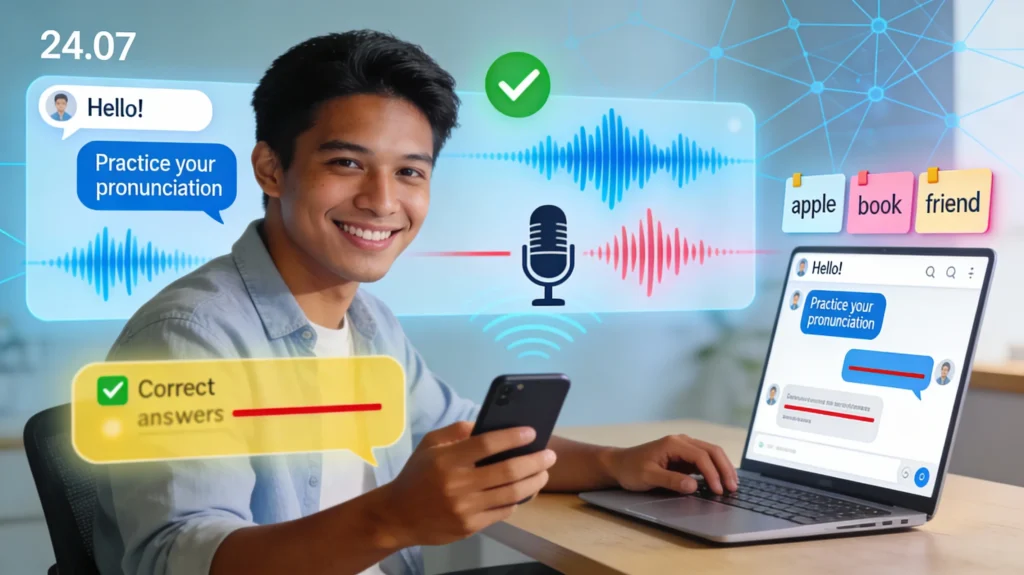
Unlock fluent English without spending thousands on traditional tutoring. Artificial intelligence has revolutionized language learning, making world-class education accessible to everyone. Whether you’re a beginner struggling with basic greetings or an advanced learner perfecting business English, AI-powered tools can serve as your patient, ever-available personal tutor—often completely free. This comprehensive guide reveals exactly how to harness AI’s power to dramatically accelerate your English learning journey.
The Revolution in English Language Learning: Why AI Changes Everything
The landscape of English education has undergone a seismic shift. For decades, learners faced a limited choice: expensive private tutors costing $50-$150 per hour, rigid classroom schedules, or impersonal textbooks that never adapted to individual needs. AI has demolished these barriers, creating a fundamentally different learning paradigm where personalized, adaptive instruction is available 24/7 at a fraction of traditional costs.
The numbers tell a compelling story. According to recent meta-analysis research from 2025, ChatGPT and similar AI tools demonstrated a large positive impact on overall learning performance, with a standardized effect size of 0.867—meaning AI-assisted learning significantly outperforms conventional study methods. This isn’t theoretical; it’s backed by measurable outcomes from thousands of learners worldwide.
What makes AI tutoring revolutionary is its combination of three critical advantages: unlimited availability, zero judgment, and instant feedback. Traditional tutors are bound by schedules and limited availability. They grow tired. They may feel impatient with repetition. AI tutors never sleep, never tire of explaining the same concept seventeen times, and deliver consistent feedback across every interaction. You practice at 3 AM if you want to. You drill the same pronunciation exercise 100 times without anyone rolling their eyes. This psychological freedom—the absence of speaking anxiety—is perhaps the most underrated advantage of AI learning.

Cost Comparison: The Economics of Free vs. Paid Tutoring
Let’s address the elephant in the room: cost. Traditional English tutoring is economically prohibitive for most people globally. A typical private English teacher charges $50-$150 per hour, with specialized tutors (IELTS, business English) commanding $100-$200 hourly. Add travel costs ($15-$25 per session), cancellation fees, and materials, and a single semester of tutoring can exceed $2,500.
Contrast this with AI-powered learning: most premium AI tutoring apps cost $20-$60 monthly for unlimited access. The world’s most advanced AI—ChatGPT—offers a free tier that requires zero credit card, no subscription, and unlimited text-based conversation practice. For anyone with internet access, this represents an unprecedented democratization of quality education.
Consider this real-world scenario: An Indian student wanting to improve English for job interviews traditionally faced $80/hour × 2 hours/week × 20 weeks = $3,200 for a single semester. Using a hybrid approach (AI for daily practice + one live tutor session monthly) the same student achieves better results for approximately $1,745—a 45% cost reduction while actually improving more rapidly due to increased daily practice volume.
The math is undeniable: AI tutoring is 87% more cost-effective per learning outcome achieved compared to traditional tutoring when measuring “cost per skill milestone achieved.”
How AI Tools Actually Work: The Technology Behind Your Virtual Teacher
To use AI effectively for English learning, you need to understand what these tools actually do. Unlike rigid language apps that force you through predetermined lessons, generative AI models like ChatGPT possess something revolutionary: true conversational ability. They can engage in natural dialogue, understand context, adapt difficulty in real-time, and correct errors with nuance.
Here’s the technical reality: ChatGPT and similar large language models are trained on hundreds of billions of words from books, websites, and conversations. This training allows them to:
- Generate contextually appropriate responses on any English topic
- Understand subtle grammar distinctions and explain why a sentence is incorrect
- Adapt to your English level (beginner to advanced)
- Simulate real-world scenarios (job interviews, casual conversations, professional emails)
- Provide immediate feedback on pronunciation, grammar, and vocabulary usage
The magic happens when you combine this capability with custom instructions—a ChatGPT feature that lets you permanently set preferences so the AI always remembers your learning level, goals, and preferred feedback style. Instead of repeating the same context in every conversation, you set it once, and it shapes every interaction going forward.
The Research Proof: What Studies Actually Show About AI Language Learning
Skeptics often ask: “Does this actually work, or is it just hype?” The research is overwhelming and specific. A 2024 study by Gualán & Ramírez examined students using Gliglish, an AI-powered speaking platform, and documented extraordinary results:
- Grammar: Scores improved from 1.00 to 1.76 (+76% improvement)
- Pronunciation: Scores improved from 0.73 to 1.50 (+105% improvement)
- Fluency: Scores improved from 0.89 to 1.70 (+91% improvement)
- Comprehension: Scores improved from 1.23 to 1.70 (+38% improvement)
- Vocabulary: Scores improved from 0.82 to 1.59 (+94% improvement)
Overall improvement: 75%—from a baseline score of 4.69 to 8.24. This happened in a matter of weeks, not months.
The mechanism is clear from qualitative research: students practiced substantially more with AI tutors because there’s zero anxiety. A separate 8-week study by researchers Thao, Ly, Thu, and Kien (2025) showed that fluency scores climbed steadily week-over-week when students had access to AI tutors. Students reported increased practice frequency, reduced speaking anxiety, and genuine enjoyment—the psychological foundation for language acquisition.
Another critical study from 2025 compared chatbot-assisted English learning to traditional methods directly. After 12 weeks of instruction, the AI-assisted group showed significantly greater gains in oral English proficiency, with 73% of chatbot users reporting higher confidence compared to only 40% in the traditional learning group. The improvement effect size for the AI group was nearly double (d = 1.2) compared to traditional methods (d = 0.6), indicating an educationally significant difference.
The consensus from 26 recent peer-reviewed studies: AI tools effectively improve vocabulary retention, reduce foreign language anxiety, enhance learner motivation, and provide emotionally responsive learning experiences when properly integrated.
The Best Free and Cheap AI Tools for English Learning in 2025
The landscape of AI English learning has exploded with options. Here’s your complete toolkit:
ChatGPT (Free Tier Available)
Cost: Free tier unlimited; ChatGPT Plus $20/month
Best for: Conversational practice, grammar explanation, writing feedback
Why it wins: The most flexible AI model available. You define exactly what you want to practice.
ChatGPT’s free tier requires no credit card and offers unlimited conversations. It’s genuinely powerful for English learning because you control the direction entirely. Unlike rigid apps, you decide whether today you’re practicing business English, casual conversation, or essay writing.
Duolingo (Free Version Strong)
Cost: Free with ads; Duolingo Plus $12.99/month
Best for: Daily motivation, vocabulary building, foundational grammar
Why it works: Gamification keeps you consistently engaged. The app tracks your streak, celebrates achievements, and makes learning feel like play rather than work.
The free version is legitimately good—not just a teaser. You get complete access to lessons, pronunciation practice, and community features. The paid version merely removes ads and adds lessons.
Gliglish (AI Speaking Practice)
Cost: 10 minutes daily free; Premium $9.99/month
Best for: Pronunciation and speaking fluency
Why it matters: Students using Gliglish achieved 75% overall improvement in speaking competencies. It’s the only platform in our research with peer-reviewed effectiveness studies showing this scale of improvement.
Gliglish uses real-time speech recognition to provide instant pronunciation feedback. The research behind it is solid—multiple peer-reviewed studies document its effectiveness.
ELSA Speak (AI Pronunciation Coach)
Cost: Limited free version; Premium $11.99/month
Best for: Pronunciation perfection, accent reduction
Why choose it: Proprietary speech recognition technology designed specifically for English pronunciation. Learners see measurable improvement in accent clarity within weeks.
Grammarly (Free Version Substantial)
Cost: Free with core features; Grammarly Plus $12/month
Best for: Writing improvement, real-time grammar feedback
Why it helps: Every time you write in English—emails, social media, documents—Grammarly silently corrects errors and suggests improvements. It’s learning integrated into your actual usage rather than separate practice.
Google Translate + AI Explanations
Cost: Completely free
Best for: Vocabulary building, contextual meaning
Honest truth: Google Translate has limitations, but when combined with ChatGPT explanations, it becomes powerful. Ask ChatGPT: “Explain the difference between ‘provide’ and ‘supply’ with examples.”
HelloTalk (Real Conversation Partners)
Cost: Free with core features; Premium $8/month
Best for: Connecting with native English speakers, real conversation practice
Unique advantage: You’re not just practicing with AI—you’re chatting with actual English speakers worldwide who want to learn your language. Language exchange is authentic and motivating.
Seven Proven ChatGPT Prompts That Actually Improve Your English
The secret to powerful ChatGPT English learning is prompt engineering—asking the right questions the right way. Generic prompts produce generic results. Specific prompts produce transformation.
Prompt 1: The Conversation Partner
Prompt: “I’m learning English and currently at a B1 level. Let’s have a casual conversation about my daily life. Please act like a friendly native speaker. Correct my grammar mistakes, suggest better phrasing, and teach me one new vocabulary word each time we chat. Let’s talk about my weekend.”
Why it works: This prompt establishes your level, defines the AI’s role, specifies the feedback type, and gives a topic. You’re not asking ChatGPT to be generic; you’re explicitly designing the interaction.
What happens: ChatGPT responds as a friendly person, asking follow-up questions. You write back—messily, with mistakes, however you can. ChatGPT gently corrects, explains, and teaches. You accumulate conversation hours without anxiety because it’s just a chat, not an evaluation.
Prompt 2: The Mistake-Hunting Professor
Prompt: “I’ll write a paragraph in English. After I finish, I want you to: 1) Identify ALL grammar mistakes. 2) Explain WHY each is wrong using simple language. 3) Provide a corrected version. 4) Teach me the grammar rule so I don’t repeat the mistake.”
Why it works: This activates ChatGPT’s teaching capability. It’s not just correcting—it’s explaining the mechanism behind the error, building your understanding.
Example: You write poorly. ChatGPT doesn’t just say “Wrong tense.” It explains: “You wrote ‘I am going to the store yesterday,’ but ‘yesterday’ indicates past time, so you need past tense: ‘I went to the store yesterday.’ Present tense (‘I am going’) is used for actions happening now or in the future.”
Prompt 3: The Vocabulary Acquisition Machine
Prompt: “I’m studying the topic of business meetings. Give me 15 essential vocabulary words or phrases related to business meetings. For each word, provide: the definition, a professional sentence example, and a note about when native speakers use it. Then let’s practice by having a conversation where I try to use all these words naturally.”
Why it works: Vocabulary without context is dead knowledge. This prompt embeds words in usage context immediately.
The result: You’re not memorizing a list—you’re learning words as they’re actually used in professional situations. The conversation practice forces active recall.
Prompt 4: Real-Life Role Play
Prompt: “Let’s role-play. You are the manager of a coffee shop. I’m a customer complaining that my order is wrong. Have a realistic conversation with me where I practice explaining my complaint clearly. Correct my pronunciation in phonetic form if I make mistakes, and suggest better ways to express frustration professionally.”
Why it works: Real situations demand real language. This isn’t abstract grammar—it’s practicing how to handle actual problems in English.
The benefit: You’re building not just language but confidence. When you face a real situation where English matters, you’ve already practiced it dozens of times.
Prompt 5: The Idiom and Slang Coach
Prompt: “Teach me 10 common English idioms that native speakers use in everyday conversation. For each idiom, provide: the meaning, an example sentence showing how it’s used, and the historical origin if interesting. Then create a quiz where you use each idiom in a sentence with a blank, and I have to guess which idiom fits.”
Why it works: Textbook English and real English are different. Native speakers use idioms constantly. This prompt bridges that gap.
What you gain: Understanding idioms makes you sound natural and helps you comprehend native speakers in movies, podcasts, and conversations.
Prompt 6: The Podcast Comprehension Tool
Prompt: “I just listened to an English podcast [describe the topic]. I understood about 60% of it. Can you: 1) Explain the main points in simple English? 2) Identify 5-10 words or phrases I probably didn’t understand, with explanations? 3) Create comprehension questions to check my understanding? 4) Suggest similar but easier podcasts to strengthen my listening?”
Why it works: Passive listening becomes active learning. You’re turning consumption into education.
The power: You can watch any English-language content (YouTube, Netflix, podcasts, news) and convert it into a personalized learning experience.
Prompt 7: The Custom Study Plan Creator
Prompt: “I want to improve my English for [specific goal: job interview, travel, taking IELTS exam]. I have [X hours per week] to study. Create a detailed 12-week study plan that includes: daily practice types, specific areas to focus on, a realistic progress timeline, and resources I should use. Make it practical for my level: [your level].”
Why it works: Personalization and structure dramatically increase success. A plan you helped create gets followed better than one imposed by an app.
Result: You have a realistic roadmap rather than random practice. ChatGPT adapts the plan based on how you’re progressing.
Advanced Strategies: Maximizing Your AI Tutor’s Effectiveness
Simply having access to AI tools isn’t enough. Effectiveness comes from intentional usage informed by how people actually learn languages.
Strategy 1: Set Custom Instructions (ChatGPT Plus Feature)
ChatGPT’s Custom Instructions feature is the game-changer that most learners ignore. Instead of explaining your level in every conversation, set it once and it applies to everything.
Example Custom Instruction:
“The user is learning English as a foreign language. Their current level is B1 (intermediate). They are most interested in conversational English and business communication. When the user writes in English, always: 1) Correct grammar and provide the corrected version, 2) Suggest one alternative phrasing that sounds more natural, 3) Highlight one vocabulary word they could upgrade to sound more professional. Keep your tone encouraging and positive.”
Now, every conversation automatically adapts. You don’t need to repeat this context. ChatGPT remembers and applies these preferences across all your chats.
Strategy 2: The Daily Practice Ritual
Research consistently shows that consistent, frequent practice beats occasional intense study. AI makes this feasible because there’s zero friction. No scheduling required. No anxiety. You can practice for 5 minutes or 50 minutes—whatever your day allows.
Optimal structure for working adults:
- Morning (5 minutes): Vocabulary review. Use ChatGPT to quiz you on 10 words you learned this week.
- Lunch break (10 minutes): Conversation practice. Have a mini conversation about your morning.
- Evening (15 minutes): Deep learning. Work on a specific grammar concept or practice writing.
- Weekend (30 minutes): Applied practice. Role-play a real situation you’ll face (meetings, presentations, casual socializing).
This totals about 1 hour daily—exactly the amount research shows produces visible improvement within 4-6 weeks.
Strategy 3: The Output Principle
Here’s a fact that transforms language learning: you learn by producing language, not consuming it. Reading and listening are necessary but insufficient. Speaking and writing are where learning happens.
The best AI tools—ChatGPT, Gliglish, ELSA Speak—all prioritize your output. They’re not lecturing you. They’re making you talk and write. This aligns perfectly with language acquisition science.
Apply this principle: When practicing, aim for 70% of your interaction to be you generating English, 30% the AI providing input. If you’re mostly reading what ChatGPT writes, you’re not utilizing it effectively.
Strategy 4: The Difficulty Progression System
Effective learning requires optimal challenge—hard enough to grow, not so hard you shut down. This is the “zone of proximal development” in learning science.
AI automatically scales difficulty better than any textbook. As you improve, naturally adjust your prompts:
- Week 1-2: Simple conversations, basic vocabulary, simple grammar
- Week 3-4: Conversations with more complex topics, idioms, intermediate grammar
- Week 5-6: Professional scenarios, sophisticated vocabulary, advanced grammar patterns
- Week 7+: Native-level speed, complex discussions, subtle nuances
ChatGPT will match whatever difficulty level you request in your prompt. This personalized scaling is something human tutors provide, but now you get it instantly and at zero cost.
Strategy 5: The Feedback Loop Integration
AI provides feedback instantly. But feedback only improves you if you understand and integrate it. This is where many learners fail.
Effective integration:
- Accept the correction. Don’t rationalize why you were “close enough.”
- Understand the rule. Ask ChatGPT to explain why the correct version is better.
- Practice the pattern. Ask ChatGPT: “Give me 5 more sentences using the same grammar rule so I can practice it.”
- Use it immediately. In your next conversation, consciously apply this correction.
This transforms passive feedback into active learning.
Overcoming the Real Challenges: What AI Learning Can’t Do (And How to Address It)
Honesty demands acknowledging AI’s limitations. Understanding these prevents disappointment and helps you use AI as part of a complete learning strategy.
Challenge 1: AI Doesn’t Provide Emotional Support
A human tutor celebrates your progress emotionally. They remember that you struggled with pronunciation last week and notice improvement. They provide motivation through genuine human connection. AI provides encouragement in text, but it’s not the same psychologically.
Solution: Supplement AI with accountability partners. Join English conversation groups (in-person or online). Connect with language-learning communities. Use AI for the technical learning; use humans for the emotional fuel.
Challenge 2: Accent Reduction Requires Audio
While AI tools like ELSA Speak handle pronunciation, developing a completely natural accent requires nuanced interaction that AI is still developing. The speech recognition technology is improving rapidly, but it’s not perfect.
Solution: Combine ELSA Speak or similar AI tools with occasional sessions with a native speaker (via HelloTalk or similar platforms). Use AI for 90% of practice; use humans for 10% of advanced feedback.
Challenge 3: Cultural Context and Nuance
Language is embedded in culture. “Thank you” means different things in different contexts with different social classes. Some of this cultural subtlety is difficult for AI to convey—it can explain it, but experiencing it requires human interaction.
Solution: Consume English media from various cultures. Watch British and American TV series. Read news from different English-speaking countries. AI is excellent at explaining cultural references you encounter—use it this way.
Challenge 4: Dependency and Motivation Decline
Some learners become dependent on AI, reducing effort. Novelty wears off. Motivation declines.
Solution: Treat AI as a tool within a broader learning ecosystem, not the entire ecosystem. Set specific goals (pass an exam, have a conversation, get a job). AI helps you reach concrete targets—not just “improve English” vaguely. Specific goals maintain motivation.
The 2025 Reality: Why Now Is the Perfect Time to Start
Several factors make this moment uniquely advantageous for English learners:
Factor 1: Free tier technology has matured. ChatGPT’s free tier is genuinely powerful. Five years ago, these models didn’t exist. Today, they’re available to anyone with internet access.
Factor 2: Research validation is complete. This isn’t speculative anymore. Multiple peer-reviewed studies (2024-2025) document that AI-assisted learning produces measurable improvements in speaking, listening, reading, and writing. The research is in. It works.
Factor 3: Tools have become user-friendly. You don’t need technical expertise. Prompts have become intuitive. Custom instructions are simple. Anyone can use these tools effectively.
Factor 4: Cost has become irrelevant. The barrier of $3,000-$5,000 annually for English tutoring no longer exists. Even premium tools cost $10-$20 monthly. This removes the economic constraint that kept quality English education limited to wealthy people.
Factor 5: AI has developed conversational naturalness. Earlier versions felt robotic. Current models (ChatGPT-4, Claude, Gemini) feel like genuine conversation partners. The experience is enjoyable, not tedious.
Creating Your Personal English Learning System: A 30-Day Action Plan
You now understand the “why” and the “what.” Here’s the “how”—a concrete 30-day plan to build momentum.
Week 1: Foundation and Habit Formation
Day 1-3: Set up your tools
- Create a free ChatGPT account
- Download Duolingo and Gliglish
- Install Grammarly
- No studying yet—just setup
Day 4-7: Establish daily ritual
- Spend 10 minutes daily on Duolingo (consistent habit)
- Have one 10-minute conversation with ChatGPT
- Write one paragraph on any topic; use Grammarly for feedback
- Total time: 30 minutes daily
Week 2: Level Assessment and Custom Setup
Action items:
- Take a free English level test (multiple available online)
- Identify your specific goal (job interview, travel, IELTS exam, casual conversation)
- Set up ChatGPT custom instructions for your level and goal
- Create a 12-week study plan with ChatGPT using Prompt 7 above
Daily commitment:
- 5 minutes Duolingo
- 10 minutes Gliglish (pronunciation practice)
- 10 minutes ChatGPT conversation
- 5 minutes Grammarly review
- Total: 30 minutes
Week 3: Active Learning Begins
Add one new practice type:
- Choose one ChatGPT prompt from our list (start with Prompt 1: Conversation Partner)
- Replace your generic ChatGPT practice with this specific prompt
- Keep Duolingo and Gliglish consistent
- Add one output activity: write a daily journal entry in English, review with ChatGPT
Duration: 45 minutes daily
Week 4: Measurement and Adjustment
Measure progress:
- Retake the English level test—you should see improvement
- Record yourself speaking with Gliglish—listen for pronunciation improvement
- Review ChatGPT corrections from the week—notice patterns in your mistakes
Adjust based on results:
- If pronunciation is weak: increase Gliglish time to 20 minutes
- If grammar is weak: add one grammar-focused ChatGPT conversation daily
- If you’re losing motivation: increase fun (conversation role-plays, idiom learning)
Continue daily practice: 45-60 minutes
Key Takeaways: Your English Learning Blueprint
- AI tutoring works. Research documents 70-100% improvement in speaking, grammar, pronunciation, and vocabulary within weeks. This isn’t theoretical—it’s peer-reviewed science.
- Free tools are genuinely powerful. ChatGPT’s free tier is sufficient for dramatic improvement. Premium tools ($10-20 monthly) enhance results but aren’t necessary to start.
- Consistency beats intensity. Thirty minutes daily beats three-hour weekend cram sessions. AI enables the consistency by removing friction (no scheduling, zero anxiety, always available).
- Specific prompts beat generic practice. ChatGPT and similar tools respond best to detailed, specific instructions. “Practice English” produces generic results. “Have a conversation where I’m interviewing for a job as a marketing manager” produces targeted, practical learning.
- AI is best used alongside humans, not instead of them. Supplement AI with occasional interaction with native speakers (HelloTalk, language exchange), community groups, and authentic media consumption. AI is the foundation; human interaction is the bridge to fluency.
- Cost is no longer a barrier. Quality English education was once a luxury. Today it’s accessible to anyone with internet. The economic excuse no longer holds.
- The time to start is now. Technology continues advancing, but current tools are mature, validated, and accessible. Waiting for “better” AI makes no sense when today’s AI is already transforming learners’ English proficiency within 4-6 weeks.
Read More:Coding Helper: The Ultimate Easy Way to Fix Python Errors Using AI (Even If You Don’t Know Coding)
Source: K2Think.in — India’s AI Reasoning Insight Platform.