In today’s competitive job market, preparing for interviews isn’t just about memorizing answers anymore. The way you deliver your responses—your tone, pacing, confidence, and clarity—matters just as much as the content itself. Real-time AI voice feedback has emerged as a game-changing tool that transforms how candidates prepare, practice, and ultimately perform in interviews. This comprehensive guide explores how AI voice mode interview preparation works, why it’s effective, and how you can leverage it to dramatically improve your interview performance and landing your dream job.
Why Traditional Interview Prep Falls Short
The conventional approach to interview preparation has remained largely unchanged for decades. Candidates research companies, memorize answers, and perhaps practice with a friend if they’re lucky. However, research reveals a troubling statistic: 70% of hiring managers report that candidates show up unprepared to interviews, and this lack of thorough preparation directly impacts hiring decisions.
The fundamental problem with traditional methods is that they don’t simulate the real interview experience. Practicing in front of a mirror or with a friend doesn’t replicate the pressure, the precise timing demands, or the professional scrutiny you’ll face. Additionally, most candidates never get feedback on their vocal delivery—how nervous they sound, whether they’re speaking too fast, if their pitch conveys confidence, or whether they’re using filler words.
According to research from psychological science, employers have significantly more favorable impressions of candidates after hearing their pitch rather than reading it. This audio-first impression makes vocal delivery critical, yet it’s an element most candidates never meaningfully practice. The disconnect between how you rehearse and how you perform on interview day creates anxiety and missed opportunities.
The Science Behind AI Voice Mode Interview Coaching
AI voice mode interview practice represents a significant technological leap forward. These systems use a combination of natural language processing (NLP), machine learning, and advanced voice analysis to provide real-time, actionable feedback during mock interviews.
How Real-Time Feedback Works
When you use AI voice mode for interview practice, several sophisticated technologies work simultaneously. The AI interviewer listens to your response and analyzes multiple vocal and linguistic elements in real-time. Real-time feedback eliminates the waiting period—rather than waiting days for someone to review your performance, you get instant insights immediately after answering each question.
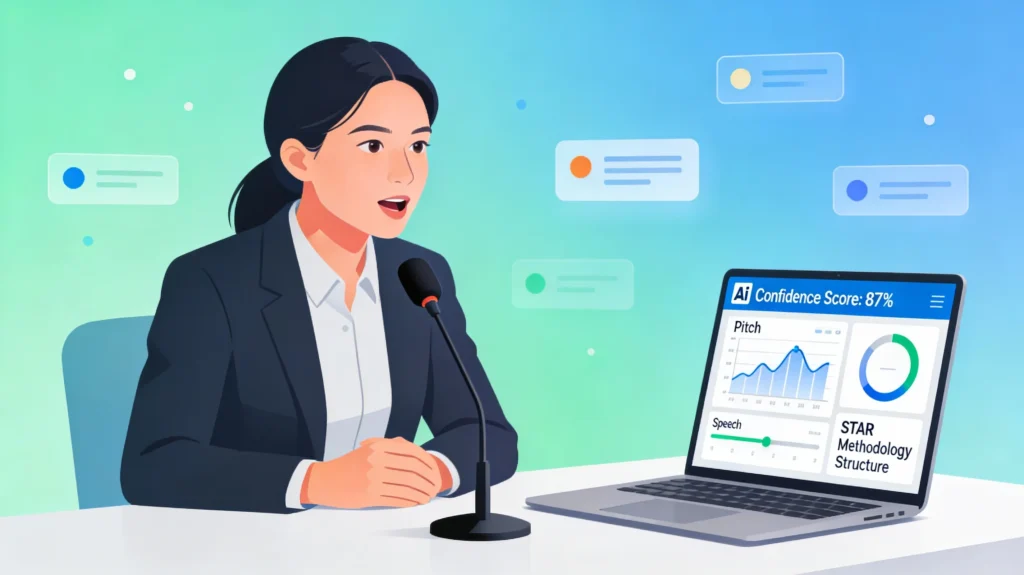
The system evaluates your speech clarity, pacing, confidence markers, and whether your response follows structured formats like the STAR method. Behind the scenes, AI systems examine prosody (the rhythm and intonation of speech), pitch stability, speech rate, pause patterns, and even micro-tremors in your voice that signal nervousness.
Key Vocal Metrics AI Analyzes
Research into voice analysis reveals that specific acoustic features directly correlate with interview success. Pitch variance indicates emotional engagement—monotone delivery suggests lack of confidence, while healthy variation signals leadership potential and engagement. Speaking rate matters too; consistently paced speech reflects composure and thoughtfulness, whereas rushed speech often betrays anxiety.
The patterns of pauses and filler words tell a powerful story. According to AI analysis, fewer hesitations and fewer awkward pauses boost your confidence score significantly. Additionally, voice energy and volume link directly to assertiveness and enthusiasm—qualities hiring managers actively assess.
The Research: Measurable Impact of AI Voice Interview Prep
The effectiveness of AI-powered voice interview coaching is now backed by substantial research data. One prominent case study demonstrates the transformative power: Interview Optimiser, powered by Hume’s Empathic Voice Interface (EVI), achieved a 76% reduction in per-session costs while improving user satisfaction and realism ratings.
More importantly, the engagement metrics are compelling. The platform achieved 23% higher retention among users receiving prosody feedback, meaning users stayed engaged and continued practicing longer when they received detailed vocal delivery analysis. Additionally, 60% of users rated the experience as “more realistic than expected,” which directly addresses the primary limitation of traditional mock interviews.
Confidence Building Through Real-Time Coaching
Research on AI Coach, an AI-powered interview preparation system, revealed striking results. 87% of users enhanced their interview skills within two weeks, which substantially outpaces traditional preparation timelines. Furthermore, 92% of users reported higher interview confidence, with users specifically crediting AI Coach’s realistic simulations and actionable feedback.
The confidence-building aspect is critical because interviewer psychology shows that 49% of employers know within the first five minutes whether a candidate is a good fit. Real-time AI coaching helps you cultivate the vocal presence and poise needed to make that critical first impression.
STAR Method Integration with AI Feedback
The STAR method (Situation, Task, Action, Result) has become the gold standard for behavioral interview responses. Research shows that behavioral interview questions are 55% effective at predicting job performance, compared to only 10% effectiveness for traditional questions. What’s remarkable is that AI voice systems now provide real-time feedback specifically on STAR structure adherence.
According to LinkedIn research from 2024, recruiters rate STAR responses 25% more reliable than unscripted anecdotes. The combination of STAR methodology with AI voice coaching creates a powerful synergy: you’re not just structuring your responses better, you’re also delivering them with authentic confidence that comes from practice.
Platform Comparison: Leading AI Voice Interview Tools
The market for AI-powered interview preparation has exploded, offering candidates unprecedented options. Here’s what distinguishes the leading platforms:
ChatGPT Voice Mode
Free or part of ChatGPT Plus ($20/month), ChatGPT’s voice mode has become accessible to millions. The advantage is immediate availability and customization—you can upload your resume and specific job description to tailor the interview experience.
The practical advantage of voice mode is that it paces with you: if you speak slowly, it responds slowly; if you talk fast, it keeps pace. This creates natural conversation flow. Users report that voice-based practice feels significantly closer to real interview scenarios than traditional text-based preparation.
Interview Optimiser (Hume AI)
Interview Optimiser specializes in prosody-based feedback, analyzing vocal tone, confidence levels, and emotional regulation patterns. The platform provides comprehensive vocal delivery analytics alongside realistic mock interviews. The 23% higher retention rate among users suggests the feedback quality is genuinely valuable.
Final Round AI
Final Round AI combines speech pattern analysis with content evaluation. The platform analyzes pacing, filler word reduction, clarity improvements, and overall confidence delivery. Real-time feedback identifies whether you’re rambling or losing focus, then guides you toward more polished answers.
Interview.ai Platforms
Most modern interview preparation platforms now incorporate real-time guidance during interviews, customized to your resume and the specific job description. These tools work seamlessly across Zoom, Google Meet, and Microsoft Teams—the platforms most commonly used for actual interviews.
Step-by-Step: How to Practice Using AI Voice Mode
Step 1: Research and Preparation
Start with thorough research on the company and role. Study the job description line-by-line, identifying key skills and values the employer emphasizes. This research phase typically requires 2-3 hours but forms the foundation for everything that follows.
Step 2: Upload Your Materials
Provide the AI with your resume and the job description. This context allows the AI to ask role-specific questions and evaluate your answers for relevance to the actual position. The platform can then assess whether you’re emphasizing the most critical skills and experiences.
Step 3: Conduct Your First Mock Interview
Begin with an introductory question—usually “Tell me about yourself”—and have the AI interviewer ask behavioral questions common for your role. Speak naturally, as though you’re in the actual interview.
The first session establishes your baseline. Don’t worry about perfection; this is practice. Focus on getting through the entire interview without stopping.
Step 4: Review Your Feedback
After each response, pause to receive feedback. The AI will highlight:
- Clarity rating: Whether your answer was clear and concise
- STAR structure compliance: If you followed Situation-Task-Action-Result format
- Vocal metrics: Your confidence score, pace, and any filler words detected
- Suggested improvements: Specific, actionable ways to refine that response
Step 5: Iterate and Improve
Practice 3-5 additional interviews, focusing on refining weak areas identified in previous sessions. Research shows that candidates who conduct five or more mock interviews perform significantly better than those with no mock interview experience.
With each iteration, you’re building muscle memory—your brain becomes more comfortable retrieving stories, structuring responses, and maintaining vocal confidence under pressure.
Step 6: Analyze Your Progress
Most AI platforms provide progress tracking. You should see measurable improvements in your confidence scores, reduction in filler words, and increasingly consistent pacing. This data-driven feedback is psychologically powerful—seeing numerical improvement boosts actual confidence.

Advanced Techniques: Maximizing Your AI Voice Practice
Customizing the Interview Experience
Advanced users create multiple practice scenarios. Request that the AI adopt different interviewer personas—a technical expert, an HR professional, a senior manager, or a recruiter. This prepares you for the varied interview experience.
Technical Question Preparation
If you’re interviewing for technical roles, use AI platforms to practice coding questions and system design discussions. Real-time feedback helps you explain complex concepts clearly, which is as important as solving the problem correctly.
Handling Behavioral Curveballs
Practice with unexpected questions. Ask the AI interviewer to include follow-up questions and to probe deeper into your responses, simulating how real interviewers investigate your examples. This builds genuine adaptability.
Recording and Self-Review
Most platforms allow you to record your mock interviews. Watching yourself provides powerful feedback—you’ll notice vocal patterns, body language (if on video), and delivery issues you might miss through audio feedback alone.
Critical Success Metrics: What to Monitor
As you practice with AI voice mode, track these specific metrics:
Confidence Score: This aggregate measure typically ranges from 0-100 and reflects your vocal stability, tone steadiness, and pace consistency. Aim for steady improvement, with scores generally increasing 5-10 points per practice session.
Filler Word Count: Monitor your use of “um,” “uh,” “like,” and “you know.” Each reduction indicates growing comfort with your material. Most candidates can reduce filler words by 60-80% with focused practice.
Speech Rate (words per minute): Optimal interview pace is typically 120-150 words per minute. Speaking too quickly betrays nervousness; too slowly suggests uncertainty.
Pause Patterns: Meaningful pauses signal thoughtfulness, while nervous hesitations suggest unprepared responses. Learn to pause deliberately rather than fill silence with filler words.
STAR Compliance: Measure whether you’re actually hitting all four components and allocating appropriate time—roughly 20% Situation, 10% Task, 60% Action, 10% Result.
The Psychology: How Confidence Translates to Results
Here’s where the real transformation happens. Research on human decision-making reveals that when you practice with AI that provides consistent, positive feedback, your own confidence calibrates appropriately. This isn’t false confidence—it’s earned confidence based on genuine improvement.
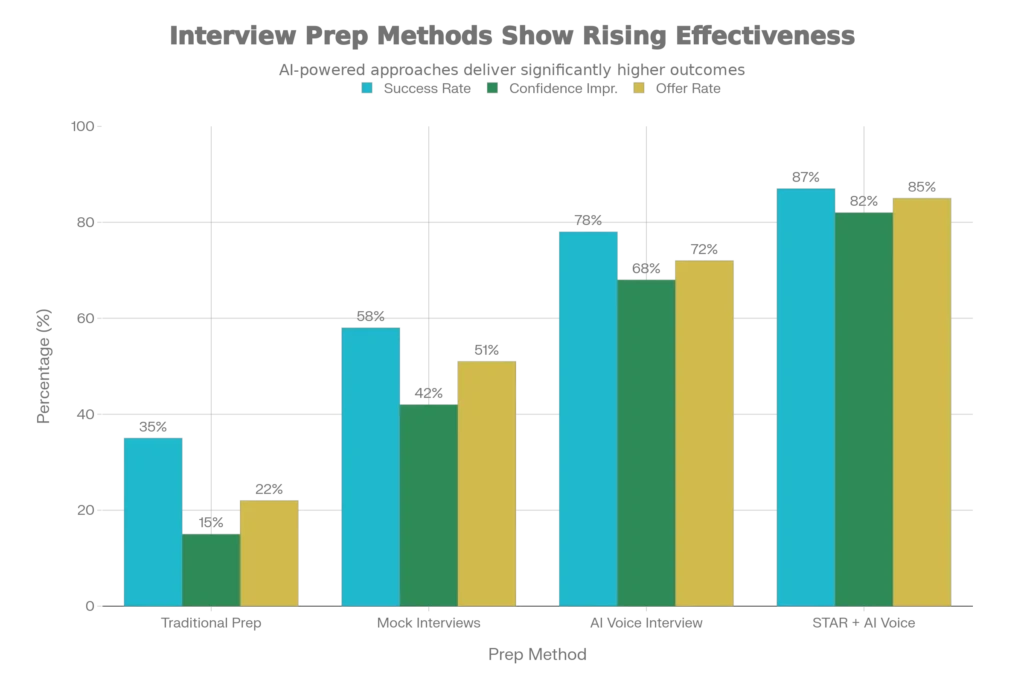
Multiple interviews increase success significantly: candidates’ chances of receiving a job offer rise to 51% after participating in three interviews with structured feedback. The combination of structured practice with objective AI feedback removes the guesswork from interview preparation.
The vocal delivery improvements aren’t superficial either. Studies on voice similarity and perception show that confident vocal patterns increase trustworthiness and likability ratings from listeners—exactly what you need from hiring managers.
Overcoming Common Challenges
“I Sound Robotic”
This occurs when you over-memorize. Practice until your points are internalized but not verbatim. The goal is to sound conversational, not recited. AI feedback specifically identifies over-rehearsal, helping you calibrate authenticity.
“I Get Too Nervous in Real Interviews”
Repeatedly practicing under “pressure” (even artificial pressure) builds genuine anxiety resilience. Your nervous system habituates to the interview experience through repeated exposure. Real neurological adaptation occurs with consistent practice.
“My Accent Affects My Score”
Good news: modern AI systems don’t penalize accents. They measure clarity and engagement, not pronunciation conformity. Your authentic voice is an asset, not a liability.
“I Don’t Have Time for Extensive Practice”
You need only 5-10 hours of preparation for a standard interview. Using AI dramatically accelerates learning—you get feedback immediately rather than waiting for a human coach. Even limited practice with real-time feedback beats extensive unfocused preparation.
The Competitive Advantage: Data-Driven Hiring
Here’s a crucial insight: 20% of companies now use AI to help interview candidates, and 94% of those companies say it’s improved how they field and hire applicants. This means many of your competitors are already being evaluated by AI systems.
By practicing with AI voice mode, you’re not just preparing better—you’re getting accustomed to how AI evaluates you, which may include your actual interview. This familiarity removes an element of surprise and anxiety.
Practical Preparation Timeline
Week 1 (5 hours)
- Research company and role deeply (2 hours)
- Set up AI voice coaching platform (0.5 hours)
- Conduct first 2-3 mock interviews (2 hours)
- Initial analysis and feedback review (0.5 hours)
Week 2 (4 hours)
- Practice 3-4 additional mock interviews (3 hours)
- Focus on weak areas from Week 1 feedback (1 hour)
Week 3 (3 hours)
- 2 final practice interviews targeting remaining challenges (2 hours)
- Pre-interview ritual and confidence building (1 hour)
This timeline assumes the interview is approximately 3 weeks away. If you have less time, compress the schedule; if you have more, extend the practice period.
The Research Shows Real Results
Statistics from the field paint a compelling picture:
- 87% of users improved interview skills within two weeks using AI coaching
- 92% reported higher interview confidence
- 60% rated AI voice interviews as more realistic than traditional prep
- 76% reduction in preparation costs when using specialized AI platforms
- 23% higher engagement and retention with AI platforms providing voice feedback
These aren’t marginal improvements—they represent fundamental changes in interview preparation effectiveness.
Conclusion: The Future of Interview Preparation
Interview preparation is undergoing a technological transformation. AI voice mode coaching removes the barriers that made effective interview practice historically difficult: the cost of hiring coaches, the availability of quality mock interview partners, and the lack of real-time, objective feedback on your performance.
The combination of realistic voice-to-voice interaction, prosody-based feedback, STAR methodology guidance, and continuous iteration creates an unprecedented opportunity to genuinely master interview performance. You’re not just preparing answers; you’re building authentic confidence, refining your vocal delivery, and developing the composure that makes the difference in actual interviews.
The research is clear: candidates who invest in structured, AI-powered voice coaching outperform their peers. The hiring statistics back this up—after multiple interviews with professional feedback, offer rates rise to 51% and beyond. The technology is accessible, affordable, and remarkably effective.
Your next interview doesn’t have to be stressful or uncertain. With consistent practice using AI voice mode real-time feedback, you can walk into that interview room knowing you’ve genuinely prepared, you sound confident, and you’ve practiced under realistic conditions. That’s not just preparation—that’s a competitive advantage.R
Read More:Meeting Notes: Stop Taking Notes: 3 AI Bots That Record and Summarize Zoom Meetings.
Source: K2Think.in — India’s AI Reasoning Insight Platform.