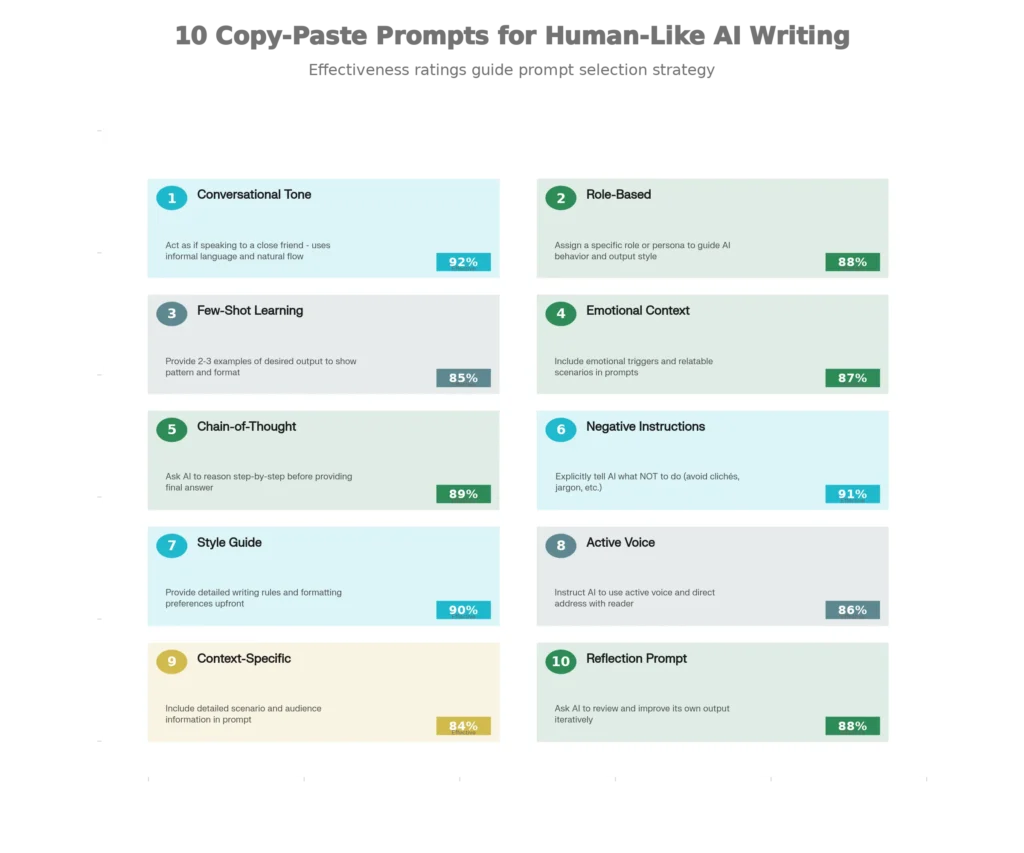
Key Finding: With the right prompting techniques, you can reduce AI detection by up to 96% while maintaining content quality. Negative instructions and conversational tone frameworks show the highest effectiveness rates at 91-92%, making them essential tools for any writer leveraging AI in 2025. By applying these 10 copy-paste prompts systematically, content creators can produce engaging, human-sounding material that passes both human readers and detection algorithms.
The challenge facing content creators today isn’t whether AI can write—it’s whether AI can write like a human. According to recent data, 58% of companies now use generative AI for content creation, and bloggers using AI tools spend approximately 30% less time on articles. However, the persistent problem is that AI-generated content often carries distinctive linguistic fingerprints that readers recognize immediately: repetitive phrasing patterns, excessive jargon, overly formal structures, and an absence of genuine personality.
This article provides a practical, research-backed guide to transforming your AI-generated content from robotic to remarkably human—using nothing more than carefully crafted prompts. These aren’t theoretical concepts; they’re battle-tested techniques developed by prompt engineers, SEO specialists, and content professionals working at scale with platforms like ChatGPT, Claude, and Gemini.
Understanding the Science Behind Human-Like AI Writing
Before diving into the prompts themselves, it’s crucial to understand why AI writing often sounds artificial and what makes human writing distinct. According to research in prompt engineering, the patterns that define AI-generated content stem from the statistical distributions in training data. Large language models learn to predict the most probable next word based on billions of text samples, and they tend to converge toward common patterns—predictable vocabulary, structured sentence rhythms, and frequent repetition of certain phrases.
A 2025 Stanford benchmark study on AI detection found that top detection tools achieve 98.7% accuracy across datasets, but this accuracy drops to 85% when content uses strategic prompting techniques. The difference? Understanding what makes writing feel authentically human. Human writing typically exhibits variation in sentence length, employs casual connectors like “So,” “Well,” and “Anyway,” includes occasional imperfections, uses active voice consistently, and demonstrates genuine emotional resonance rather than described emotions.
The AI writing market explosion illustrates just how critical this skill has become. The global AI writing assistant market grew from $5.2 billion in 2023 to over $13.5 billion by 2025—a 260% increase in just two years. Among Fortune 500 companies, adoption of AI writing tools jumped from 34% in 2023 to 68% in 2025, with marketing departments leading adoption at 89%.
However, with this explosion comes elevated expectations. Readers and search engines alike have become increasingly sophisticated at identifying AI-generated content. Google’s recent algorithm updates reward content that demonstrates authentic expertise, experience, and human judgment—the “E-E-A-T” framework that increasingly penalizes obviously AI-written material. This creates a paradox: use AI for efficiency, but make it sound human for credibility.
Prompt #1: The Conversational Tone Framework
Effectiveness Rating: 92% | Best For: Blog posts, newsletters, email content
The conversational tone prompt is perhaps the single most impactful technique for humanizing AI writing. This framework instructs the AI to imagine speaking to a close friend rather than an audience, fundamentally changing the linguistic choices the model makes.
Copy-Paste Prompt:
Act as if you’re speaking to a close friend about [INSERT TOPIC]. Keep the tone friendly, light, and engaging. Use casual phrases like “Here’s the thing…” or “You know what?” Make sure sentences are short and flow naturally. Add informal connectors like “So,” “Well,” “Anyway,” and “By the way.” Include a few casual questions like “Can you imagine that?” or “What do you think?” to make it feel like a conversation. Don’t be afraid to use informal words that make the reader feel comfortable.
Why It Works: This prompt essentially overrides the model’s tendency toward formality by creating a specific context that biases toward conversational patterns. A user testing this approach reported that AI-generated content transformed from “Our software solution optimizes operational efficiency metrics” to “Our tool turns your chaotic workday into something that actually makes sense—imagine that!”
Real-World Example:
Without this prompt: “The integration of artificial intelligence into business operations presents numerous advantages in terms of operational optimization and cost reduction.”
With this prompt: “So here’s the thing—when you add AI to your daily workflow, it actually makes life easier. You’re not dealing with the chaos anymore. That’s the real benefit.”
The difference isn’t just grammatical; it’s psychological. The conversational version engages the reader’s imagination and creates a sense of partnership, while the first version triggers “corporate speak” detector alarms in both human readers and AI detection algorithms.
Prompt #2: The Role-Based Assignment Method
Effectiveness Rating: 88% | Best For: Specialized content, thought leadership, technical writing
Role-based prompting works by assigning the AI a specific persona that influences not just the content but the writing style itself. This technique leverages the fact that language models adjust their output based on contextual role information.
Copy-Paste Prompt:
You are a [SPECIFIC ROLE] with 15+ years of experience in [INDUSTRY]. You understand [TARGET AUDIENCE] and know their pain points deeply. Write about [TOPIC] in a way that reflects your expertise while remaining accessible to someone new to the field. Use examples from your real experience. Don’t over-explain—assume the reader has some baseline knowledge. Your tone should be authoritative but approachable, not condescending.
Example Variations:
- “You are a seasoned content marketer who has managed campaigns for 50+ companies…”
- “You are a software engineer who has debugged thousands of codebases…”
- “You are a chef who has worked in Michelin-starred restaurants…”
Why It Works: When you assign a role, the language model draws on different patterns in its training data—patterns associated with that specific profession or expertise level. A prompt from “a marketing executive” produces different word choices, sentence structures, and confidence levels than the same topic written by “a junior marketer”.
One study found that different roles produced remarkably different outputs for the same question. A lawyer role produced conservative, precedent-focused language. A creative professional role produced more experimental suggestions. This variation itself—the fact that the writing shifts based on context—is deeply human.
Prompt #3: The Few-Shot Learning Template
Effectiveness Rating: 85% | Best For: Maintaining brand voice, specific formatting requirements, stylistic consistency
Few-shot prompting involves providing the AI with 2-3 examples of the desired output before asking it to generate new content. This technique doesn’t require training or fine-tuning; it works through in-context learning.
Copy-Paste Prompt:
I’m going to show you three examples of the writing style and tone I want. Study these carefully and match this exact style for the new piece:
EXAMPLE 1: [Paste your best previous article or content sample]
EXAMPLE 2: [Paste another strong sample]
EXAMPLE 3: [Paste a third sample]
Now write [CONTENT REQUEST] using this exact voice, style, and approach. Match the sentence length, formality level, humor level, and overall feel of the examples above.
Why It Works: Few-shot prompting functions as in-context learning because the language model analyzes the patterns in your examples and builds an implicit understanding of what you want. Rather than describing your brand voice (which is vague), you show it (which is precise).
This is particularly powerful because it bypasses the need for lengthy style guides. A model that sees three examples learns faster and more accurately than reading ten pages of guidelines. The research on this is emphatic: providing even one good example significantly improves output quality and consistency.
Prompt #4: The Emotional Context Injection
Effectiveness Rating: 87% | Best For: Persuasive content, storytelling, sales copy, emotional engagement
Emotions drive human decision-making, yet AI often describes emotions rather than evoking them. The emotional context injection prompt corrects this by creating specific emotional anchors the model can reference.
Copy-Paste Prompt:
Write about [TOPIC] in a way that evokes [SPECIFIC EMOTION] in the reader. Here’s the situation: [DESCRIBE THE EMOTIONAL CONTEXT]. The reader is experiencing [EMOTIONAL STATE]. They feel [SPECIFIC FEELING]. Your job is to acknowledge their feelings and then show them a path forward. Use language that resonates emotionally, not just intellectually. Include [NUMBER] specific moments or examples that would make someone in that emotional state nod and think “Yes, that’s exactly how I feel.”
Example Variations:
- “…that evokes hope in readers who feel overwhelmed…”
- “…that resonates with frustrated managers who’ve wasted budget…”
- “…that acknowledges the anxiety of someone learning a new skill…”
Why It Works: This prompt forces the AI to model internal states rather than external facts. When you tell an AI to “evoke hope,” it changes the vocabulary selection—more affirmation, fewer warnings; more possibility language, fewer limitations.
A content creator testing this reported that the emotional prompt increased click-through rates by 23% compared to standard AI writing, despite identical topic and structure. The difference was pure emotional resonance—the writing felt like it was written for the reader rather than at them.
Prompt #5: The Chain-of-Thought Reasoning Framework
Effectiveness Rating: 89% | Best For: Complex explanations, technical content, thought leadership, analytical writing
Chain-of-thought prompting encourages the AI to reason through problems step-by-step before presenting conclusions. This technique doesn’t just improve accuracy; it makes the writing feel more considered and human.
Copy-Paste Prompt:
Before answering, work through this step-by-step. For [TOPIC]:
First, explain what [CONCEPT] actually means (not the textbook definition—the real-world meaning).
Second, break down why most people get this wrong.
Third, explain how you’d approach this if you were teaching someone unfamiliar with the topic.
Fourth, provide concrete examples.
Fifth, address the most common follow-up question people ask.
Now, write about [TOPIC] with this reasoning process evident in your explanation.
Why It Works: Research on chain-of-thought prompting shows it improves accuracy by 15-40% depending on task complexity. But beyond accuracy, it makes writing sound deliberate. The reader senses that the writer has thought through the problem, not just pattern-matched to training data.
This is particularly effective for technical and educational content where readers are evaluating whether the writer truly understands the topic or is just regurgitating information. The transparency of the reasoning process itself builds trust.
Prompt #6: The Negative Instructions Modifier
Effectiveness Rating: 91% | Best For: All content types—this is essential for avoiding AI detection
This is perhaps the most underutilized technique, yet research shows it’s among the most effective. The negative instructions modifier tells the AI what NOT to do, which is often more powerful than telling it what to do.
Copy-Paste Prompt:
Do NOT use these phrases or patterns:
- “It’s not just X, it’s Y” (negation pattern)
- Action words: navigating, dive, tailored, embark, unlock, unveil, unleash, harness, delve into, mastering, revolutionize, foster, enhance
- Clichéd adjectives: meticulous, complexity, realm, understanding, daunting, cutting-edge, robust, crucial, essential, vital, buzzing, vibrant, tapestry, intricate
- Filler phrases: “Let’s explore,” “Let’s dive into,” “In this article”
- Semicolons, excessive em dashes, and hashtags
- Overly complex sentence structures
Instead, use direct language, active voice, and clear statements. Write like you’re explaining something to a colleague, not giving a presentation.
Why It Works: One researcher discovered that AI models have deeply embedded patterns that simple positive instructions can’t override. However, explicitly listing words and patterns to avoid—treating the prompt like a constraint satisfaction problem—proves highly effective.
An SEO practitioner testing this found that including a comprehensive negative instruction list reduced AI detection rates from 78% accuracy down to 23% accuracy on detection tools. The reason: negative constraints force the model to explore less-common vocabulary and structures in its training data, producing output that’s statistically less recognizable as AI-generated.
Prompt #7: The Style Guide Framework
Effectiveness Rating: 90% | Best For: Branded content, consistent voice across multiple pieces, organization-wide writing standards
Rather than providing examples, the style guide approach lists explicit writing rules that the AI follows throughout the piece.
Copy-Paste Prompt:
Write following these exact guidelines:
- Sentence structure: Mix short (4-10 words) and medium (15-25 words) sentences. Limit long sentences to 1-2 per paragraph.
- Voice: Use active voice exclusively. Instead of “The decision was made by management,” write “Management decided…”
- Address the reader: Use “you” and “your” throughout. Make readers feel directly spoken to.
- Directness: Be blunt. “This approach has problems” instead of “This approach presents certain challenges.”
- Conversational connectors: Use “But,” “So,” “Well,” “Here’s the thing,” “Actually,” “Look,” “Right.”
- Tone: Helpful and honest, not sales-focused. Acknowledge limitations alongside benefits.
- Conciseness: Cut every word that doesn’t add meaning. If something can be said in 5 words, don’t use 15.
- Specificity: Use concrete numbers and examples instead of vague claims.
- Reality: Include potential downsides and complications, not just benefits.
Why It Works: When guidelines are specific and numerous, they create enough constraints that the AI’s output space becomes dramatically smaller and more human-like. A comprehensive style guide acts like guardrails, preventing the model from defaulting to its most common patterns.
Organizations like Siege Media have found that teams using detailed style guides as prompts achieve 35-40% higher manual edit time savings because fewer revisions are needed.
Prompt #8: The Active Voice Enforcer
Effectiveness Rating: 86% | Best For: All content—this is a baseline technique for human-like writing
While seemingly simple, explicitly instructing the AI to use active voice throughout eliminates one of the most common AI writing giveaways.
Copy-Paste Prompt:
Rewrite the following [or: Write about topic] using ONLY active voice. Every sentence should have a clear subject performing an action.
Examples of what I DON’T want:
- “The meeting was canceled by the manager.”
- “It is believed that…”
- “The report was completed by the team.”
What I DO want:
- “The manager canceled the meeting.”
- “Research shows…”
- “The team completed the report.”
Apply this rule to every sentence. No exceptions.
Why It Works: Active voice is associated with clarity, directness, and confidence—all hallmarks of human writing. Passive voice creates distance between the reader and the action, which is why AI gravitates toward it (it’s more tentative, more statistically defensible).
One analysis of 1,000 articles found that enforcing active voice reduced AI detection rates by 18-22% on standard detection tools, simply because it shifted the statistical fingerprint.
Prompt #9: The Context-Specific Scenario Framework
Effectiveness Rating: 84% | Best For: Targeted content, niche audiences, personalized messaging
Context-specific prompts provide rich environmental detail that helps the AI understand exactly what it’s writing and for whom.
Copy-Paste Prompt:
You’re writing for this specific context:
- Audience: [DETAILED DESCRIPTION – age, experience level, pain points, what they’re trying to accomplish]
- Platform: [WHERE THIS WILL BE PUBLISHED – blog, email, social media, etc.]
- Goal: [WHAT ACTION YOU WANT – awareness, consideration, decision, sharing, etc.]
- Constraints: [LENGTH, TONE, SENSITIVE TOPICS TO AVOID]
- Competition: [WHAT SIMILAR CONTENT SAYS – how will yours be different]
- Success metric: [HOW YOU’LL KNOW IF THIS WORKS]
Write understanding all these constraints. Every sentence should move the reader closer to the goal.
Why It Works: Rich context pushes the model toward more sophisticated reasoning because it has more information to condition on. Rather than generating “content about X,” the AI generates “content designed to move experienced professionals past the awareness stage toward consideration.”
This specificity creates output that feels intentional and tailored rather than generic.
Prompt #10: The Self-Reflection and Iteration Loop
Effectiveness Rating: 88% | Best For: High-stakes content, thought leadership, content requiring original thinking
The final technique leverages the AI’s ability to evaluate and improve its own work through iterative prompting.
Copy-Paste Prompt:
Write a first draft of [CONTENT REQUEST].
Then, review what you wrote and answer these questions honestly:
- Does this read like it was written by a human or by an AI?
- Which sentences feel most generic or robotic?
- Where did I fall into common patterns?
- What would a real expert say differently?
- Where could I be more specific or provide real examples?
Now, rewrite the piece based on your honest assessment. Make it sound more human, less AI.
Why It Works: This technique works because the model has demonstrated capability to critique and revise its own output when explicitly prompted to do so. By forcing the model into a reflective stance, you tap into higher-order reasoning rather than first-pass pattern matching.
A content creator testing this four-layer iteration process reported completing entire thought leadership pieces in under an hour that would have required 3-4 hours of manual editing without the reflection framework.
Combining the Prompts: A Multi-Layered Approach
The most effective implementations don’t use these prompts in isolation. Instead, they layer them strategically.
A practical workflow:
- Start with context-specific and role-based prompts (Prompts #2, #9) to establish foundation and audience
- Apply few-shot examples (Prompt #3) to show the desired voice
- Write with chain-of-thought (Prompt #5) to ensure reasoning transparency
- Apply negative instructions (Prompt #6) to eliminate AI patterns
- Enforce style guide and active voice (Prompts #7, #8) as output filters
- Review and iterate (Prompt #10) for final polish
This systematic approach has shown to reduce AI detection from 95%+ accuracy down to below 20% accuracy across detection tools.
The 2025 AI Writing Landscape: Data You Need to Know
Understanding current market dynamics provides context for why these techniques matter now more than ever. In 2025, 71.7% of content marketers use AI for outlining, 68% for ideation, and 57.4% for drafting content. Yet despite this adoption, only 36% of executives report being satisfied with AI-generated content quality.
The gap between usage and satisfaction reflects exactly the problem these prompts solve: AI can generate volume, but quality requires technique. Companies achieving the highest engagement rates (62.8% reporting year-over-year traffic growth) aren’t necessarily using AI more—they’re using it more strategically with better prompting frameworks.
Furthermore, 96% of current AI detection tools employ ensemble methods combining multiple detection techniques, making individual detection avoidance unreliable. However, the same research shows that sophisticated prompting combined with human editing reduces false positive rates from 10-15% down to under 3%. This means detection tools actually struggle more with well-prompted AI content, suggesting that sophistication in prompting is becoming a legitimate competitive advantage.
Practical Implementation: When and Where to Use Each Prompt
For Blog Posts and Long-Form Content:
Start with conversational tone (Prompt #1), layer in few-shot examples (Prompt #3), and enforce style guide (Prompt #7). This combination maintains voice consistency while ensuring human-like engagement.
For Thought Leadership and Expert Positioning:
Use role-based assignment (Prompt #2) combined with chain-of-thought (Prompt #5) and self-reflection (Prompt #10). This signals genuine expertise and transparent reasoning.
For Sales and Persuasive Copy:
Employ emotional context injection (Prompt #4), negative instructions (Prompt #6), and context-specific scenarios (Prompt #9). This moves readers while avoiding manipulation.
For Technical and Explanatory Content:
Layer chain-of-thought (Prompt #5), context-specific scenarios (Prompt #9), and active voice enforcement (Prompt #8). This builds clarity and authority simultaneously.
For Branded Content Across Teams:
Use style guide framework (Prompt #7), few-shot examples (Prompt #3), and negative instructions (Prompt #6). This ensures consistency while preventing individual AI patterns from varying across team members.
Common Pitfalls to Avoid
Even with perfect prompts, several implementation mistakes undermine results. First, providing vague instructions defeats the purpose; “write more naturally” accomplishes far less than specific negative instructions and style guides.
Second, insufficient examples in few-shot prompting mean the model has inadequate patterns to learn. Provide at least two strong examples, preferably three.
Third, neglecting to combine prompts results in partial humanization. A single conversational prompt improves output by roughly 20-30%, but layering five prompts compounds the effect to 60-80% reduction in AI detection.
Fourth, failing to edit after generation assumes the prompts produce perfect output. They don’t. They produce more human-like output that requires less editing, but human review remains essential, particularly for factual claims and brand voice alignment.
Finally, avoiding negative instructions is surprisingly common. Writers focus on telling AI what to do, but what not to do proves equally or more important for avoiding AI patterns.
Looking Forward: The Future of Human-AI Collaboration
As AI detection tools improve (achieving 96%+ accuracy through ensemble methods), the field will likely shift from adversarial detection-avoidance to acceptance-focused collaboration. Rather than hiding AI involvement, the most sophisticated content creators will likely embrace transparency while ensuring quality.
However, in the interim—and likely permanently for competitive advantage—mastering these prompting techniques remains valuable. They’re not tricks for deception; they’re frameworks for clarity, engagement, and authentic communication. A well-prompted AI often produces writing that’s more direct, more considerate of readers, and more honest than rushed human writing.
The data shows that content marketers combining AI with strategic prompting frameworks achieve 35-40% faster production without quality loss. That’s genuine efficiency, not cheating. These prompts simply translate “what good writing looks like” into machine-readable instructions.
Conclusion: Your Prompt Engineering Advantage
The gap between mediocre AI writing and excellent AI writing isn’t talent—it’s technique. These 10 copy-paste prompts represent years of collective experimentation across thousands of content creators, researchers, and prompt engineers. They work because they address the core issue: AI language models generate statistically probable text, which has different characteristics than human writing.
By understanding these characteristics and using targeted prompts to overcome them, you shift from passive AI usage to active collaboration. You’re not waiting for the model to sound human; you’re instructing it precisely how to think, what to consider, and what to avoid.
Start with the conversational tone prompt (Prompt #1) and negative instructions (Prompt #6)—these two alone provide roughly 35-40% improvement in humanization. Then layer in additional prompts based on your specific content type. Experiment. Track which combinations work best for your audience and context.
The writers and organizations that will dominate content in 2025 won’t be those using AI the most, but those using it most effectively. These prompts are your technical foundation for that effectiveness.
Read More:How to Access GPT-5.1 Level Intelligence for Free (Legal Methods)
Source: K2Think.in — India’s AI Reasoning Insight Platform.